Fujifilm · X Series
X-Pro3
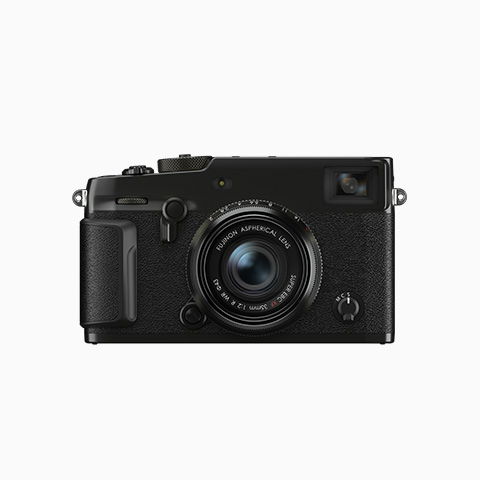
A 26.1-megapixel APS-C mirrorless camera with a hybrid optical/electronic viewfinder, titanium top and base plates and a concealed tilting touchscreen.
- Type
- Mirrorless
- Sensor
- APS-C
- Megapixels
- 26.1
- Lens
- Fujifilm X mount
- Video
- 4096 × 2160 at 29.97 fps
- Body weight
- 447 g
What reviewers say
Both praise image quality, colour, low-light autofocus and robust construction, but find the hidden screen and fixed optical-viewfinder magnification restrictive. Photography Blog sees it as a niche choice worth trying before buying. Amateur Photographer enjoys composing through the viewfinder, yet finds menu access frustrating and considers a conventional X-T body more broadly useful. Both note that a tripod restricts screen movement.
Specifications
Report a wrong or missing specImage and sensor
- Camera type
- Mirrorless
- Sensor format
- APS-C
- Sensor type
- X-Trans CMOS 4
- Sensor dimensions
- 23.5 × 15.6 mm
- Effective resolution
- 26.1 MP
- Largest image
- 6240 × 4160
- RAW recording
- Yes
- Standard ISO range
- 160–12800
- Image formats
- JPEG and 14-bit RAF RAW; 17 film simulations including Classic Neg.; HDR and up-to-nine-frame multiple-exposure functions
- ISO detail
- Standard ISO160–12800; extended ISO80/100/125/25600/51200
- Image processor
- X-Processor 4
Lens and shooting
- Lens mount
- Fujifilm X mount
- Stabilisation
- Optical lens stabilisation
- Maximum continuous burst
- 30 fps
- Lens detail
- Fujifilm X mount; exact maker photograph shows XF23mmF2 R WR, excluded from body specifications and weight
- Autofocus
- Hybrid phase/contrast AF, 117 or 425 single-point positions, Zone and Wide/Tracking modes; maker current table lists phase-detection low-light limit −7 EV with XF50mmF1.0, contrasting with earlier −6 EV launch wording on its overview
- Shutter
- Mechanical up to 1/8000 second, electronic up to 1/32000 second; mechanical timed exposures up to 15 minutes or Bulb up to 60 minutes. Maker warns electronic shutter may distort fast motion and cannot use flash
- Burst detail
- Up to 30 fps electronic with 1.25× crop, 20 fps electronic without that crop or 11 fps mechanical. Maker 30 fps buffer is 60 JPEG or 35 lossless-compressed RAW frames; media and conditions affect results
- Stabilisation detail
- No in-body sensor-shift stabilisation; compatible optically stabilised lenses supported, as described by Photography Blog
- Flash
- Compatible external TTL hot shoe; sync 1/250 second or slower; no built-in flash according to Photography Blog
- Exposure controls
- Physical shutter-speed/ISO and exposure-compensation dials, front/rear command dials and autofocus joystick; no rear four-way controller
Video
- Highest video resolution
- 4096 × 2160 at 29.97 fps
- Video detail
- DCI4K 4096×2160 and UHD4K 3840×2160 up to 29.97p at 200/100 Mbps, approximately 15-minute clip limit. Full HD up to 59.94p for approximately 59 minutes; Full HD high-speed up to 120p for approximately 6 minutes. H.264 MOV with stereo 24-bit/48 kHz PCM audio; no HDMI output in maker table
- Audio
- Combined 2.5 mm microphone/shutter-release input; USB-C headphone adapter support described by Amateur Photographer
Screen and viewfinder
- Viewfinder
- Hybrid optical/electronic
- Screen size
- 3″
- Screen dots
- 1,620,000
- Touchscreen
- Yes
- Tilting screen
- Yes
- Display detail
- Concealed 3-inch 3:2 touchscreen folds downward through approximately 180°; 1.62 million dots. Separate rear 1.28-inch square colour Memory LCD displays film simulation or status information; cannot operate the quick menu, as both reviews note
- Viewfinder detail
- Hybrid reverse-Galilean optical finder with electronic frame lines, approximately 95% coverage and fixed 0.52× magnification; 0.5-inch OLED EVF with approximately 3.69 million dots, 100% coverage and 0.66× magnification with 50 mm equivalent lens at infinity
Connections and design
- Wi-Fi
- Yes
- Bluetooth
- Yes
- Battery life (maker's claim)
- 370 photographs
- Body weight
- 447 g
- Release detail
- Maker financial report confirms launch in November 2019; exact earliest worldwide retail day unconfirmed, so month precision retained
- Recording media
- Two UHS-II SD/SDHC/SDXC slots; maker lists cards up to 512 GB, compatibility list applies
- Ports
- USB-C USB3.1 Gen1 and combined 2.5 mm microphone/remote input; hot shoe; maker explicitly lists no HDMI output
- Wireless connections
- Wi-Fi IEEE802.11b/g/n; Bluetooth Low Energy 4.2
- Battery life detail
- NP-W126S; approximately 370 EVF or 440 optical-viewfinder shots in Normal mode with XF35mmF1.4 R under maker CIPA conditions; USB charging supported
- Dimensions
- 140.5×82.8×46.1 mm; minimum depth 34.8 mm
- Weight detail
- Approximately 447 g without battery/card or 497 g including battery/card; photographed lens excluded
- Materials
- Magnesium frame with titanium top/base plates; weather-resistant maker design, operating temperature −10°C to +40°C; Dura finishes use scratch-resistant coating and are colour/configuration variants
Pros and cons
Pros
- Optical and electronic viewfinder modes
- Dual UHS-II SD slots
- Titanium top and base plates
Cons
- Main screen folds inward when closed
- No in-body stabilisation
- No HDMI output
Closest rivals
Model | Type | Sensor | Megapixels | Lens | Video | Body weight | Released |
|---|---|---|---|---|---|---|---|
| Mirrorless | APS-C | 24.2 | Sony E-mount | 3840 × 2160 at 30 fps | 352 g | Sept 2019 | |
| Mirrorless | APS-C | 24.2 | Sony E-mount | 3840 × 2160 at 30 fps | 359 g | Feb 2019 | |
| Mirrorless | APS-C | 24.2 | Sony E-mount | 3840 × 2160 at 30 fps | 418 g | Oct 2019 |


Sources
- fujifilm-x.com/en-gb/products/cameras/x-pro3/specifications
- fujifilm-x.com/en-gb/products/cameras/x-pro3
- ir.fujifilm.com/en/investors/ir-news/auto_20200205458079/pdfFile.pdf
- photographyblog.com/reviews/fujifilm_x_pro3_review
- amateurphotographer.com/review/fujifilm-x-pro3
Photo: fujifilm-x.b-cdn.net