Photo 1 of 5
Olympus · PEN
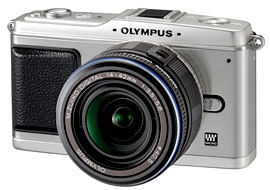
PEN E-P1
The first Olympus Micro Four Thirds camera, combining a metal mirrorless body, interchangeable lenses, sensor stabilisation and 720p video.
- Type
- Mirrorless
- Sensor
- Four Thirds
- Megapixels
- 12.3
- Lens
- Micro Four Thirds
- Video
- 1280 × 720 at 30 fps
- Body weight
- 335 g
What reviewers say
Both praised the construction, image quality and stabilisation, but criticised slow autofocus, the basic screen and absent flash and finder. Photography Blog considered low-light quality comparable to APS-C DSLRs; Cameralabs found it behind the best APS-C models. Both noted audible movie focusing, while Cameralabs also criticised the kit zoom’s collapsing mechanism.
From photographyblog.com and cameralabs.com
Specifications
Report a wrong or missing specImage and sensor
- Camera type
- Mirrorless
- Sensor format
- Four Thirds
- Sensor type
- High-speed Live MOS
- Sensor dimensions
- 17.3 × 13 mm
- Effective resolution
- 12.3 MP
- Largest image
- 4032 × 3024
- RAW recording
- Yes
- Standard ISO range
- 100–6400
- Sensor detail
- 4/3-type Live MOS; approximately 13.1 million total photosites, 4:3 aspect ratio; Supersonic Wave Filter dust reduction
- Image formats
- 12-bit losslessly compressed RAW, JPEG and RAW+JPEG; sRGB and Adobe RGB. Aspect options 4:3, 3:2, 16:9 and 6:6; JPEG cropped to selected ratio while RAW records aspect metadata
- ISO detail
- Manual ISO 100–6400 in 1/3 or 1 EV steps; automatic ISO 200–6400 customisable, default 200–1600
- Image processor
- TruePic V
Lens and shooting
- Lens mount
- Micro Four Thirds
- Stabilisation
- Sensor shift
- Maximum continuous burst
- 3 fps
- Lens detail
- Lens kit includes M.Zuiko Digital ED 14–42mm F3.5–5.6; pancake kit 17mm F2.8 and VF-1 optical finder. These interchangeable kit lenses are not built-in camera specifications
- Autofocus
- Eleven-area contrast-detection High-Speed Imager AF; single AF, continuous AF, manual focus and single AF plus manual override. Live View magnification 7× or 10×. Adapted Four Thirds lenses operate single AF when continuous AF is selected
- Shutter
- Electronically controlled focal-plane shutter, 60–1/4000 second; Bulb up to 30 minutes, default eight minutes. Optional RM-UC1 wired remote supports Bulb control; Anti-Shock delay 1/8–30 seconds
- Burst detail
- Maker continuous rate approximately 3 fps. Buffer approximately 10 RAW or 12 large-normal JPEG under maker conditions with Toshiba Super High Speed Class 6 4 GB card; JPEG count depends on resolution and compression
- Stabilisation detail
- Sensor shift for stills, with normal and horizontal/vertical panning modes and manual focal-length input for adapted lenses. Maker claims up to 4 EV depending on lens and shooting conditions. Movie mode uses electronic correction with a slight crop
- Flash
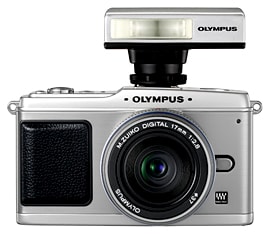
- No built-in flash; hot shoe supports FL-50R, FL-36R, FL-20 and FL-14. Flash synchronisation 1/180 second or slower; external flash compensation ±3 EV
- Exposure controls
- iAUTO, Program with shift, aperture priority, shutter priority, Manual, scene modes and six Art Filters. 324-zone digital ESP, centre-weighted and spot metering with highlight/shadow options; ±3 EV compensation. Two-axis level gauge; two My Mode settings
Video
- Highest video resolution
- 1280 × 720 at 30 fps
- Video detail
- AVI Motion JPEG at 30 fps: 1280 × 720, 16:9, or 640 × 480, 4:3. Maximum individual recording approximately seven minutes HD or fourteen minutes VGA. Certain Art Filters lower the frame rate
- Audio
- Built-in stereo microphone and mono playback speaker. Stereo linear PCM, 16-bit 44.1 kHz, WAVE format; still-photo audio recording up to thirty seconds
Screen and viewfinder
- Viewfinder
- None
- Screen size
- 3″
- Screen dots
- 230,000
- Tilting screen
- No
- Display detail
- Fixed HyperCrystal LCD with 100% Live View coverage, ±7-step brightness and colour-temperature adjustment
- Viewfinder detail
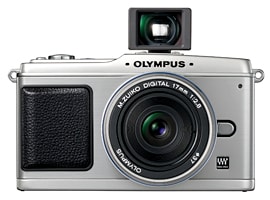
- No built-in finder; optional VF-1 optical finder supplied with the 17mm pancake kit uses the hot shoe, so cannot be fitted simultaneously with a shoe-mounted flash
Connections and design
- Battery life (maker's claim)
- 300 photographs
- Body weight
- 335 g
- Release detail
- Olympus support dates E-P1 to July 2009. The Japanese 16 June announcement schedules lens and pancake kits for 3 July, and made-to-order body-only versions for late July; month precision represents the model rather than assigning the kit day to every configuration
- Recording media
- SD and SDHC memory cards
- Ports
- Hi-Speed USB 2.0 and selectable NTSC/PAL analogue AV through proprietary multi-connector; same connector accepts RM-UC1 wired remote. Mini HDMI Type C provides HD video and stereo audio; flash hot shoe
- Battery life detail
- BLS-1 rechargeable lithium-ion battery. Maker CIPA claim approximately 300 photographs using BLS-1 and Toshiba Class 6 4 GB SDHC card
- Dimensions
- 120.5 × 70 × 35 mm (width × height × depth), excluding protrusions
- Weight detail
- Approximately 335 g body only, excluding battery, card and lens
- Materials
- Metal exterior; silver version has hairline finishing
- Colours
- Silver and white
Pros and cons
Pros
- Sensor stabilisation with adapted-lens focal-length settings
- RAW recording and two exposure control dials
- 720p video with stereo audio
Cons
- No built-in viewfinder or flash
- Fixed screen with 230000 dots
- HD movie clips limited to approximately seven minutes
Closest rivals
Model | Type | Sensor | Megapixels | Lens | Video | Body weight | Released |
|---|---|---|---|---|---|---|---|
| Mirrorless | APS-C | 14.2 | Sony E-mount | 1280 × 720 at 30 fps | 239 g | Jun 2010 | |
| Mirrorless | APS-C | 14.2 | Sony E-mount | 1920 × 1080 | 229 g | Jun 2010 | |
| Mirrorless | APS-C | 16.1 | Sony E-mount | 1920 × 1080 at 60 fps | 210 g | Sept 2011 |


Sources
- olympus.co.jp/jp/news/2009a/nr090616ep1spj.html
- olympus.co.jp/jp/news/2009a/nr090616ep1j.html
- support.jp.omsystem.com/en/support/imsg/digicamera/qa/products/ep1
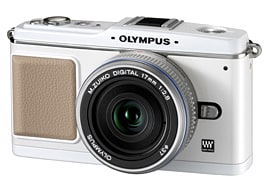
- White Olympus PEN E-P1 with M.Zuiko Digital 17mm f/2.8 kit lens: Olympus official launch photograph of white PEN E-P1 with M.Zuiko Digital 17mm f/2.8 kit lens; complete supplied canvas and white background preserved. Body specifications exclude the mounted kit lens.
- Silver Olympus PEN E-P1 with mounted lens and FL-14 external flash: Olympus official E-P1 launch photograph of the pictured camera configuration; complete supplied canvas and white background preserved. Mounted lens and external accessories are not part of the body specifications.
- Silver Olympus PEN E-P1 with M.Zuiko Digital 17mm f/2.8 lens and VF-1 optical finder: Olympus official E-P1 launch photograph of the pictured camera configuration; complete supplied canvas and white background preserved. Mounted lens and external accessories are not part of the body specifications.
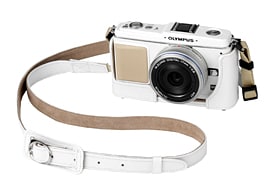
- White Olympus PEN E-P1 with M.Zuiko Digital 17mm f/2.8 lens, white body jacket and shoulder strap: Olympus official E-P1 launch photograph of the pictured camera configuration; complete supplied canvas and white background preserved. Mounted lens and external accessories are not part of the body specifications.