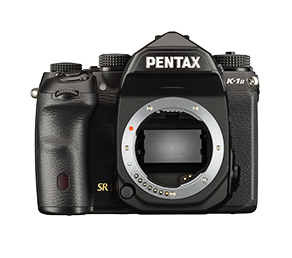
PENTAX · PENTAX K
K-1 Mark II
A 36.4-megapixel full-frame DSLR with sensor-shift stabilisation, an optical viewfinder, built-in GPS and dual SD card slots.
- Type
- DSLR
- Sensor
- Full frame
- Megapixels
- 36.4
- Lens
- PENTAX KAF2 bayonet mount
- Video
- 1920 × 1080 at 30 fps
- Body weight
- 925 g
What reviewers say
Both find it capable for detailed stills, with effective stabilisation and useful pixel-shift modes, but consider the autofocus improvements modest and handheld composites prone to artefacts. Photography Blog finds improved high-ISO noise performance; DPReview instead finds forced RAW noise reduction sacrifices detail as sensitivity rises. Both see limited reasons for existing K-1 owners to upgrade.
From photographyblog.com and dpreview.com
Specifications
Report a wrong or missing specImage and sensor
- Camera type
- DSLR
- Sensor format
- Full frame
- Sensor type
- CMOS without an optical low-pass filter
- Sensor dimensions
- 35.9 × 24 mm
- Effective resolution
- 36.4 MP
- Largest image
- 7360 × 4912
- RAW recording
- Yes
- Standard ISO range
- 100–819200
- Sensor detail
- 36.4 effective megapixels, 36.77 total; no optical low-pass filter. Sensor-shift anti-aliasing simulator offers moiré reduction
- Image formats
- 14-bit PEF or DNG RAW, JPEG and simultaneous RAW/JPEG; full-frame and APS-C crop. Tripod pixel shift combines four sensor-shifted exposures; Dynamic handheld mode aligns four shots without eliminating Bayer interpolation
- ISO detail
- Maker standard sensitivity ISO 100–819200; no separate expanded range listed
- Image processor
- PRIME IV with an accelerator unit
Lens and shooting
- Lens mount
- PENTAX KAF2 bayonet mount
- Stabilisation
- Sensor shift
- Maximum continuous burst
- 6.4 fps
- Lens detail
- KAF4, KAF3, KAF2 including power zoom, KAF and KA lenses; native KAF2 bayonet with autofocus coupler, information and power contacts
- Autofocus
- SAFOX 12 phase detection through viewfinder, 33 points including 25 central cross-type points, EV −3 to 18 at ISO 100; contrast detection in live view
- Shutter
- Mechanical focal-plane shutter 1/8000–30 seconds, Bulb and optional timed Bulb 10 seconds–20 minutes; electronic shutter available in live view and tripod pixel shift
- Burst detail
- Maximum 4.4 fps at full-frame resolution with up to 70 JPEGs or 17 RAW files; 6.4 fps in 15-megapixel APS-C crop with up to 100 JPEGs or 50 RAW files, at ISO 100
- Stabilisation detail
- Five-axis sensor-shift SR II; maker claims five shutter-speed steps. Built-in GPS supports Astrotracer; horizon and composition adjustment use the sensor-shift mechanism
- Flash
- Hot shoe and X-sync socket for external flash, sync 1/200 second
- Exposure controls
- PASM, sensitivity priority and combined shutter/aperture priority; ±5 EV exposure compensation and 86,000-pixel RGB metering sensor
Video
- Highest video resolution
- 1920 × 1080 at 30 fps
- Video detail
- Full HD 1920×1080 at 30/25/24 progressive frames or 60i/50i fields; 1280×720 at 60/50p. H.264 MOV, up to 25 minutes or 4 GB. 4K is interval-movie output only, not continuous video
- Audio
- Built-in stereo microphone, external stereo mic input and headphone monitoring; adjustable recording level and wind-noise reduction
Screen and viewfinder
- Viewfinder
- Optical
- Screen size
- 3.2″
- Screen dots
- 1,037,000
- Touchscreen
- No
- Tilting screen
- Yes
- Display detail
- 3.2-inch flexible-tilt LCD, approximately 1.037 million dots; outdoor-view and red night-vision settings. No touchscreen, as DPReview confirms
- Viewfinder detail
- Optical pentaprism, approximately 100% coverage and 0.70× magnification with FA 50mm F1.4 focused at infinity; eye relief 20.6 mm from view window
Connections and design
- Wi-Fi
- Yes
- Battery life (maker's claim)
- 670 photographs
- Body weight
- 925 g
- Release detail
- Pentax Europe's current product table confirms April 2018 market launch; original Japanese launch notice stated late April. Earliest worldwide retail day unconfirmed, so month precision retained. Later Ricoh notice announces ending current K-series production; surviving range pages do not prove ongoing production
- Recording media
- Two UHS-I SD/SDHC/SDXC slots; sequential, duplicate or separate RAW/JPEG recording
- Ports
- Micro-B USB 2.0, Type D micro-HDMI, microphone and headphone sockets, external power, cable switch and X-sync terminals
- Wireless connections
- IEEE 802.11b/g/n Wi-Fi at 2.4 GHz; built-in GPS, QZSS/SBAS reception and electronic compass
- Battery life detail
- D-LI90P rechargeable lithium-ion battery; approximately 670 shots under CIPA conditions, or 340 minutes playback
- Charging
- Included D-BC90 external battery charger; optional K-AC167 AC adapter kit
- Dimensions
- Approximately 136.5 × 110 × 85.5 mm, excluding protrusions
- Weight detail
- Approximately 925 g body only; 1010 g including battery and SD card
- Materials
- Magnesium-alloy exterior and maker −10°C operating limit; weather resistance is not a waterproof rating
- Colours
- Standard black body; limited cosmetic editions not separate generations
- In the box
- D-LI90P battery, D-BC90 charger and AC cord, strap, viewfinder cap, eyecup, body cap, hot-shoe and connector covers, strap rings and Digital Camera Utility 5 CD-ROM
Pros and cons
Pros
- Five-axis in-body stabilisation
- Flexible tilting screen and illuminated controls
- Built-in GPS and Astrotracer
Cons
- Video limited to Full HD
- Body weighs 925 g before battery and card
- Full-frame continuous shooting limited to 4.4 fps
Closest rivals
Model | Type | Sensor | Megapixels | Lens | Video | Body weight | Released |
|---|---|---|---|---|---|---|---|
| DSLR | Full frame | 45.7 | Nikon F mount | 3840 × 2160 at 29.97 fps | 915 g | Sept 2017 | |
| DSLR | Full frame | 20.1 | Canon EF | 5472 × 2886 at 59.94 fps | 1250 g | Feb 2020 | |
| DSLR | Full frame | 30.4 | Canon EF | 4096 × 2160 at 29.97 fps | 800 g | Sept 2016 |


Sources
- ricoh-imaging.co.jp/english/products/k-1-2/spec
- news.ricoh-imaging.co.jp/rim_info/2018/20180222_019720.html
- pentax.eu/products/pentax-k1-mark-ii
- us.ricoh-imaging.com/pentax-digital-slr-cameras-aim-for-a-new-stage
- photographyblog.com/reviews/pentax_k_1_mark_ii_review
- dpreview.com/reviews/0873273576/pentax-k-1-ii-review
Photo: ricoh-imaging.co.jp