Amazon Fire TV (2nd Gen) vs Amazon Fire TV (3rd Gen)
Better figure, where one is clearly better
| AmazonFire TV (2nd Gen) | AmazonFire TV (3rd Gen) | |
|---|---|---|
| Overview | ||
| Released | October 2015 | October 2017 |
| Video and audio | ||
| Resolution | 4K | 4K |
| HDR | None | HDR10 (better) |
| Dolby Atmos | – | Yes |
| Video | HEVC and H.264 decoding up to 3840 × 2160 at 30 fps; HEVC Main 10 input but 8-bit output; VP9 up to YouTube 4K; HDCP 2.2 | HEVC up to 3840 × 2160 at 60 fps, 35 Mbps, Main 10 Profile Level 5.1; H.264 up to 4K 30 fps or 1080p 60 fps; VP9 up to 4K 60 fps; HDCP 2.2 |
| HDR | HDR output is not supported, according to Amazon’s developer specifications | – |
| Audio | Dolby Digital and Dolby Digital Plus input formats; surround audio via HDMI | Dolby Atmos via Dolby Digital Plus for supported titles and compatible equipment; Dolby Digital, Dolby Digital Plus, AAC, FLAC, MP3, Vorbis, PCM and Opus input formats |
| Performance | ||
| Software | Fire OS | Fire OS |
| Storage | 8 GB | 8 GB |
| Chip details | MediaTek 8173C; two Cortex-A72 cores up to 2 GHz and two Cortex-A53 cores up to 1.573 GHz; PowerVR Rogue GX6250 GPU; 32-bit applications | Amlogic S905Z; quad-core Cortex-A53 CPU up to 1.5 GHz; Mali-450 MP3 GPU; 32-bit applications |
| Memory | 2 GB RAM | 2 GB RAM |
| Storage | Internal storage includes operating software; microSD expansion supports up to 128 GB for downloaded apps and games | Internal capacity includes operating software |
| Software and services | Fire OS 5 based on Android 5.1 (API level 22); build model AFTS. Amazon’s launch release confirms US shipping from 5 October 2015. | Fire OS 6 based on Android 7.1 (API level 25); build model AFTN; Amazon confirms US shipping from 25 October 2017 |
| Connections | ||
| Wi-Fi | Wi-Fi 5 | Wi-Fi 5 |
| Ethernet | Yes | No |
| Voice remote | Yes | Yes |
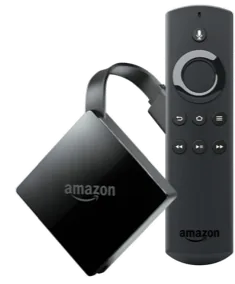
| Ports | HDMI, Ethernet, USB 2.0, microSD and power; no optical audio output. USB version and port list confirmed by AVForums’ exact-model inspection. | Pendant housing with attached HDMI lead and Micro-USB power input; separate Ethernet adapter optional, no built-in socket or microSD slot |
| Wi-Fi and Bluetooth | Dual-band 802.11a/b/g/n/ac with 2 × 2 MIMO; Bluetooth 4.1 with BLE; Miracast supported | Dual-band 802.11a/b/g/n/ac with 2 × 2 MIMO; Bluetooth 4.2 with BLE; Miracast not supported according to Amazon’s developer specifications |
| Remote | Included microphone-equipped voice remote; Alexa functions varied by region, with AVForums reporting no Alexa assistant in the UK at its 2015 review | First-generation Alexa Voice Remote with microphone; no television volume controls. Hands-free control requires a linked compatible Echo; availability differed by region at launch. |
| Design | ||
| Type | Box | Box |
| Power | External power supply | External mains supply; cannot be powered from the television’s USB port according to Stuff’s exact-model inspection |

More comparisons
- Amazon Fire TV (3rd Gen) vs Amazon Fire TV Stick 4K (3rd Gen)
- Amazon Fire TV (2nd Gen) vs Amazon Fire TV Stick 4K (3rd Gen)
- Amazon Fire TV (3rd Gen) vs Amazon Fire TV Stick HD (2026)
- Amazon Fire TV (2nd Gen) vs Amazon Fire TV Stick HD (2026)
- Amazon Fire TV (3rd Gen) vs Amazon Fire TV Stick 4K Plus
- Amazon Fire TV (2nd Gen) vs Amazon Fire TV Stick 4K Plus
- Amazon Fire TV (3rd Gen) vs Amazon Fire TV Stick 4K Select
- Amazon Fire TV (2nd Gen) vs Amazon Fire TV Stick 4K Select
- Amazon Fire TV (3rd Gen) vs Amazon Fire TV Stick HD (2024)
- Amazon Fire TV (2nd Gen) vs Amazon Fire TV Stick HD (2024)
- Amazon Fire TV (3rd Gen) vs Amazon Fire TV Stick 4K Max (2nd Gen)
- Amazon Fire TV (2nd Gen) vs Amazon Fire TV Stick 4K Max (2nd Gen)
- Amazon Fire TV (3rd Gen) vs Amazon Fire TV Stick 4K (2nd Gen)
- Amazon Fire TV (2nd Gen) vs Amazon Fire TV Stick 4K (2nd Gen)
- Amazon Fire TV (3rd Gen) vs Amazon Fire TV Cube (3rd Gen)
- Amazon Fire TV (2nd Gen) vs Amazon Fire TV Cube (3rd Gen)