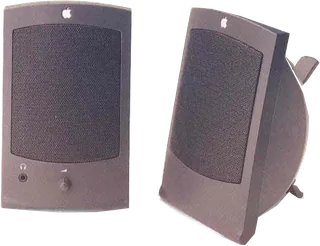
Apple Apple Pro Speakers vs Apple AppleDesign Powered Speakers II
Better figure, where one is clearly better
| AppleApple Pro Speakers | AppleAppleDesign Powered Speakers II | |
|---|---|---|
| Overview | ||
| Released | January 2001 | 1994 |
| Sound | ||
| Type | Speaker | Speaker |
| Channels | stereo | stereo |
| Dolby Atmos | No | No |
| Drivers | Clear spherical housings with visible speaker cones. Apple developed the system with Harman Kardon; unpublished driver dimensions and enclosure measurements are not inferred from photographs. The original Apple product photos show dark cone surrounds; the later iMac brochure shows pale surrounds. These images describe the photographed versions without guessing their exact ordering-code mapping. | Full-range, tuned-port bass-reflex system with magnetic shielding and active equalisation. Apple claims maximum 90 dB SPL at 0.5 m at 200 Hz; the original generation's 90 Hz condition is not transferred. |
| Amplifiers | The speakers receive amplified audio and power from the host Mac, with no external amplifier box of their own. Apple's original Power Mac G4 product page claims 20 W total, 10 W per channel, supplied by the computer; it publishes no RMS or distortion conditions. The UK July 2002 iMac data sheet instead specifies 9 W per speaker and an 18 W internal iMac amplifier. These are host-specific claims, not interchangeable speaker or mains-consumption ratings. | Built-in dual-channel amplifier. Apple labels output power 14 W without channel, RMS or distortion conditions; no additional rating is inferred. Maximum input is 2 V peak-to-peak. Exact model uses a 12 V DC supply; maximum 24 W electrical input is distinct from audio output. Mains compatibility is 100–240 V, 50 or 60 Hz depending on the regional power-supply module; the listed US kits include a 120 V module. Shared Service Source's generic 15 V/40 W table describes the original speakers and is not applied to Speakers II. |
| Frequency response | Apple specifies 70 Hz to 20 kHz without a tolerance or measurement conditions. No comparison with a measured response is implied. | Maker gives 150 Hz to 20 kHz without a tolerance. This is not the original generation's 90 Hz to 17 kHz ±3 dB specification. |
| Connections | ||
| Wi-Fi | No | No |
| Bluetooth | No | No |
| AirPlay | No | No |
| Voice assistants | None | None |
| Wi-Fi | No Wi-Fi; wired speaker connection only. | No built-in Wi-Fi; analogue inputs only. |
| Bluetooth | No Bluetooth; wired speaker connection only. | No built-in Bluetooth; analogue inputs only. |
| Ports | One attached cable connects the pair to a compatible Mac's dedicated Apple speaker minijack. This is a special powered connector, not a standard headphone socket or USB input. The visually similar Power Mac G4 Cube speakers are a separate USB-powered system with their own external amplifier; their connectivity is not transferred here. | Two 3.5 mm stereo input sockets, labelled computer and CD/audio; one front stereo headphone output; connection for the satellite speaker. The supplied CD cable converts dual RCA source sockets to a 3.5 mm input. A miniplug speaker cable is permanently attached to the satellite end. No original-generation revision-B subwoofer socket is documented. |
| Streaming | No network player or music service built in. Plays audio supplied by a compatible Mac. | Plays sound from a separately connected computer, CD or cassette player or television. No network player is built in. |
| Design | ||
| Battery life detail | No battery. Draws power through the special amplified Apple speaker connection on the host computer. | External mains-powered 12 V DC module; no battery operation documented. |
| Controls | Volume and sound settings are controlled on the host Mac; no separate speaker volume dial is shown in the maker's product images. | Front volume control and headphone socket. Unlike the original AppleDesign speakers, Speakers II has no power switch and is designed to stay powered. No tone or balance controls. Exact Apple support confirms neither input uses the original generation's noise gate, so quiet passages are not subject to that circuit's cutoff. |
| Mounting | Separate desktop speaker pair. Apple's photos show the integrated circular supports; no mounting-hole standard is published. | Integrated sliding rear foot adjusts the listening angle while retaining a three-point stance. Apple's exact M2497 stand-design patent identifies front contact points and the curved adjustable foot; this is a technical illustration, not a photograph of an undocumented revision. |
| Size | Speaker dimensions and exact pair weight were not recovered from the manufacturer; computer dimensions and weight in the shared iMac sheet are not applied to the speakers. | Maker gives 6.8 × 4.13 × 3.94 inches (height × width × depth), with published metric figures 175 × 107 × 101 mm. Published 1.34 lb (612 g) weight is not identified as per speaker versus pair, so no headline weight is assigned. |
| Colours | Transparent housings. The original 2001 product photos show dark surrounds; the 2002 iMac bundle photograph shows pale surrounds. Apple's surviving Japanese product list names M8282J/A and M8756G/A as Apple Pro Speakers, but it does not map the photographed surrounds to those ordering codes. | Slate and platinum. Original brochure offers slate separately and platinum in bundles; the later technical support sheet also lists the platinum M2668LL/A ordering kit. Colours do not establish distinct hardware generations. |
| In the box | Standalone pair sold as an optional Power Mac G4 accessory. Some iMac G4 configurations include the pair; the iMac, keyboard and mouse in the brochure scene are bundle companions rather than parts supplied with the standalone speakers. Apple announced the optional speakers alongside immediately available Power Mac G4 configurations on 9 January 2001; its archived 23 January product page offers online ordering and describes the then-current powered connection. January 2001 is supported, but a separate exact first-sale day for the speaker accessory remains unresolved. A separately sold Harman Kardon iSub can be used with the compatible Mac system; it is not included. | Main powered speaker, satellite speaker with attached connection cable, regional power-supply module, 3.5 mm computer cable, 3.5 mm-to-dual-RCA CD cable, user guide and limited warranty. The photographed Apple Multimedia Kit adds a separately bundled AppleCD 300e Plus, headphones and CD-ROM titles. Apple names the original generation in its exact comparison FAQ. Its stand-design patent records introduction on 14 March 1994; recovered contemporary purchase accounts and GEnieLamp's November 1994 hands-on test establish retail in 1994, but the actual first month remains unresolved. Introduction and document dates are not used as first sale. |