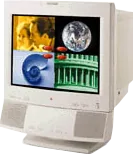
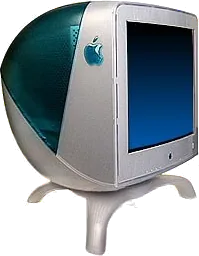
Apple AppleVision 1710AV vs Apple Studio Display (17-inch CRT, 1999)
Better figure, where one is clearly better
| AppleAppleVision 1710AV | AppleStudio Display (17-inch CRT, 1999) | |
|---|---|---|
| Overview | ||
| Released | August 1995 | January 1999 |
| Display | ||
| Screen size | 16.1″ | 16″ |
| Panel | CRT (Nominal 17-inch Trinitron CRT, 16.1-inch viewable image, 0.26 mm stripe pitch; no fixed native pixel matrix) | CRT (Nominal 17-inch Mitsubishi Diamondtron aperture-grille CRT, 16-inch viewable image; 0.25 mm aperture grille pitch. Vertically flat screen, without a fixed native pixel matrix.) |
| Colour modes | DigitalColor feedback and automatic calibration against factory measurements, with ambient-light and phosphor-age compensation; ColorSync 2.0 support. Selectable colour temperature 4100–9300 K in Apple's Japanese specification. | – |
| Supported signal modes | Apple lists 640 × 480 at 60 or 66.67 Hz; 800 × 600 at 60.31 or 75 Hz; 832 × 624 at 74.55 Hz; 1024 × 768 at 60 or 74.93 Hz; 1152 × 870 at 75 Hz; and 1280 × 1024 at 60 or 75.03 Hz. Horizontal scan range 30–80 kHz and vertical range 50–120 Hz. Supported signal modes depend on the computer/video card, not a native matrix or native refresh rate. | Supported signal modes include 1600 × 1200 at up to 60 Hz, 1280 × 1024 at up to 75 Hz and 1024 × 768 at up to 85 Hz. Horizontal scan 30–85 kHz; vertical scan 48–160 Hz. These are selectable CRT modes, not a fixed native matrix or one native refresh rate. |
| Screen coating | Antiglare and antistatic treatment | Antireflective and antistatic screen coating |
| Connections | ||
| Video inputs | DA-15 | VGA |
| USB-C charging | None | None |
| Speakers | Yes | – |
| Other connections | Macintosh 15-pin DA-15 analogue RGB connector, supplied PC VGA adaptor, ADB input and two pass-through device connections. Front headphone output mutes the internal speakers; audio input/output and microphone connections are described in Service Source. No second independent video input inferred from secondary wording. | Captive 15-pin mini D-Sub VGA cable; included VGA-to-Macintosh adaptor for older Mac video connectors |
| Speaker detail | Built-in bass-reflex stereo speakers and directional microphone. Service Source states 70 Hz–20 kHz ±6 dB audio response and 92 dB SPL at 1 kHz, measured at 0.5 m; these are maker audio claims, not reviewer measurements. | – |
| Design | ||
| Stand adjusts | Tilt, swivel | Tilt, swivel |
| Weight with stand | 27 kg | 20.8 kg |
| Size with stand | Service Source and October 1995 Apple Facts give 507 × 405 × 452 mm (height × width × depth); Apple's Japanese specification instead gives 507 × 410 × 484 mm, retained as a regional source difference | January 1999 maker datasheet gives 41.1 × 42.7 × 44.7 cm (width × height × depth); archived support sheet instead lists 18.9 × 16.5 × 16.9 inches (height × width × depth), an unresolved maker conflict |
| Weight detail | Service Source and Apple Facts publish 27 kg (60 lb); Japanese specification approximately 27 kg | January 1999 M6221LL/A datasheet specifies 20.8 kg (45.9 lb); archived Apple support sheet instead lists 48 lb. The model-specific datasheet metric figure is used. |
| Controls | Power, brightness, contrast, geometry, convergence, colour temperature, bass, treble, volume, microphone on/off and speaker mute. AppleVision Macintosh software provides screen controls; PC operation uses on-screen controls. Automatic power-on degauss. | Power, brightness, contrast, on-screen geometry, convergence, degauss, moiré and colour-temperature controls |
| Colours | – | Translucent Blueberry and white enclosure; the later August 1999 Graphite revision has the same performance and internal circuitry according to Apple's service manual |
| Power and support | ||
| Power use | Service Source and English support archive state 130 W maximum; Japanese specification instead gives 150 W operating maximum, 11 W or less standby and 0 W energy-saving mode | January 1999 datasheet specifies maximum 150 W operating, less than 15 W standby and less than 5 W with the computer in energy-saving mode. Archived support sheet instead gives maximum 120 W; this maker conflict is retained. |
| Power supply | Service Source and Japanese specification 100–240 V AC, 50–60 Hz; English archive instead lists 100–120/220–240 V bands. Mains frequency is not screen refresh. | January 1999 datasheet specifies 90–264 V AC, 47–63 Hz; these are mains ratings, not display refresh rates |
| Software | System 7.1 or later. Contemporary 7 August 1995 TidBITS reports Apple announcing availability; Apple's later English support archive dates introduction 8 August 1995. August retail month retained rather than inferring an exact day. Japanese regional dimensions and power differ from Service Source; figures remain qualified. Brightness and contrast ratio are unpublished. | Maker announced the new Studio Display family on 5 January 1999; January retail precision is used because a distinct first-sale day is unconfirmed. January datasheet lists Power Macintosh G3 with Mac OS 8.0 or later. Brightness and contrast ratio are unpublished and omitted; no pixel density is assigned to this CRT. |
| In the box | – | Display, Apple Displays software, power cord, VGA-to-Macintosh adaptor and user manual |
| Certifications | EPA Energy Star, VESA DPMS and MPR-2; additional regional approvals listed in Apple's Japanese specification | – |
More comparisons
- Apple AppleVision 1710AV vs Apple Studio Display (2026)
- Apple AppleVision 1710AV vs Apple Studio Display XDR
- Apple Studio Display (17-inch CRT, 1999) vs Apple Studio Display (2026)
- Apple Studio Display (17-inch CRT, 1999) vs Apple Studio Display XDR
- Apple Studio Display (17-inch CRT, 1999) vs Apple Studio Display (2022)
- Apple Studio Display (17-inch LCD, 2001) vs Apple Studio Display (17-inch CRT, 1999)
- Apple Studio Display (17-inch CRT, 1999) vs Apple Studio Display (17-inch CRT ADC, 2000)
- Apple Studio Display (15-inch ADC, 2000) vs Apple Studio Display (17-inch CRT, 1999)
- Apple AppleVision 1710AV vs Apple Studio Display (17-inch CRT ADC, 2000)
- Apple Studio Display (15-inch DVI, 1999) vs Apple Studio Display (17-inch CRT, 1999)
- Apple Studio Display (17-inch CRT, 1999) vs Apple Studio Display (21-inch CRT, 1999)
- Apple Studio Display (15-inch LCD, 1999) vs Apple Studio Display (17-inch CRT, 1999)
- Apple Multiple Scan 720 Display vs Apple Studio Display (17-inch CRT, 1999)
- Apple AppleVision 750 Display vs Apple Studio Display (17-inch CRT, 1999)
- Apple Studio Display (15-inch LCD, 1998) vs Apple Studio Display (17-inch CRT, 1999)
- Apple Multiple Scan 1705 Display vs Apple Studio Display (17-inch CRT, 1999)