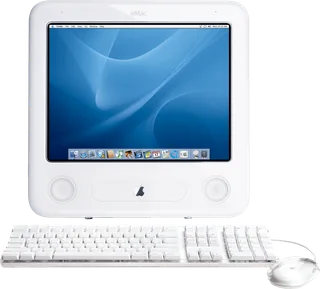
Apple eMac (2002) vs Apple iMac G3 (Summer 2000)
Better figure, where one is clearly better
| AppleeMac (2002) | AppleiMac G3 (Summer 2000) | |
|---|---|---|
| Overview | ||
| Released | June 2002 | July 2000 |
| Performance | ||
| Processor | PowerPC G4 0.7 GHz (eMac 2002) or PowerPC G4 0.8 GHz (eMac 2002) | PowerPC G3 350 MHz (iMac), PowerPC G3 400 MHz (iMac), PowerPC G3 450 MHz (iMac) or PowerPC G3 500 MHz (iMac) |
| CPU cores | 1 | 1 |
| Graphics | NVIDIA GeForce2 MX (32 MB DDR) | ATI RAGE 128 Pro (8 MB) |
| Memory | 128 MB, 256 MB, 512 MB or 1 GB | 64 MB, 128 MB or 1 GB |
| Storage | 40 GB to 60 GB (better) | 7 GB to 30 GB |
| CPU | 700 MHz PowerPC G4 with Velocity Engine, 256 KB full-speed L2 cache and 100 MHz system bus in Apple's original consumer specification. The August update also offered an 800 MHz processor. EveryMac identifies both as PowerPC 7441; Apple publishes only the G4 family and clock speeds. | 350, 400, 450 or 500 MHz PowerPC G3 with 512 KB backside L2 cache. All use a 100 MHz system bus. Generic clock-only chip records do not infer silicon suppliers; cache differences remain in model details. |
| GPU | NVIDIA GeForce2 MX with AGP 2× support and 32 MB dedicated DDR video memory | ATI RAGE 128 Pro with 8 MB dedicated SDRAM and AGP support across the range. |
| Memory type | 128 MB SDRAM standard on 700 MHz configurations, 256 MB on the August 800 MHz SuperDrive configuration. Two user-accessible 168-pin DIMM slots support up to 1 GB using 128 MB, 256 MB or 512 MB DIMMs. | 64 MB PC100 SDRAM standard on 350/400/450 MHz configurations; 128 MB on 500 MHz Special Edition. Two DIMM slots support up to 1 GB in the current maker sheet. Configurations retain each base and maximum memory with its original processor and drive. |
| Storage type | Original consumer 700 MHz CD-RW model has a 40 GB Ultra ATA disk and maximum 24× CD-R, 10× CD-RW and 32× CD reading. August 2002 consumer choices were 700 MHz Combo with 40 GB and 800 MHz SuperDrive with 60 GB. Optical-drive speeds for those later choices are not assumed from the original CD-RW specification. | 350 MHz: 7 GB hard drive and CD-ROM, Indigo. 400 MHz DV: 10 GB and CD-ROM, Indigo or Ruby. 450 MHz DV+: 20 GB and 4x DVD-ROM, Indigo, Ruby or Sage. 500 MHz DV Special Edition: 30 GB and DVD-ROM, Graphite or Snow. Ultra ATA hard drives; original storage stays tied to each processor. |
| Display | ||
| Screen size | 17″ | 15″ |
| Resolution | 1280 × 960 (better) | 1024 × 768 |
| Panel | CRT | – |
| Refresh rate | 72 Hz | 75 Hz (better) |
| Display type | Flat 17-inch CRT with 16-inch viewable area and 0.25 mm dot pitch. Supported analogue modes are 1280 × 960 at 72 Hz, 1152 × 864 at 80 Hz, 1024 × 768 at 89 Hz, 800 × 600 at 112 Hz and 640 × 480 at 138 Hz; these are not a fixed pixel matrix. The headline refresh applies to the highest published screen resolution. | Nominal 15-inch CRT with 13.8-inch viewable diagonal (EveryMac exact DV+ specification); no fixed LCD native resolution. |
| Display features | – | 1024 × 768 at 75 Hz; 800 × 600 at 95 Hz and 640 × 480 at 117 Hz. Scalar refresh describes the highest-resolution mode. Exact supported modes are from EveryMac’s DV+ specification. |
| Connections | ||
| Ports | 3 × USB-A, Ethernet, headphone jack | 2 × USB-A, Ethernet, 2 × headphone jack |
| Ethernet | 0.1 Gb/s | 0.1 Gb/s |
| Wi-Fi | Optional AirPort 802.11b | – |
| Back ports | Three USB 1.1 ports on the computer shared across two 12 Mbps controllers, plus two on the keyboard; two FireWire 400 ports sharing 8 W; mini-VGA; headphone and analogue audio input; 10/100BASE-T Ethernet and a 56K V.90 modem on the consumer model. No built-in Bluetooth is specified. | Two FireWire 400 ports and VGA video mirroring on DV, DV+ and DV Special Edition only; the entry 350 MHz model lacks them. Two 12 Mbps USB ports on the computer, 10/100BASE-T Ethernet, 56K V.90 modem, audio line-in/out and two front headphone jacks; keyboard USB ports are not counted as chassis ports. AirPort card is optional on DV configurations; no standard wireless specification is added. |
| External displays | VGA display mirroring through an optional VGA display adapter; the external screen repeats the internal screen rather than providing an extended desktop. | DV configurations provide VGA mirroring; entry model has no external video connector. |
| Speakers | Integrated stereo system with internal 16 W digital amplifier | Integrated Odyssey stereo sound system designed with Harman Kardon, built-in microphone and fanless enclosure. |
| Microphones | Built-in microphone | – |
| Keyboard and mouse | Apple Pro Keyboard and optical Apple Pro Mouse; optional Tilt and Swivel Stand | Apple Pro Keyboard and optical Apple Pro Mouse. |
| Design and power | ||
| Type | All-in-one | All-in-one |
| Weight | 22.7 kg | – |
| Width × depth × height | 406 × 433 × 406 mm | – |
| Operating system | macOS | macOS |
| Size and weight detail | Maker metric dimensions and reference weight retained. Weight varies with configuration and manufacturing process; published centimetre and inch values do not convert exactly. | Maker gives height 15.0, width 15.0 and depth 17.1 inches, weight 34.7 pounds. No converted or sibling metric values are added to main fields. |
| Power supply | Configured for 100 V AC or 220 V AC according to country; 47–63 Hz, single phase | 100–260 V AC, 47–63 Hz, single phase; maximum continuous power 150 W. |
| Power use | Maximum continuous electrical power 170 W | – |
| Colours | White | – |
| In the box | June consumer configuration included Mac OS X 10.1.4 and Mac OS 9.2.2, iPhoto, iMovie 2, iTunes and other bundled applications. Apple confirmed immediate US consumer availability on 4 June 2002; this record describes those consumer CD-RW, Combo and SuperDrive configurations, excluding the earlier education-only CD-ROM option. The original April education announcement planned US/Canadian availability in May; its first actual institutional sale remains unresolved. The August 700 MHz Combo was stated as available that week; 800 MHz SuperDrive was expected at the end of August, not a confirmed first-sale day. | Mac OS 9.0.4, iMovie 2 and productivity software. Maker confirms DV, DV+ and DV Special Edition are available immediately on 19 July 2000; the 350 MHz entry configuration was scheduled to ship the next month, August 2000. |

More comparisons
- Apple iMac 24″ (M4) vs Apple iMac G3 (Summer 2000)
- Apple iMac 24″ (M3) vs Apple iMac G3 (Summer 2000)
- Apple iMac 24″ (M1) vs Apple iMac G3 (Summer 2000)
- Apple iMac G3 (Summer 2000) vs Apple iMac (Retina 5K, 27-inch, 2020)
- Apple iMac G3 (Summer 2000) vs Apple iMac (Retina 4K, 21.5-inch, 2019)
- Apple iMac G3 (Summer 2000) vs Apple iMac (Retina 5K, 27-inch, 2019)
- Apple iMac G3 (Summer 2000) vs Apple iMac Pro (2017)
- Apple iMac (21.5-inch, 2017) vs Apple iMac G3 (Summer 2000)
- Apple eMac (2002) vs Apple eMac (2005)
- Apple iMac G3 (Summer 2000) vs Apple Mac mini (2005)
- Apple eMac (2002) vs Apple eMac (USB 2.0, 2004)
- Apple iMac G3 (Summer 2000) vs Apple iMac G4 (15-inch, USB 2.0)
- Apple eMac (2002) vs Apple eMac (ATI Graphics, 2003)
- Apple eMac (2002) vs Apple iMac G4 (17-inch, Flat Panel)
- Apple eMac (2002) vs Apple iMac G4 (15-inch, Flat Panel)
- Apple eMac (2002) vs Apple iMac G3 (Summer 2001)