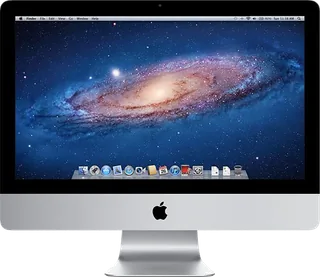
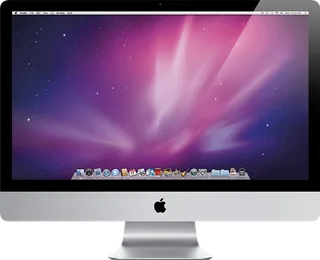
Apple iMac (21.5-inch, Mid 2011) vs Apple iMac (27-inch, Mid 2010)
Better figure, where one is clearly better
| AppleiMac (21.5-inch, Mid 2011) | AppleiMac (27-inch, Mid 2010) | |
|---|---|---|
| Overview | ||
| Released | May 2011 | July 2010 |
| Performance | ||
| Processor | Intel Core i5-2400S, Intel Core i5-2500S or Intel Core i7-2600S | Intel Core i3-550, Intel Core i5-680, Intel Core i5-760 or Intel Core i7-870 |
| CPU cores | 4 | 2 or 4 |
| Graphics | AMD Radeon HD 6750M (512 MB GDDR5) or AMD Radeon HD 6770M (512 MB GDDR5) | ATI Radeon HD 5670 (512 MB GDDR3) or ATI Radeon HD 5750 (1 GB GDDR5) |
| Memory | 4 GB, 8 GB or 16 GB | 4 GB, 8 GB or 16 GB |
| Storage | 500 GB to 2 TB | 256 GB to 2 TB |
| CPU | 2.5 GHz quad-core Core i5-2400S or 2.7 GHz quad-core Core i5-2500S; the higher model offers a 2.8 GHz quad-core Core i7-2600S upgrade. Exact model identities cross-checked with EveryMac; the i5 has 6 MB shared L3 cache. Intel confirms the i7 has eight threads and up to 3.8 GHz Turbo Boost. | 3.2 GHz dual-core Core i3-550 or optional 3.6 GHz dual-core Core i5-680, both with Hyper-Threading and 4 MB L3 cache; higher model has a 2.8 GHz quad-core Core i5-760 or optional 2.93 GHz quad-core Core i7-870 with Hyper-Threading, both with 8 MB L3 cache. Exact identities cross-checked with EveryMac; optional unpublished boost figures omitted. |
| GPU | 2.5 GHz model has AMD Radeon HD 6750M with 512 MB GDDR5; 2.7 GHz and optional i7 models have Radeon HD 6770M with 512 MB GDDR5 | Dual-core models have ATI Radeon HD 5670 with 512 MB GDDR3; quad-core models have ATI Radeon HD 5750 with 1 GB GDDR5 |
| Memory type | Four SO-DIMM slots, 1333 MHz DDR3; 4 GB standard as two 2 GB modules. Base model offers an 8 GB factory upgrade; higher model offers 8 or 16 GB. Memory is user accessible. | 4 GB standard as two 2 GB modules; four user-accessible SO-DIMM slots support up to 16 GB of 1333 MHz DDR3. UK launch release offers factory upgrades to 8 or 16 GB for both models. |
| Storage type | Base model has a 500 GB 7200 rpm hard drive. Higher model has a 1 TB 7200 rpm drive, configurable to 2 TB and a 256 GB solid-state second drive. Mixed hard-drive-plus-SSD options are described here rather than labelled Fusion Drive or presented as a single SSD; no standalone 256 GB row is inferred from the support sheet's second-drive wording. Slot-loading 8x SuperDrive with 4x double-layer DVD burning. | 1 TB 7200 rpm hard drive standard, configurable to 2 TB. UK launch release explicitly offers a 256 GB SSD as a primary or secondary drive. Separate hard-drive-plus-SSD options are described here rather than labelled Fusion Drive or combined into a single SSD capacity. Slot-loading 8x SuperDrive with double-layer DVD burning. |
| Display | ||
| Screen size | 21.5″ | 27″ |
| Resolution | 1920 × 1080 | 2560 × 1440 (better) |
| Panel | IPS LCD | IPS LCD |
| Brightness | – | 375 nits |
| Display type | Glossy LED-backlit IPS widescreen display, millions of colours; optional unpublished refresh rate and brightness omitted | Glossy LED-backlit IPS widescreen display, 2560 × 1440 pixels and maker typical brightness 375 cd/m²; refresh rate unpublished and omitted |
| Connections | ||
| Ports | Thunderbolt, 4 × USB-A, Ethernet, SD card slot, headphone jack | DisplayPort, 4 × USB-A, Ethernet, SD card slot, headphone jack |
| Ethernet | 1 Gb/s | 1 Gb/s |
| External displays | Up to 1 | Up to 1 |
| Wi-Fi | 802.11n | 802.11n |
| Bluetooth | 2.1 + EDR | 2.1 + EDR |
| Camera | FaceTime HD camera | iSight camera |
| Back ports | One Thunderbolt port also provides Mini DisplayPort video output; four USB 2.0 ports, FireWire 800 at 7 W, Gigabit Ethernet, SDXC slot, headphone/optical digital output and line-in/optical digital input. FireWire and audio input are described here because the main port list has no fields for them; IR receiver built in. | Mini DisplayPort audio/video input and output, four USB 2.0 ports, FireWire 800 at 7 W, Gigabit Ethernet, SDXC slot, headphone/optical digital output and line-in/optical digital input. FireWire and audio input are described here because the main port list has no fields for them. |
| External displays | Full built-in resolution and one external display up to 2560 × 1600 simultaneously; extended desktop and mirroring, optional DVI/VGA/dual-link DVI adapters | Full built-in resolution and one external display up to 2560 × 1600 simultaneously; Mini DisplayPort input can display an external DisplayPort source. Extended desktop and mirroring, with optional DVI/VGA/dual-link DVI output adapters. |
| Speakers | Stereo speakers with two internal 17 W amplifiers, built-in microphone and support for iPhone headset microphones | Built-in stereo speakers with two internal 17 W amplifiers, microphone and support for iPhone headset microphones |
| Keyboard and mouse | Apple Wireless Keyboard and Magic Mouse, with Magic Trackpad substitution available from the online store | Apple Wireless Keyboard and Magic Mouse; Magic Trackpad available separately |
| Design and power | ||
| Type | All-in-one | All-in-one |
| Weight | 9.3 kg (better) | 13.8 kg |
| Width × depth × height | 528 × 188.5 × 451 mm | 650 × 207 × 517 mm |
| Operating system | macOS | macOS |
| Power supply | Maximum continuous power 205 W; 100–240 V AC, 50–60 Hz single phase | Maximum continuous power 365 W; 100–240 V AC, 50–60 Hz single phase |
| Materials | Aluminium and glass enclosure, arsenic-free display glass and mercury-free LED backlight; BFR-free and PVC-free components, with PVC-free AC cord availability limited to named regions | Aluminium and glass enclosure, arsenic-free display glass and mercury-free LED backlight; BFR-free and PVC-free components, with PVC-free AC cord availability limited to named regions |
| In the box | iMac, Apple Wireless Keyboard, Magic Mouse, power cord, install/restore DVDs and documentation. Launch press specifies Mac OS X Snow Leopard and iLife '11; the later support sheet lists OS X Lion, reflecting the software update rather than launch software. | iMac, Apple Wireless Keyboard, Magic Mouse, cleaning cloth, power cord, install/restore DVDs and documentation; Mac OS X Snow Leopard and iLife at launch |
More comparisons
- Apple iMac (21.5-inch, Mid 2011) vs Apple iMac 24″ (M4)
- Apple iMac 24″ (M4) vs Apple iMac (27-inch, Mid 2010)
- Apple iMac (21.5-inch, Mid 2011) vs Apple iMac 24″ (M3)
- Apple iMac 24″ (M3) vs Apple iMac (27-inch, Mid 2010)
- Apple iMac 24″ (M1) vs Apple iMac (27-inch, Mid 2010)
- Apple iMac (21.5-inch, Mid 2011) vs Apple iMac 24″ (M1)
- Apple iMac (27-inch, Mid 2010) vs Apple iMac (Retina 5K, 27-inch, 2020)
- Apple iMac (21.5-inch, Mid 2011) vs Apple iMac (Retina 5K, 27-inch, 2020)
- Apple iMac (21.5-inch, Mid 2011) vs Apple iMac (Retina 4K, 21.5-inch, 2019)
- Apple iMac (21.5-inch, Mid 2011) vs Apple iMac (Retina 5K, 27-inch, 2019)
- Apple iMac (27-inch, Mid 2010) vs Apple iMac (Retina 4K, 21.5-inch, 2019)
- Apple iMac (27-inch, Mid 2010) vs Apple iMac (Retina 5K, 27-inch, 2019)
- Apple iMac (21.5-inch, Mid 2011) vs Apple iMac Pro (2017)
- Apple iMac (27-inch, Mid 2010) vs Apple iMac Pro (2017)
- Apple iMac (21.5-inch, 2017) vs Apple iMac (21.5-inch, Mid 2011)
- Apple iMac (21.5-inch, 2017) vs Apple iMac (27-inch, Mid 2010)