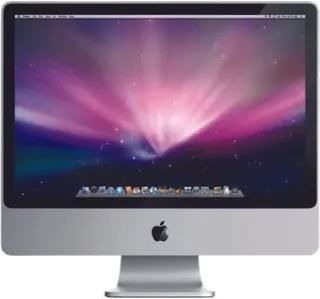
Apple iMac (24-inch, Early 2008) vs Apple iMac (Retina 5K, 27-inch, 2020)
Better figure, where one is clearly better
| AppleiMac (24-inch, Early 2008) | AppleiMac (Retina 5K, 27-inch, 2020) | |
|---|---|---|
| Overview | ||
| Released | April 2008 | August 2020 |
| Performance | ||
| Processor | Intel Core 2 Duo E8235 or Intel Core 2 Duo E8435 | Intel Core i5-10500, Intel Core i5-10600, Intel Core i9-10910 or Intel Core i7-10700K |
| CPU cores | 2 | 6, 8 or 10 |
| CPU threads | – | 12, 16 or 20 |
| Graphics | ATI Radeon HD 2600 PRO (256 MB GDDR3) or NVIDIA GeForce 8800 GS (512 MB GDDR3) | Radeon Pro 5300 (4 GB GDDR6), Radeon Pro 5500 XT (8 GB GDDR6), Radeon Pro 5700 (8 GB GDDR6) or Radeon Pro 5700 XT (16 GB GDDR6) |
| Memory | 2 GB or 4 GB | 8 GB, 16 GB, 32 GB, 64 GB or 128 GB (better) |
| Storage | 320 GB to 1 TB | 256 GB to 8 TB (better) |
| CPU | 2.8 GHz Intel Core 2 Duo E8235, configurable to 3.06 GHz E8435; 6 MB shared L2 cache and 1066 MHz frontside bus. Exact processor identities cross-checked with EveryMac. | Six-core Core i5 at 3.1 GHz (Turbo Boost 4.5 GHz) or 3.3 GHz (4.8 GHz), or eight-core Core i7 at 3.8 GHz (5.0 GHz). Upper two bases configurable to 3.6 GHz ten-core Core i9 (5.0 GHz). Exact CPU identities follow Geekbench. Apple specifies a 5.0 GHz Core i7 limit in this iMac, while Intel lists 5.1 GHz for the chip itself. |
| GPU | Either processor supports ATI Radeon HD 2600 PRO with 256 MB GDDR3 or optional NVIDIA GeForce 8800 GS with 512 MB GDDR3 | Radeon Pro 5300 with 4 GB GDDR6 on the two Core i5 bases. Upper base has Radeon Pro 5500 XT with 8 GB GDDR6, optionally Radeon Pro 5700 with 8 GB or 5700 XT with 16 GB GDDR6. |
| Memory type | Two user-accessible SO-DIMM slots for 800 MHz DDR2 SDRAM; 2 GB standard, configurable to 4 GB | 2666 MHz DDR4; 8 GB standard as two 4 GB modules. Four user-accessible SO-DIMM slots; configurable to 16/32/64/128 GB on every base. |
| Storage type | 320 GB 7200 rpm Serial ATA hard drive with either processor, configurable to 500 GB, 750 GB or 1 TB; slot-loading 8x SuperDrive with 4x double-layer DVD burning | Lower base: fixed 256 GB SSD. Middle base: 512 GB/1/2 TB SSD. Upper base: 512 GB/1/2/4/8 TB SSD. |
| Display | ||
| Screen size | 24″ | 27″ |
| Resolution | 1920 × 1200 | 5120 × 2880 (better) |
| Panel | – | IPS LCD |
| Brightness | 385 nits | 500 nits (better) |
| Display type | Glossy widescreen TFT active-matrix LCD, millions of colours; typical contrast 750:1 and 178° horizontal and vertical viewing angles. Panel technology and refresh rate unpublished and omitted. | LED-backlit Retina 5K display; IPS panel confirmed by EveryMac. Apple does not publish native refresh rate in the specification sheet. |
| Display features | Optional 24-inch VESA Mount Adapter kit | Wide colour (P3), one billion colours and True Tone; standard glass or optional nano-texture glass |
| Connections | ||
| Ports | 3 × USB-A, Ethernet, headphone jack | 2 × Thunderbolt 3, 4 × USB-A, SD card slot, Ethernet, headphone jack |
| Ethernet | 1 Gb/s | 1 Gb/s |
| External displays | Up to 1 | Up to 2 (better) |
| Wi-Fi | 802.11n draft; compatible with 802.11a/b/g | 802.11ac |
| Bluetooth | 2.1 + EDR | 5.0 |
| Camera | iSight camera | 1080p FaceTime HD |
| Back ports | Three USB 2.0 ports on the computer, plus two on the supplied keyboard; one FireWire 400 and one FireWire 800 port, each rated 7 W; mini-DVI output, Gigabit Ethernet, headphone/optical digital output and line-in/optical digital input. FireWire, mini-DVI and audio input described here. | Four USB-A ports; two Thunderbolt 3 USB-C ports with DisplayPort, Thunderbolt up to 40 Gb/s and USB 3.1 Gen 2 up to 10 Gb/s; UHS-II SDXC, Gigabit Ethernet and 3.5 mm headphone jack; Kensington lock slot. Optional 10Gb Ethernet supports 1/2.5/5/10Gb connections. Thunderbolt 2, HDMI, DVI and VGA require adapters. |
| External displays | One external display in extended desktop or mirroring mode; digital resolutions up to 1920 × 1200 and analogue up to 2048 × 1536. DVI, VGA, S-video and composite adapters sold separately. | One 6K or 5K external display, or two 4K displays; two 6K displays require Radeon Pro 5700 or 5700 XT. All listed external modes run at 60 Hz. |
| Speakers | Built-in stereo speakers with internal 24 W digital amplifier and built-in microphone | Stereo speakers |
| Microphones | – | Three-mic array with directional beamforming; supports Hey Siri |
| Keyboard and mouse | Apple Keyboard, Mighty Mouse and infrared Apple Remote; optional wireless keyboard and wireless Mighty Mouse | Rechargeable Magic Keyboard and Magic Mouse 2; optional numeric keyboard and Magic Trackpad |
| Design and power | ||
| Type | All-in-one | All-in-one |
| Weight | – | 8.92 kg |
| Width × depth × height | 569 × 207 × 520 mm | 650 × 203 × 516 mm |
| Operating system | macOS | macOS |
| Size and weight detail | Maker weight 25.4 pounds (11.5 kg), varying by configuration and manufacturing process; shared scalar weight omitted | Dimensions include the stand; weight varies by configuration and manufacturing process. A built-in VESA mount version was also available. |
| Power supply | Maximum continuous power 280 W; 100–240 V AC, 50–60 Hz single phase | 100–240 V AC, 50–60 Hz, single phase |
| Power use | Apple environmental report for MB325 at 230 V records 1.65 W off, 2.58 W sleep and 36.2 W idle with display off or 113.2 W with display on; display on means full brightness | – |
| Materials | Recyclable aluminium and glass enclosure; arsenic-free display glass, majority of circuit-board laminates free of brominated flame retardants and PVC-free internal cables | Recyclable, low-carbon aluminium enclosure; arsenic-free glass and mercury-free LED backlight |
| In the box | iMac, Apple Keyboard, Mighty Mouse, Apple Remote, cleaning cloth, power cord, install/restore DVDs and documentation; Mac OS X Leopard and iLife '08 | iMac, Magic Keyboard, Magic Mouse 2, power lead, Lightning to USB cable and polishing cloth |

More comparisons
- Apple iMac (Retina 5K, 27-inch, 2020) vs Apple Mac Studio (M4 Max or M3 Ultra)
- Apple iMac 24″ (M4) vs Apple iMac (Retina 5K, 27-inch, 2020)
- Apple iMac (Retina 5K, 27-inch, 2020) vs Apple Mac mini (M4 or M4 Pro)
- Apple iMac (24-inch, Early 2008) vs Apple iMac 24″ (M4)
- Apple iMac 24″ (M3) vs Apple iMac (Retina 5K, 27-inch, 2020)
- Apple iMac (24-inch, Early 2008) vs Apple iMac 24″ (M3)
- Apple iMac (Retina 5K, 27-inch, 2020) vs Apple Mac Pro (M2 Ultra)
- Apple iMac 24″ (M1) vs Apple iMac (Retina 5K, 27-inch, 2020)
- Apple iMac (24-inch, Early 2008) vs Apple iMac 24″ (M1)
- Apple iMac (Retina 5K, 27-inch, 2019) vs Apple iMac (Retina 5K, 27-inch, 2020)
- Apple iMac Pro (2017) vs Apple iMac (Retina 5K, 27-inch, 2020)
- Apple iMac (27-inch, Late 2012) vs Apple iMac (Retina 5K, 27-inch, 2020)
- Apple iMac (27-inch, Late 2013) vs Apple iMac (Retina 5K, 27-inch, 2020)
- Apple iMac (Retina 5K, 27-inch, 2020) vs Apple iMac (Retina 5K, 27-inch, Late 2014)
- Apple iMac (Retina 5K, 27-inch, 2020) vs Apple iMac (Retina 5K, 27-inch, Mid 2015)
- Apple iMac (27-inch, Mid 2011) vs Apple iMac (Retina 5K, 27-inch, 2020)