Apple iPad Air (3rd generation) vs Samsung Galaxy Tab A7
Better figure, where one is clearly better
| AppleiPad Air (3rd generation) | SamsungGalaxy Tab A7 | |
|---|---|---|
| Overview | ||
| Released | March 2019 | October 2020 |
| Display | ||
| Screen size | 10.5″ | 10.4″ |
| Resolution | 2224 × 1668 (better) | 2000 × 1200 |
| Sharpness | 265 pixels per inch (better) | 224 pixels per inch |
| Panel | LCD | LCD |
| Brightness | 500 nits | – |
| Display type | Retina; LED-backlit IPS LCD (IPS confirmed by Notebookcheck) | TFT LCD, WUXGA+, 16 million colours; 10.4-inch full rectangle |
| Pixel density | 264 ppi | – |
| Display features | P3 wide colour; True Tone; fully laminated; anti-reflective coating with 1.8% reflectivity; oleophobic coating | – |
| Performance | ||
| Chip | A12 Bionic | Qualcomm Snapdragon 662 |
| Memory | 3 GB | 3 GB |
| Storage | 64 GB, 256 GB (better) | 32 GB, 64 GB |
| CPU | 64-bit A12 Bionic; M12 motion coprocessor; 3 GB RAM confirmed by iFixit | Qualcomm Snapdragon 662 (SM6115), four CPU cores at 2.0 GHz and four at 1.8 GHz in Samsung’s original Russian launch table. Original 3 GB RAM/32 GB and 3 GB/64 GB configurations; microSD up to 1 TB for media |
| AI engine | Neural Engine | – |
| Cameras | ||
| Rear camera | 8 MP | 8 MP |
| Ultra wide camera | None | None |
| Front camera | 7 MP (better) | 5 MP |
| Rear camera | f/2.4 five-element lens; backside illumination; hybrid IR filter; autofocus; wide colour and Live Photos; HDR; panorama up to 43 MP; burst; timer; auto image stabilisation | 8 MP autofocus; no flash. Full HD 1920 × 1080 recording at 30 fps |
| Front camera | FaceTime HD; f/2.2; Retina Flash; wide colour capture; backside illumination; auto HDR; burst; timer | 5 MP, positioned on the long edge for landscape video calls |
| Video recording | Rear 1080p; slow-motion at 240 fps; stabilised time-lapse; video stabilisation; 3x video zoom; front 1080p at 30 fps | – |
| Battery and connections | ||
| Battery life (maker's claim) | Up to 10 hours | Up to 13 hours |
| Battery (mAh) | – | 7,040 mAh |
| Fastest charging | – | 15 W |
| Battery capacity | 30.2 Wh | – |
| Mobile data option | Yes | Yes |
| Stylus | Supported, sold separately | Not supported |
| Keyboard made for it | Yes | No |
| Battery life detail | Up to 10 hours Wi-Fi browsing, video or music; nine hours cellular browsing | 7,040 mAh typical, 6,820 mAh rated in the exact South African maker footnote. Up to 13 hours in Samsung’s US family specification sheet means average expected performance under typical usage conditions, not continuous video playback |
| Charging | USB power adapter or USB computer charging | Up to 15 W Adaptive Fast Charging. Original maker Russian launch includes a 7.75 W charger; the 15 W adapter is sold separately |
| USB-C | Lightning; 3.5 mm headphone jack; Smart Connector | USB Type-C, USB 2.0; 3.5 mm stereo headphone socket |
| Wi-Fi | Dual-band 802.11a/b/g/n/ac; HT80 with MIMO | Wi-Fi 5 (802.11a/b/g/n/ac), 2.4 and 5 GHz, VHT80; Wi-Fi Direct |
| Bluetooth | Bluetooth 5.0 | Bluetooth 5.0 |
| Mobile network | Gigabit-class LTE; nano-SIM with Apple SIM support and eSIM; cellular model weighs 464 g | Optional LTE SM-T505, 477 g; Wi-Fi SM-T500, 476 g in maker launch tables. One physical nano-SIM in the exact European manual |
| Stylus support | Apple Pencil (1st generation), sold separately | No active Samsung S Pen support in Notebookcheck’s original exact-model test |
| Keyboards | Smart Keyboard, sold separately | No dedicated keyboard connector in the exact device layout; launch accessory is a Book Cover stand. General Bluetooth keyboards are separate peripherals |
| Design | ||
| Weight | 456 g (better) | 476 g |
| Thickness | 6.1 mm (better) | 7 mm |
| Height × width | 250.6 × 174.1 mm | 157.4 × 247.6 mm |
| Operating system | iPadOS | Android |
| Biometrics | Touch ID in Home button | Face recognition; no fingerprint reader in exact controls and independent tests |
| Speakers | Stereo speakers | Four speakers with Dolby Atmos |
| Microphones | Dual microphones | Two microphones in the exact European user-manual device layout |
| Sensors | Three-axis gyro; accelerometer; barometer; ambient light; compass; iBeacon; GPS and GNSS on cellular model | Accelerometer, gyro, geomagnetic, Hall and light sensors; GPS, GLONASS, BeiDou and Galileo |
| Materials | – | Metal body; no IP rating established in the maker sources read |
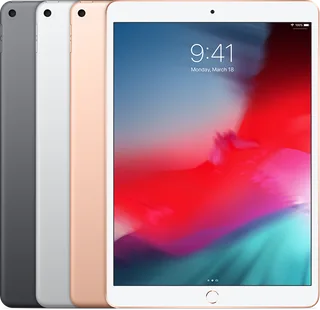
| Colours | Silver, Gold, Space Grey | Dark Grey, Gold and Silver. Silver has a white front bezel; Dark Grey and Gold have black bezels |
| Software at launch | iOS 12; orders opened 18 March 2019, with shops receiving it the following week | Android 10; One UI 2.5 in Notebookcheck’s original full review and maker feature illustration. Current exact UK support publishes an Android 12 user guide. This original SM-T500/SM-T505 is separate from the later SM-T503/SM-T509 refresh and A7 Lite |
| In the box | iPad Air; Lightning to USB cable; USB power adapter | Tablet, 7.75 W charger, USB cable and quick-start documentation in original maker/review evidence; LTE includes an ejection pin |

More comparisons
- Apple iPad Air 11″ (M4) vs Apple iPad Air (3rd generation)
- Apple iPad Air 13″ (M4) vs Apple iPad Air (3rd generation)
- Samsung Galaxy Tab A11+ vs Samsung Galaxy Tab A7
- Samsung Galaxy Tab A7 vs Samsung Galaxy Tab S10 Lite
- Samsung Galaxy Tab A7 vs Samsung Galaxy Tab S11
- Samsung Galaxy Tab A7 vs Samsung Galaxy Tab S11 Ultra
- Samsung Galaxy Tab A11 vs Samsung Galaxy Tab A7
- Samsung Galaxy Tab A7 vs Samsung Galaxy Tab S10 FE
- Samsung Galaxy Tab A7 vs Samsung Galaxy Tab S10 FE+
- Apple iPad Air 11″ (M3) vs Apple iPad Air (3rd generation)
- Apple iPad Air 13″ (M3) vs Apple iPad Air (3rd generation)
- Samsung Galaxy Tab A7 vs Samsung Galaxy Tab S10 Ultra
- Apple iPad Air 11″ (M2) vs Apple iPad Air (3rd generation)
- Apple iPad Air 13″ (M2) vs Apple iPad Air (3rd generation)
- Apple iPad Air (3rd generation) vs Apple iPad Air (5th generation)
- Apple iPad (9th generation) vs Samsung Galaxy Tab A7