Apple Macintosh Color Classic II vs Apple Macintosh TV
Better figure, where one is clearly better
| AppleMacintosh Color Classic II | AppleMacintosh TV | |
|---|---|---|
| Overview | ||
| Released | – | October 1993 |
| Performance | ||
| Processor | 68030 33 MHz (Macintosh Color Classic II) | 68030 32 MHz (Macintosh IIvx) |
| CPU cores | 1 | 1 |
| Memory | 8 MB (better) | 5 MB |
| Storage | 160 MB | 160 MB |
| CPU | 33 MHz Motorola 68030 with integrated PMMU, 32-bit data path at 33 MHz and 0.5K L1 cache; no L2 cache. Optional Motorola 68882 maths coprocessor, not supplied as standard. Exact current Apple specifications override the archived Service Source table, which incorrectly retains a 16-bit bus and 16-bit registers from the original Color Classic. | Motorola MC68030 at nominal 32 MHz, with integrated paged memory management and a 16 MHz system bus; 0.5 KB L1 cache, no L2 cache and no floating-point coprocessor. Service Source claims an optional math socket, conflicting with the exact Apple support table and both contemporary reviews; that capability is not adopted |
| GPU | – | 512 KB fixed VRAM supports 256 colours in computer mode at 640 × 480. Television mode uses 640 × 240 with 16-bit colour; TV video is full-screen and cannot be displayed in a desktop window. Apple shared display record specifies 14-inch Trinitron tube, 13-inch viewable area, 0.26 mm aperture-grille pitch and 66.62 Hz Macintosh mode |
| Memory type | 4 MB soldered memory, one 72-pin SIMM slot and 36 MB maximum; minimum 80 ns, supported module capacities 1, 2, 4, 8, 16 and 32 MB. 1 MB ROM. Exact current maker table overrides the shared service manual’s conflicting two 30-pin SIMMs and 10 MB limit. | 5 MB supplied: 4 MB on the logic board plus a 1 MB 72-pin SIMM; expandable to 8 MB by replacing it with 4 MB. Exact Apple Tech Info Library specifies 80 ns fast-page SIMMs; service manual says 100 ns, so the stricter maker requirement retained. 1 MB ROM |
| Storage type | Apple’s exact Japanese Performa 275 bundle has 8 MB RAM and a 160 MB SCSI hard drive, retained in configurations. Color Classic II support lists 80–160 MB internal disks but does not establish each factory RAM/disk pairing; no guessed combinations added. Internal 1.44 MB SuperDrive floppy, optional external CD-ROM. Original capacity units retained. | 160 MB internal SCSI hard disk, 1.44 MB Apple SuperDrive floppy and AppleCD 300i double-speed CD-ROM for data, audio CDs and Kodak Photo CDs |
| Expansion slots | One LC-compatible processor-direct slot; optional Ethernet expansion card and optional 68882 coprocessor. User-removable logic board. No standard Ethernet adapter. | No available general-purpose expansion slots; the internal TV hardware occupies the nonstandard slot. External SCSI supports up to six peripherals |
| Display | ||
| Screen size | 10″ | 14″ |
| Resolution | 512 × 384 | 640 × 480 (better) |
| Panel | CRT | CRT |
| Refresh rate | – | 66.62 Hz |
| Display type | Built-in 10-inch colour CRT tube with 512 × 384 Macintosh resolution. Exact current maker support does not identify a separate viewable diagonal or refresh rate; the archived service manual conflicts over display size, so neither a viewable-area measurement nor refresh rate is inferred. | – |
| Display features | 256K built-in VRAM supplies 256 colours; optional additional 256K VRAM supports 32,768 colours. The Japanese Performa 275 specification confirms both modes. | – |
| Connections | ||
| Ports | Headphone jack | 2 × headphone jack |
| Back ports | Two ADB ports, DB-25 SCSI, printer and modem serial connections, and audio connections; no external video or floppy connector, USB or FireWire. Ethernet is optional through expansion. | DB-25 SCSI, two RS-232/RS-422 mini-DIN-8 serial ports, two ADB ports and stereo sound output. Coaxial antenna/cable input plus RCA composite-video and sound inputs for external AV equipment; front stereo headphone socket. No built-in Ethernet, USB, external floppy connector or computer video-output port |
| External displays | – | Uses the built-in CRT; no computer video-output port. US-only NTSC 181-channel cable-ready tuner, with no PAL or SECAM version. TV software supports still-frame capture, closed captions, channel scanning and password protection; does not record QuickTime movies |
| Speakers | Built-in speaker and omnidirectional microphone. Exact Japanese Performa 275 table calls the internal speaker system stereo; the archived service manual describes monophonic audio. This unresolved wording is retained without asserting stereo playback for every regional configuration. | Built-in stereo speakers; 8-bit digital-to-analogue output with 22 kHz sampling, plus stereo compact-disc playback. TV/video audio can continue while the Macintosh desktop is visible. RCA AV audio inputs are distinct from a computer microphone input, which Apple removed from the corrected specification in November 1993 |
| Keyboard and mouse | Archived shared Service Source lists a keyboard, ADB Mouse II, ADB and power cables. The exact Japanese Performa 275 bundle includes an Apple Keyboard II and bundled Japanese At Ease, ClarisWorks, HyperCard Lite and Photo CD Sampler software; regional software and keyboards can differ. | Matching black ADB keyboard and mouse, infrared remote control, preinstalled productivity software and bundled CD-ROM titles; software bundle varies by channel |
| Design and power | ||
| Type | All-in-one | All-in-one |
| Weight | – | 18.9 kg |
| Operating system | macOS | macOS |
| Size and weight detail | Exact current Apple support publishes 14.5 inches high × 9.9 inches wide × 12.6 inches deep and 22.5 lb weight. The archived shared manual instead provides differently rounded metric dimensions and a 22.5–23.2 lb configuration range; those values are not silently substituted for the exact current figures. | Exact Apple Tech Info Library gives 445 mm high, 344 mm wide, 420 mm deep and 18.9 kg for the main unit. Service Source agrees on weight, width and depth but gives 455 mm height; current archive instead lists 40.5 lb and the LC 520 form factor. Headline dimensions omitted because height conflict remains unresolved. Keyboard and mouse weights excluded |
| Power supply | Maximum 100 W; automatic 90–240 V AC, 47–63 Hz. Apple lists 0.83 A and a 3.6 V lithium clock battery. Keyboard soft-power control. | Corrected Apple Tech Info Library gives 90–264 V AC, 47–63 Hz; 40 W maximum excluding display or 60 W including display. Service manual gives 100–240 V and 120 W maximum, an unresolved rating conflict; these are published maximum ratings, not measured use. 3.6 V lithium clock battery |
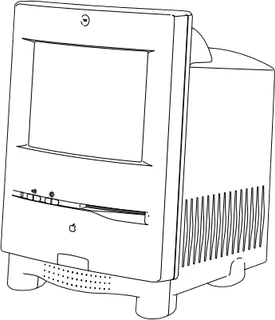
| In the box | Original Japanese system software 7.1 with System Enabler 403; Apple lists support through Mac OS 7.6.1. Current maker support gives 21 October 1993 as introduction, which does not establish first retail sale; released omitted. Apple states this system was not sold in the US. Performa 275 is a Japanese consumer bundle of this hardware, not a separate generation. The main image and additional views are original maker service illustrations, not press photographs; exact-model photographic coverage remains unresolved. | System 7.1 with System Enabler 404. Apple release dated 25 October 1993 states immediate US availability through selected retailers, higher-education campuses and the Apple Catalog; the Fall 1993 order catalogue and January 1994 MacUser article confirm it was sold. Maker press-release text preserved in November 1993 Mini’app’les newsletter |
More comparisons
- Apple Macintosh Performa 5400/160 vs Apple Macintosh TV
- Apple Macintosh Performa 6360 vs Apple Macintosh TV
- Apple Macintosh Performa 6400/180 vs Apple Macintosh TV
- Apple Macintosh Performa 6400/200 vs Apple Macintosh TV
- Apple Macintosh Color Classic II vs Apple Macintosh Performa 5400/160
- Apple Macintosh Color Classic II vs Apple Macintosh Performa 6360
- Apple Macintosh Color Classic II vs Apple Macintosh Performa 6400/180
- Apple Macintosh Color Classic II vs Apple Macintosh Performa 6400/200
- Apple Macintosh Color Classic II vs Apple Macintosh LC 580
- Apple Macintosh Color Classic II vs Apple Macintosh Performa 5200CD
- Apple Macintosh LC 580 vs Apple Macintosh TV
- Apple Macintosh Performa 5200CD vs Apple Macintosh TV
- Apple Macintosh Performa 5300CD vs Apple Macintosh TV
- Apple Macintosh Performa 6300CD vs Apple Macintosh TV
- Apple Macintosh Color Classic II vs Apple Macintosh Performa 5300CD
- Apple Macintosh Color Classic II vs Apple Macintosh Performa 6300CD