Apple Macintosh IIsi vs Apple Macintosh Performa 6400/180
Better figure, where one is clearly better
| AppleMacintosh IIsi | AppleMacintosh Performa 6400/180 | |
|---|---|---|
| Overview | ||
| Released | October 1990 | 1996 |
| Performance | ||
| Processor | 68030 20 MHz (Macintosh IIsi) | PowerPC 603e 180 MHz (Performa 6400) |
| CPU cores | 1 | 1 |
| Memory | 1 MB | 16 MB (better) |
| Storage | – | 1.6 GB |
| CPU | 20 MHz Motorola 68030 with integrated memory management and 0.5 KB L1 cache; 68882 floating-point coprocessor optional through an expansion adapter | 180 MHz PowerPC 603e with integrated floating-point unit, 32 KB L1 cache and a 64-bit 40 MHz bus. The 256 KB Apple High Performance Module L2 cache is optional, unlike the standard cache of the 6400/200. The shared Service Source calls the processor 603ev; the exact specification page and original brochure use 603e. |
| GPU | Built-in 8-bit colour video supports 512 × 384 and 640 × 480 using 64–320 KB of system RAM | 1 MB built-in video DRAM, not expandable; 640 × 480 and 800 × 600 at 16-bit colour, 832 × 624 and 1024 × 768 at 8-bit colour. A separate PCI graphics card is needed for additional capabilities. |
| Memory type | 1 MB soldered to the logic board plus four 30-pin SIMM slots in one matched bank; 100 ns memory and 1–17 MB total supported by Apple; 512 KB ROM | 8 MB soldered to the logic board and an 8 MB DIMM supplied; two 168-pin 64-bit fast-page-mode DIMM sockets support up to 136 MB total, with 70 ns or faster memory. |
| Storage type | Internal 1.44 MB floppy drive with SCSI hard-drive options of 40 or 80 MB; Apple does not document the paired RAM and drive configurations on its support sheet | 1.6 GB internal IDE hard drive, 1.44 MB SuperDrive floppy drive and tray-loading 8× CD-ROM. The shared service manual lists a 1.2 GB drive and AppleCD 600i for generic 6400 configurations; the exact 180 MHz support page and ordering brochure agree on 1.6 GB and 8×. |
| Expansion slots | One processor-direct slot can be used directly or with an optional NuBus adapter; no built-in NuBus slot or L2 cache | Two PCI 2.0 slots for 6.88-inch cards with Mac drivers; Communications Slot II occupied by the supplied modem, plus positions for optional video input and TV/FM tuner cards. One pre-cabled 5.25-inch internal SCSI bay. Optional Avid Cinema requires the Apple Video System and occupies one PCI slot; it is not supplied with the standard 180 MHz configuration. |
| Display | ||
| Screen | None built in | None built in |
| Connections | ||
| Ports | Headphone jack | Headphone jack |
| Front ports | – | 3.5 mm headphone output and volume buttons; optional infrared remote support. |
| Back ports | One Apple Desktop Bus port, DB-15 video, DB-19 external floppy, DB-25 SCSI, printer and modem serial ports, sound output and microphone input; no built-in Ethernet | DB-15 monitor output, ADB, DB-25 external SCSI, two GeoPort-compatible serial ports, 3.5 mm sound input compatible with PlainTalk microphones and line-level 3.5 mm speaker output. The supplied modem provides 28.8 Kbit/s data and 14.4 Kbit/s fax; replacing it with an Ethernet card provides wired networking. Optional video input handles composite and S-video NTSC, PAL or SECAM. |
| External displays | Built-in video supports an Apple colour display at 640 × 480 with 8-bit colour; a compatible expansion graphics card can extend display options | – |
| Speakers | Internal speaker, stereo 8-bit sound output and mono audio input | Built-in full-range monophonic speaker switches to subwoofer operation when external speakers are connected. 16-bit stereo input/output at 11.025, 22.05 or 44.1 kHz; SRS surround processing applies to rear sound output, not the front headphone jack. |
| Keyboard and mouse | – | Keyboard, mouse, cables and bundled applications listed for US order M5167LL/A; display, TV/FM tuner, Apple Video System, Avid Cinema and PC Compatibility Card are optional. Gallery image includes an optional monitor. |
| Design and power | ||
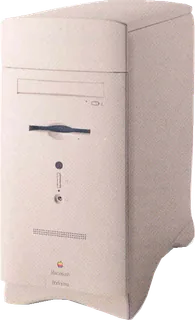
| Type | Compact | Tower |
| Weight | 4.5 kg | – |
| Width × depth × height | 315 × 378 × 102 mm | 198 × 428 × 406 mm |
| Operating system | macOS | macOS |
| Size and weight detail | Apple's 4 × 12.4 × 14.9 inch and 10 lb reference dimensions; metric fields are rounded conversions | Original brochure lists 40.6 × 19.8 × 42.8 cm (height × width × depth), matching the service manual. Weight is 20.18 kg without the monitor and varies with installed devices; the service manual explicitly excludes the CD-ROM drive. The technical booklet transposes depth and height labels. |
| Power supply | Maximum 160 W; 100–240 V AC, 50–60 Hz; 3.6 V lithium clock battery and keyboard soft power | Exact specification page and ordering brochure list 220 W maximum, 100–125 or 200–240 V AC at 47–63 Hz. The shared service manual agrees on 220 W maximum continuous but gives wider voltage bands; the original technical booklet instead states 140 W input and 98 W DC output. These conflicting ratings are retained rather than treated as measured consumption. |
| In the box | Original System Software 6.0.7. Apple lists 15 October 1990 as the introduction date; no separate first-sale day was found | Original System Software 7.5.3 with System Enabler 410 v1.1. Apple lists 5 August 1996 as introduction; the original 1996 ordering brochure and contemporary MacUser review establish sale in 1996, but a distinct first-sale month remains unresolved. |
More comparisons
- Apple Mac mini (M4 or M4 Pro) vs Apple Macintosh IIsi
- Apple Macintosh Performa 5400/160 vs Apple Macintosh Performa 6400/180
- Apple Macintosh Performa 6360 vs Apple Macintosh Performa 6400/180
- Apple Macintosh Performa 6400/180 vs Apple Power Macintosh 8200/120
- Apple Macintosh Performa 6400/180 vs Apple Power Macintosh 8500/132
- Apple Macintosh Performa 6400/180 vs Apple Power Macintosh 8500/150
- Apple Macintosh Performa 6400/180 vs Apple Macintosh Performa 6400/200
- Apple Macintosh LC 580 vs Apple Macintosh Performa 6400/180
- Apple Macintosh Performa 5200CD vs Apple Macintosh Performa 6400/180
- Apple Macintosh Performa 5300CD vs Apple Macintosh Performa 6400/180
- Apple Macintosh Performa 6300CD vs Apple Macintosh Performa 6400/180
- Apple Macintosh Performa 6400/180 vs Apple Power Macintosh 6200/75
- Apple Macintosh Performa 6400/180 vs Apple Power Macintosh 8200/100
- Apple Macintosh Performa 6400/180 vs Apple Macintosh Quadra 610 DOS Compatible
- Apple Macintosh LC 550 vs Apple Macintosh Performa 6400/180
- Apple Macintosh LC 575 vs Apple Macintosh Performa 6400/180