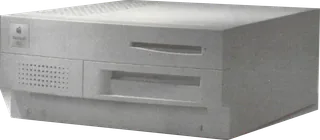
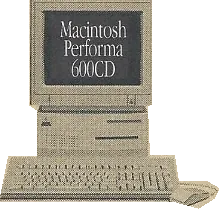
Apple Macintosh IIvi vs Apple Macintosh Performa 600
Better figure, where one is clearly better
| AppleMacintosh IIvi | AppleMacintosh Performa 600 | |
|---|---|---|
| Overview | ||
| Released | – | – |
| Performance | ||
| Processor | 68030 16 MHz (Macintosh Color Classic) | 68030 32 MHz (Macintosh Performa 600) |
| CPU cores | 1 | 1 |
| Memory | 4 MB or 5 MB | 4 MB or 5 MB |
| Storage | 40 MB to 160 MB | 160 MB |
| CPU | Nominal 16 MHz Motorola MC68030 with integrated paged memory management; Apple developer note gives the actual 15.6672 MHz clock. Optional MC68882 floating-point coprocessor socket; no onboard external RAM cache. The 32 MHz IIvx and Performa 600 are distinct models | Motorola 68030 advertised as 32 MHz; Apple TIL 10681 gives the exact 31.3344 MHz clock. Integrated paged memory management, optional socketed 68882 at the same clock, and no external RAM cache. This is distinct from the 16 MHz IIvi and the IIvx with its standard FPU and 32 KB cache |
| GPU | 512 KB dedicated VRAM standard, expandable to 1 MB with 100 ns VRAM SIMMs. 512 KB supports 16-bit colour at 512 × 384 or 8-bit at 640 × 480; 1 MB supports 16-bit at 640 × 480. The 5/80CD configuration includes 1 MB VRAM | Performa 600 has 512 KB VRAM; 600CD includes 1 MB. Supports 640 × 480 at 8-bit colour with 512 KB, or 16-bit colour with 1 MB; 512 × 384 RGB supports 16-bit colour with either capacity. Optional NuBus display cards support other monitors |
| Memory type | 4 MB soldered DRAM plus four 30-pin SIMM slots, filled in groups of four; supports up to 68 MB. 1 MB ROM; minimum SIMM speed 80 ns | 4 MB soldered DRAM and four 30-pin SIMM slots, expandable to 68 MB with 80 ns or faster fast-page-mode memory. All four expansion SIMMs must have matching capacity and speed. 1 MB ROM and 256-byte parameter RAM |
| Storage type | 1.44 MB SuperDrive and internal SCSI hard disk. Exact UK brochure offers 4/40, 4/80 and 5/80CD; Apple Europe/Pacific launch table also lists 4/160. The 5/80CD has AppleCD 300i double-speed CD-ROM and 1 MB VRAM. Other configurations have an empty 5.25-inch half-height drive bay | Both original brochure configurations include a 160 MB internal SCSI hard disk and 1.4 MB SuperDrive. 600CD adds an AppleCD 300i double-speed CD-ROM drive with multisession Photo CD support; standard 600 leaves its half-height 5.25-inch bay free. Apple supports 80–400 MB internal hard drives; this supported range is not presented as extra factory configurations |
| Expansion slots | Three internal NuBus slots and a separate accelerator slot. Room for three internal storage devices, including the optional internal CD-ROM; Ethernet requires a card | Three NuBus slots and a separate processor-direct accelerator slot. No built-in Ethernet; LocalTalk uses the serial ports. Internal SCSI expansion bay and support for up to six external SCSI devices |
| Display | ||
| Screen | None built in | None built in |
| Connections | ||
| Ports | Headphone jack | Headphone jack |
| Back ports | Two ADB, DB-15 video, DB-25 SCSI, two RS-232/RS-422 mini-DIN-8 serial ports, sound input and sound output. No built-in Ethernet, USB or external floppy connector | Two ADB ports, DB-15 video, DB-25 SCSI, two mini-DIN-8 RS-232/RS-422 serial ports, mono sound input and sound output. Serial maximum 230.4 kbit/s, or 0.920 Mbit/s with an external clock |
| External displays | Built-in video supports Macintosh 12-inch monochrome/RGB, AppleColor High-Resolution RGB and Macintosh Color displays. Larger or higher-colour displays need an appropriate NuBus video card; monitor and keyboard sold separately | Separate display required; the original brochure shows an optional 14-inch Performa Plus Display. Built-in video also supports the published Apple 12-inch monochrome/RGB, AppleColor High-Resolution RGB and Macintosh Color displays, plus 640 × 480 VGA with an appropriate adaptor |
| Speakers | Mono Macintosh sound input/output and an internal speaker, with stereo compact-disc playback through the sound-output jack. Supplied electret omnidirectional microphone | Computer-generated audio is mono, sent to both channels of a stereo output device. Audio CDs provide stereo at the sound-output socket, or mono through the built-in speaker. Electret omnidirectional microphone supplied |
| Keyboard and mouse | Apple Desktop Bus mouse and microphone; separate monitor and keyboard | Apple Extended Keyboard II, ADB mouse and microphone. Display sold separately; original Apple brochure photographs show the optional display with each configuration |
| Design and power | ||
| Type | Compact | Compact |
| Weight | 11.3 kg | 11.3 kg |
| Width × depth × height | 330 × 419 × 152 mm | – |
| Operating system | macOS | macOS |
| Size and weight detail | Published UK brochure metric measurements retained: 15.2 cm high, 33.0 cm wide and 41.9 cm deep; 11.3 kg varies with installed internal devices | Apple specifies 25 lb (11.3 kg), 6 inches high, 13 inches wide and 16.5 inches deep. TIL 10681 prints an inconsistent metric height of 152 cm beside 6 inches; dimensions_mm is omitted rather than silently correcting that source |
| Power supply | UK Apple brochure gives 100–240 V AC, 50–60 Hz single phase and 112 W maximum excluding monitor. Archived Apple support lists 230 W maximum; shared service manual lists 200 W AC and 112 W DC. Preserve these different ratings rather than treating them as measured consumption. 3.6 V lithium clock backup battery | Apple TIL 10681 states 100–240 V AC, 50–60 Hz and 112 W maximum excluding monitor; it also gives 112 W maximum DC output. Current archived support lists 230 W maximum and shared Service Source gives 200 W AC and 112 W DC. These differing ratings are retained without selecting a single headline consumption figure |
| In the box | System 7.1 and System Enabler 001, documentation, mouse and microphone; keyboard and monitor sold separately. Apple announced the IIvi on 19 October 1992 for selected countries outside the US. UK ordering brochure is printed September 1992; neither its print date nor introduction establishes first actual retail sale, so released is omitted | System 7.1P for the Performa 600, At Ease, Macintosh PC Exchange and application software varying by retailer. Apple introduced it on 14 September 1992; the original launch planned later availability, and an actual first retail date has not been independently established, so released is omitted |
More comparisons
- Apple Macintosh IIvi vs Apple Macintosh Performa 5400/160
- Apple Macintosh IIvi vs Apple Macintosh Performa 6360
- Apple Macintosh IIvi vs Apple Macintosh Performa 6400/180
- Apple Macintosh IIvi vs Apple Macintosh Performa 6400/200
- Apple Macintosh Performa 5400/160 vs Apple Macintosh Performa 600
- Apple Macintosh Performa 600 vs Apple Macintosh Performa 6360
- Apple Macintosh Performa 600 vs Apple Macintosh Performa 6400/180
- Apple Macintosh Performa 600 vs Apple Macintosh Performa 6400/200
- Apple Macintosh IIvi vs Apple Macintosh LC 580
- Apple Macintosh IIvi vs Apple Macintosh Performa 5200CD
- Apple Macintosh IIvi vs Apple Macintosh Performa 5300CD
- Apple Macintosh IIvi vs Apple Macintosh Performa 6300CD
- Apple Macintosh LC 580 vs Apple Macintosh Performa 600
- Apple Macintosh Performa 5200CD vs Apple Macintosh Performa 600
- Apple Macintosh Performa 5300CD vs Apple Macintosh Performa 600
- Apple Macintosh Performa 600 vs Apple Macintosh Performa 6300CD