Apple Macintosh LC III+ vs Apple Macintosh Performa 6400/200
Better figure, where one is clearly better
| AppleMacintosh LC III+ | AppleMacintosh Performa 6400/200 | |
|---|---|---|
| Overview | ||
| Released | – | 1996 |
| Performance | ||
| Processor | 68030 33 MHz (Macintosh LC III+) | PowerPC 603e 200 MHz (Macintosh Performa 6400/200) |
| CPU cores | 1 | 1 |
| Memory | 4 MB | 16 MB or 32 MB (better) |
| Storage | – | 2.4 GB |
| CPU | Motorola 68030 at 33 MHz with integrated memory management and 32-bit data path; optional socketed 68882, 0.5 KB first-level cache and no second-level cache. Apple Service Guide identifies the Performa 460, 466 and 467 as the 33 MHz LC III family; these aliases are not separate product records | 200 MHz PowerPC 603e with integrated floating-point unit, 32 KB L1 cache, 256 KB L2 cache and 64-bit data path at 40 MHz |
| GPU | 512 KB built-in VRAM, expandable to 768 KB with a 256 KB SIMM. A 512 KB VRAM SIMM may be fitted but only 256 KB is used. At 640 × 480 and 832 × 624, standard memory supports 8-bit colour; upgraded VRAM supports 16-bit colour | Built-in video with 1 MB DRAM supports 640 × 480 at 16-bit colour and 1024 × 768 at 8-bit colour |
| Memory type | 4 MB soldered RAM plus one 72-pin SIMM socket, maximum 36 MB. Apple specifies 80 ns minimum memory speed and SIMM capacities 1, 2, 4, 8, 16 or 32 MB. 1 MB ROM | 8 MB on the logic board, two 168-pin DIMM slots and 16–136 MB total supported by Apple |
| Storage type | Apple LC III+ support lists 80–160 MB internal SCSI hard disks and an automatic-inject 1.44 MB floppy drive. Exact original RAM/drive configuration pairing is unresolved, so structured storage capacity is omitted. Apple July 1994 Service Guide gives conflicting 80 MB and 180 MB values for Performa 460 in different tables; those are not silently assigned to this model. Performa 460-series bundles use a manual-insert SuperDrive | 2.4 GB internal IDE hard drive, 1.44 MB floppy drive and 8× CD-ROM drive |
| Expansion slots | One LC III processor-direct expansion slot. Ethernet requires an expansion card; no built-in Ethernet | Two PCI slots plus Communications Slot II, TV and video input positions; the Video Editing Edition's Avid Cinema card uses one PCI slot |
| Display | ||
| Screen | None built in | None built in |
| Connections | ||
| Ports | Headphone jack | Headphone jack |
| Back ports | One ADB, DB-15 video, DB-25 SCSI, printer and modem serial ports, omnidirectional microphone input and speaker output. No external floppy connector | DB-15 monitor output, Apple Desktop Bus, external DB-25 SCSI, two GeoPort serial connectors, PlainTalk microphone input and speaker output; front headphone jack |
| Speakers | – | Built-in subwoofer in the tower enclosure, as described by Apple Directions |
| External displays | Separate monitor required. Apple specifies 512 × 384 and 640 × 400 at 16-bit colour, plus 640 × 480 and 832 × 624 with colour depth depending on VRAM capacity | – |
| Keyboard and mouse | Performa 460-series bundles include an ADB keyboard and mouse and may include a monitor and modem; the museum photo shows the Performa 460-labelled computer alone. Exact LC III+ supplied-accessory bundle is unpublished in the recovered support record | – |
| Design and power | ||
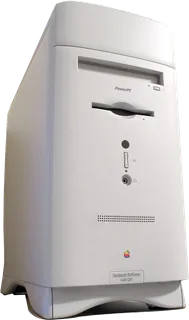
| Type | Compact | Tower |
| Operating system | macOS | macOS |
| Size and weight detail | Apple LC III+ record publishes 8.8 lb and 2.9 inches high × 12.2 inches wide × 15.3 inches deep. Unpublished metric measurements are omitted | Apple lists 16 × 7.8 × 16.9 inches (height × width × depth) and 44.5 lb |
| Power supply | Apple LC III+ support lists 100–240 V, 47–63 Hz, 50 W maximum, 0.42 A and 171 BTU/hour. These are maker ratings, not measured consumption. 3.6 V lithium clock battery | Apple lists a 220 W maximum, 100–125 or 200–240 V AC at 47–63 Hz |
| In the box | Original System 7.1 with System Enabler 003 v1.1. Apple introduction date 18 October 1993 is not established as an actual first retail sale, so released is omitted | Apple Directions lists a standard 16 MB configuration and a 32 MB Video Editing Edition with Avid Cinema hardware, both with 2.4 GB storage. Original System Software 7.5.3. Apple lists 5 August 1996 as introduction; a distinct maker first-sale date was not established. |
More comparisons
- Apple Mac mini (M4 or M4 Pro) vs Apple Macintosh Performa 6400/200
- Apple Macintosh Performa 5400/160 vs Apple Macintosh Performa 6400/200
- Apple Macintosh Performa 6360 vs Apple Macintosh Performa 6400/200
- Apple Macintosh Performa 6400/180 vs Apple Macintosh Performa 6400/200
- Apple Macintosh Performa 6400/200 vs Apple Power Macintosh 8500/180
- Apple Macintosh Performa 6400/200 vs Apple Power Macintosh 9500/150
- Apple Macintosh Performa 6400/200 vs Apple Power Macintosh 9500/180MP
- Apple Macintosh LC 580 vs Apple Macintosh Performa 6400/200
- Apple Macintosh Performa 5200CD vs Apple Macintosh Performa 6400/200
- Apple Macintosh Performa 5300CD vs Apple Macintosh Performa 6400/200
- Apple Macintosh Performa 6300CD vs Apple Macintosh Performa 6400/200
- Apple Macintosh Performa 6400/200 vs Apple Power Macintosh 6200/75
- Apple Macintosh Performa 6400/200 vs Apple Power Macintosh 9500/200
- Apple Macintosh Performa 6400/200 vs Apple Power Macintosh 9500/132
- Apple Macintosh Performa 6400/200 vs Apple Macintosh Quadra 610 DOS Compatible
- Apple Macintosh LC 550 vs Apple Macintosh Performa 6400/200