Apple Power Macintosh G3 All-In-One vs Apple Power Mac G5 (Early 2005)
Better figure, where one is clearly better
| ApplePower Macintosh G3 All-In-One | ApplePower Mac G5 (Early 2005) | |
|---|---|---|
| Overview | ||
| Released | – | April 2005 |
| Performance | ||
| Processor | PowerPC G3 233 MHz (Power Macintosh G3 Desktop) or PowerPC G3 266 MHz (Power Macintosh G3 Desktop) | 2 × PowerPC G5 2000 MHz (Power Mac Early 2005), 2 × PowerPC G5 2300 MHz (Power Mac Early 2005) or 2 × PowerPC G5 2700 MHz (Power Mac Early 2005) |
| CPU cores | 1 | 2 |
| Graphics | Built-in graphics accelerator (2 MB SGRAM; revision unpublished) | ATI Radeon 9600 (128 MB) or ATI Radeon 9650 (256 MB) |
| Memory | 32 MB | 512 MB, 4 GB or 8 GB (better) |
| Storage | 4 GB | 160 GB to 250 GB (better) |
| CPU | 233 or 266 MHz PowerPC G3 with 512 KB backside L2 cache at 117 or 133 MHz, a 66 MHz system bus and 64 KB L1 cache split equally between data and instructions. Supplier is not assigned without exact maker evidence. | Two physical PowerPC G5 processors at 2, 2.3 or 2.7 GHz, each with 512 KB L2 cache and no L3 cache. Front-side bus per processor is 1, 1.15 or 1.35 GHz. The dual 2.7 GHz model uses liquid cooling. |
| GPU | Built-in 2D/3D graphics accelerator with 2 MB SGRAM, expandable to 6 MB using the maker-supported 4 MB SGRAM module. Exact graphics-chip revision is unpublished in the read maker datasheet, so later RAGE Pro revisions are not assumed for every unit. | Dual 2 and 2.3 GHz: ATI Radeon 9600 with 128 MB DDR and two single-link DVI outputs. Dual 2.7 GHz: ATI Radeon 9650 with 256 MB GDDR3, one single-link and one dual-link DVI output. Optional NVIDIA GeForce 6800 Ultra DDL with 256 MB has two dual-link DVI outputs and occupies the adjacent PCI slot. |
| Memory type | 32 MB SDRAM standard, up to 384 MB across three 168-pin DIMM slots. Apple Service Source specifies 3.3 V, 64-bit, 10 ns unbuffered SDRAM. Its prose about 64 MB DIMMs conflicts with its 384 MB/three 128 MB DIMM maximum; the explicit published maximum is retained. Factory BTO memory options included 64 or 96 MB. | Stock 512 MB PC3200 DDR400, installed in matched pairs. Dual 2 GHz has four DIMM slots and a 4 GB maximum. Dual 2.3 and 2.7 GHz have eight slots and an 8 GB maximum. Configuration rows keep the stock drives and graphics at base and maximum memory. |
| Storage type | Both published 233 and 266 MHz base configurations have a 4 GB IDE disk, 24× maximum CD-ROM and 1.44 MB floppy drive. A 6 GB disk and 100 MB SCSI Zip drive were optional. Service Source also mentions a 2 GB disk in one table, unlike the exact base configuration datasheet; that unsupported base pairing is not assumed. | Stock 160 GB on dual 2 GHz and 250 GB on dual 2.3/2.7 GHz, all 7200 rpm Serial ATA. Two internal drive bays; optional 250 or 400 GB drives, including two 400 GB drives. One optical bay with 16x SuperDrive supporting DVD±R and up to 4x dual-layer DVD+R recording. |
| Expansion slots | Three 7-inch PCI 2.1 slots with Macintosh drivers required; three memory slots and a PERCH I/O-card slot. Optional modem fits the I/O card. The chassis has a slide-out logic-board tray. PCI card power restrictions are three 15 W cards, two 25 W cards, or one 15 W and one 25 W card. | AGP 8x Pro graphics slot. Dual 2 GHz has three 64-bit 33 MHz PCI slots. Dual 2.3 and 2.7 GHz have PCI-X: two 100 MHz slots and one 133 MHz slot. |
| Display | ||
| Screen size | 15″ | None built in |
| Resolution | 1024 × 768 | – |
| Panel | CRT | – |
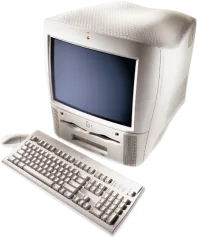
| Display type | 15-inch multiple-scan colour CRT with 13.8-inch viewable diagonal and 0.28 mm dot pitch; tilt and swivel. The supported 1024 × 768 mode is analogue, not a fixed pixel matrix. Maker advertises refresh up to 85 Hz without assigning that maximum to the highest resolution, so headline refresh is omitted. Service Source specifies 16-bit colour at 1024 × 768; the datasheet uses inconsistent colour-depth labels. | – |
| Connections | ||
| Ports | Ethernet, 3 × headphone jack | 3 × USB-A, Ethernet, headphone jack |
| Ethernet | 0.01 Gb/s | 1 Gb/s (better) |
| External displays | – | Up to 2 |
| Front ports | – | USB 2.0, FireWire 400 and headphone minijack. |
| Back ports | 10BASE-T Ethernet, one ADB, one external DB-25 SCSI, two GeoPort-compatible serial ports, rear stereo audio input/output and DB-15 monitor connector. Three headphone-compatible audio outputs total: two at the front and one at the rear. No built-in USB, FireWire or AirPort support. The optional Fast Ethernet PCI card does not change the standard network figure. | Two USB 2.0, FireWire 800, FireWire 400, Gigabit Ethernet, optical S/PDIF input/output and analogue audio line-in/out. Three chassis USB ports in total, plus keyboard USB 1.1 ports. AirPort Extreme, Bluetooth 2.0 + EDR and a V.92 modem are optional. |
| External displays | DB-15 external monitor connector documented by the exact datasheet and rear service diagram; the current support summary instead labels video as none. Display mirroring is described by the contemporary Washington Apple Pi test, not an assumed extended desktop. | Two displays in extended desktop or mirrored modes. Radeon 9600 supports two displays up to 1920 × 1200; Radeon 9650 supports one 30-inch Apple Cinema HD Display via dual-link DVI. Optional 6800 Ultra DDL supports two 30-inch displays. DVI-to-VGA adapter included. |
| Speakers | Built-in stereo speakers; 16-bit stereo audio input/output at 22.05 or 44.1 kHz | Built-in speaker; analogue and optical audio connections. |
| Microphones | Built-in microphone | – |
| Keyboard and mouse | AppleDesign Keyboard and ADB Mouse II | Apple Keyboard, Apple Mouse, USB extension cable and DVI-to-VGA adapter. |
| Design and power | ||
| Type | All-in-one | Tower |
| Weight | 26.8 kg | 20.2 kg (better) |
| Width × depth × height | 409 × 457 × 505 mm | – |
| Operating system | macOS | macOS |
| Size and weight detail | Headline dimensions and 26.8 kg weight follow the exact May 1998 maker datasheet. Apple Service Source gives 498 × 402 × 450 mm and 27 kg with inconsistent inch conversions; the current support summary gives 19.92 × 16.08 × 18 inches and 59.5 lb. Weight varies with installed devices. | The exact maker sheet labels height as 47.5 cm, width 20.6 cm and depth 51.1 cm. Earlier G5 sheets label height/depth in the opposite order; main dimensions are omitted because those published axes conflict. Maker reference weight is 20.2 kg and varies with configuration. |
| Power supply | Automatically configured 90–264 V AC, 50–60 Hz, single phase | 450 W on dual 2/2.3 GHz; 600 W on dual 2.7 GHz, as stated by the maker. |
| Materials | – | Aluminium enclosure. |
| Power use | Maximum continuous electrical input 300 W; Service Source separately lists 200 W peak output, which is not acoustic output | – |
| In the box | Mac OS 8.1 in the contemporary datasheet and Service Source; the current archived support summary instead gives original system software 8.0. The model was offered for the education market. Apple support labels introduction as 3 April 1998; the dated May 1998 datasheet describes currently available configurations and BTO ordering from 6 May. An exact first retail delivery date is not established, so released is omitted rather than substituting introduction or BTO dates. The 266 MHz base variant adds audio/video I/O plus Avid Cinema and QuickTime 3 Pro; the 233 MHz base is audio I/O only. Optional AV hardware supports composite and S-video inputs/outputs with mode restrictions in Service Source. | Mac OS X Tiger and iLife ’05. Apple’s 27 April 2005 launch says these models are available “this week”; first sale is kept at April precision rather than treating the announcement as a confirmed delivery day. The older single 1.8 GHz model retained in the launch range is represented separately as Late 2004. |

More comparisons
- Apple Mac Studio (M4 Max or M3 Ultra) vs Apple Power Mac G5 (Early 2005)
- Apple Mac Pro (M2 Ultra) vs Apple Power Mac G5 (Early 2005)
- Apple Mac Pro (Early 2008) vs Apple Power Mac G5 (Early 2005)
- Apple Mac Pro (2006) vs Apple Power Mac G5 (Early 2005)
- Apple Power Mac G5 (Early 2005) vs Apple Power Mac G5 (Late 2005)
- Apple Power Macintosh G3 All-In-One vs Apple Power Mac G5 (Late 2005)
- Apple iMac G5 (20-inch, Ambient Light Sensor) vs Apple Power Mac G5 (Early 2005)
- Apple Power Mac G5 (2003) vs Apple Power Mac G5 (Early 2005)
- Apple Power Mac G5 (Early 2005) vs Apple Power Mac G5 (June 2004)
- Apple Power Mac G5 (Early 2005) vs Apple Power Mac G5 (Late 2004)
- Apple Power Mac G4 (Mirrored Drive Doors 2003) vs Apple Power Mac G5 (Early 2005)
- Apple Power Mac G4 (FW800) vs Apple Power Mac G5 (Early 2005)
- Apple Power Mac G4 (Mirrored Drive Doors 2002) vs Apple Power Mac G5 (Early 2005)
- Apple Power Mac G4 (QuickSilver 2002) vs Apple Power Mac G5 (Early 2005)
- Apple Power Mac G4 (QuickSilver 2001) vs Apple Power Mac G5 (Early 2005)
- Apple Power Mac G4 (Digital Audio) vs Apple Power Mac G5 (Early 2005)