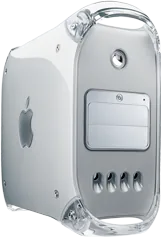
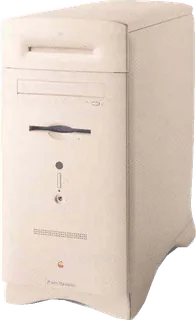
Apple Power Mac G4 (FW800) vs Apple Power Macintosh 6500/275
Better figure, where one is clearly better
| ApplePower Mac G4 (FW800) | ApplePower Macintosh 6500/275 | |
|---|---|---|
| Overview | ||
| Released | January 2003 | 1997 |
| Performance | ||
| Processor | PowerPC G4 1000 MHz (Power Mac FW800), 2 × PowerPC G4 1250 MHz (Power Mac FW800) or 2 × PowerPC G4 1420 MHz (Power Mac FW800) | PowerPC 603e 275 MHz (Power Macintosh 6500) |
| CPU cores | 1 or 2 | 1 |
| Graphics | NVIDIA GeForce4 MX (64 MB) or ATI Radeon 9000 Pro (64 MB) | – |
| Memory | 256 MB, 512 MB or 2 GB (better) | 32 MB or 48 MB |
| Storage | 60 GB to 120 GB (better) | 4 GB to 6 GB |
| CPU | Single 1 GHz, dual 1.25 GHz or dual 1.42 GHz PowerPC G4; each physical processor has 256 KB on-chip L2 cache. L3 cache is 1 MB on the single 1 GHz, 1 MB per processor on dual 1.25 GHz and 2 MB per processor on dual 1.42 GHz. Bus is 133 MHz on the single model, 167 MHz on dual models. | 275 MHz PowerPC 603e with integrated floating-point unit, 32 KB L1 cache, 512 KB L2 cache and a 64-bit 50 MHz bus. The shared service specifications use the name 603ev; the exact support page and original brochure use 603e. |
| GPU | Single 1 GHz: NVIDIA GeForce4 MX with 64 MB DDR. Dual 1.25/1.42 GHz: ATI Radeon 9000 Pro with 64 MB DDR. Optional NVIDIA GeForce4 Titanium and ATI Radeon 9700 Pro, each 128 MB DDR; independent CTO options stay in details. | ATI 3D RAGE II with 2 MB built-in SGRAM, supporting QuickDraw 2D/3D and QuickTime/MPEG-1 acceleration; Apple's exact support table gives 24-bit colour through 832 × 624, 16-bit through 1152 × 870 and 8-bit at 1280 × 1024. The brochure's 24-bit headline ends at 800 × 600. |
| Memory type | Single 1 GHz: 256 MB PC2100 DDR at 266 MHz; dual 1.25 GHz: 256 MB PC2700 DDR at 333 MHz; dual 1.42 GHz: 512 MB PC2700. Four DIMM slots support up to 2 GB. Configurations retain stock drives and GPUs at base and maximum supported memory. | Original Creative Studio supplies 32 MB in two 168-pin DIMM sockets, with no soldered system RAM; up to 128 MB using 5 V buffered EDO DIMMs. Later Americas Small Office configurations supply 48 MB. The original brochure and service specify 60 ns or faster EDO memory, while the exact support database lists 70 ns. The service narrative calls 48 MB generic 275 memory, whereas its regional tables and original brochure identify 32 MB configurations. |
| Storage type | Stock 60/80/120 GB 7200 rpm Ultra ATA/100 drives on 1/1.25/1.42 GHz respectively. Lower models have Combo DVD-ROM/CD-RW; top model has SuperDrive (DVD-R 4x, CD-R 16x). Four bays support two ATA/100 and two ATA/66 drives; two optical bays, one occupied. Optional 180 GB drive, SuperDrive on lower models and second Combo drive are not assumed in every configuration. | Original US Creative Studio M5854LL/A and Canadian launch configuration have a 4 GB IDE drive, 12× tray-loading CD-ROM and 1.44 MB floppy, without a Zip drive. Later Americas configurations documented by Apple have 6 GB, 24× CD-ROM, Zip and a 56.6 Kbit/s Apple/GV modem with Mac OS 8.0; a 32 MB Home bundle and 48 MB Small Office bundle are distinguished. An Americas education configuration has 32 MB, Zip, video input, NTSC output and Ethernet. Asia/Pacific configurations include 32 MB, 24× CD-ROM, video input and Avid Cinema. Gallery photographs show the Zip-equipped configuration. |
| Expansion slots | Four open full-length 64-bit 33 MHz PCI slots and AGP 4x graphics slot. | Two PCI 2.0 slots for approximately 7-inch cards with Mac drivers; the original Creative Studio Avid Cinema card occupies one, leaving one free. Communications Slot II, video-input slot and TV/FM tuner position are present. The modem occupies the communications slot; the original Creative Studio has a spare pre-cabled 5.25-inch SCSI bay, used by Zip in later configurations. Apple specifies five external SCSI devices with Zip fitted, six otherwise. |
| Display | ||
| Screen | None built in | None built in |
| Connections | ||
| Ports | 2 × USB-A, Ethernet, headphone jack | Headphone jack |
| Ethernet | 1 Gb/s | – |
| External displays | Up to 2 | – |
| Front ports | Headphone minijack and built-in speaker. | 3.5 mm headphone output and volume buttons; infrared receiver for the remote supplied with the Creative Studio TV/FM tuner. |
| Back ports | One FireWire 800 and two FireWire 400 (15 W total), two chassis USB 1.1, Gigabit Ethernet, V.92 modem, ADC/DVI, audio line-in/out and Apple Pro Speakers minijack. Maker four-port USB total includes two ports on the keyboard. Optional AirPort Extreme 54 Mbps 802.11g card and Bluetooth 1.1 module. | DB-15 monitor output, ADB, DB-25 external SCSI, two GeoPort-compatible serial connectors, PlainTalk-compatible sound input and line-level speaker output. The installed modem leaves one serial port available. Original Creative Studio has a 33.6 Kbit/s data/voice modem and 14.4 Kbit/s fax; the communications slot can instead take Ethernet. The exact support database lists 10BASE-T and the service documents an education Ethernet configuration, but the original Creative Studio supplies a modem. Its Apple Video System supports NTSC, PAL and SECAM input; Avid Cinema provides video editing and NTSC/PAL output. |
| External displays | Two displays in extended desktop or mirroring modes. ADC and DVI connectors with included DVI-to-VGA adapter; digital up to 1920 × 1200, analogue up to 1600 × 1200. A second ADC display needs a separately sold adapter. | – |
| Speakers | Built-in speaker; optional Apple Pro Speakers. | Built-in full-range monophonic speaker acts as a subwoofer when external speakers are connected; balance adjustment operates only with external speakers. 16-bit stereo input/output and SRS 3D surround processing. |
| Keyboard and mouse | Apple Pro Keyboard, Apple Pro Mouse, USB keyboard extension, DVI-to-VGA adapter and modem cable. | Original US Creative Studio includes keyboard, mouse, cables, Apple Video System, TV/FM Radio System, Avid Cinema hardware/software and creative applications; monitor is sold separately. Later regional Home and Small Office configurations have different software and Zip hardware. The maker primary and gallery show a Zip-equipped 6500 family configuration; the original Creative Studio 4 GB configuration does not include Zip. |
| Design and power | ||
| Type | Tower | Tower |
| Weight | 19.1 kg | – |
| Width × depth × height | 227 × 468 × 432 mm | 198 × 428 × 406 mm |
| Operating system | macOS | macOS |
| Size and weight detail | Maker reference 19.1 kg varies with configuration and manufacturing. Height 43.2 cm, width 22.7 cm, depth 46.8 cm. | Maker brochure gives 40.6 × 19.8 × 42.8 cm (height × width × depth) and 20.2 kg, varying with installed devices. The shared service manual gives 20.18 kg without the CD-ROM; standard complete-unit weight remains unresolved and the headline mass is omitted. Gallery monitor is optional. |
| Power supply | 100–125 V or 200–240 V AC, 50–60 Hz; maximum current 6.5 A at low voltage or 7.5 A at high voltage. No wattage is supplied by this sheet. | Exact support database and original brochure give 220 W maximum continuous, 100–125 or 200–240 V AC at 47–63 Hz. The shared Service Source instead gives 140 W for the 6500 and 90–130 or 180–264 V; the conflicting ratings are retained, and neither is treated as measured operating consumption. |
| In the box | Mac OS X with Classic environment rather than native Mac OS 9 boot; iLife and productivity software. Single 1 GHz and dual 1.25 GHz were available on 28 January 2003; dual 1.42 GHz was announced for the following month and subsequently reviewed. Its later availability does not change the generation’s first on-sale date. | Exact support page lists original software 7.6.1; later regional configurations use Mac OS 8.0. Apple lists 4 April 1997 as introduction, while its Canadian announcement promises limited 275/300 supply later that spring. The 1997 ordering brochure and contemporary shipping-system list establish retail sale in 1997, but the actual first-sale month remains unresolved. |
More comparisons
- Apple Mac mini (M4 or M4 Pro) vs Apple Power Mac G4 (FW800)
- Apple Mac Pro (2006) vs Apple Power Mac G4 (FW800)
- Apple Power Mac G4 (FW800) vs Apple Power Mac G5 (Late 2005)
- Apple Power Mac G5 (Late 2005) vs Apple Power Macintosh 6500/275
- Apple Power Mac G4 (FW800) vs Apple Power Mac G5 (Early 2005)
- Apple Power Mac G5 (Early 2005) vs Apple Power Macintosh 6500/275
- Apple Power Mac G4 (FW800) vs Apple Power Mac G5 (Late 2004)
- Apple Power Mac G5 (Late 2004) vs Apple Power Macintosh 6500/275
- Apple Power Mac G4 (FW800) vs Apple Power Mac G5 (June 2004)
- Apple Power Mac G5 (June 2004) vs Apple Power Macintosh 6500/275
- Apple Power Mac G4 (FW800) vs Apple Power Mac G5 (2003)
- Apple Power Mac G5 (2003) vs Apple Power Macintosh 6500/275
- Apple Power Mac G4 (FW800) vs Apple Power Mac G4 (Mirrored Drive Doors 2003)
- Apple Power Mac G4 (Mirrored Drive Doors 2003) vs Apple Power Macintosh 6500/275
- Apple iMac G4 (17-inch, Early 2003) vs Apple Power Mac G4 (FW800)
- Apple Power Mac G4 (FW800) vs Apple Power Mac G4 (Mirrored Drive Doors 2002)