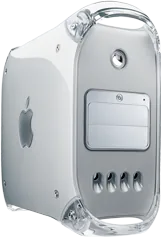
Apple Power Mac G4 (FW800) vs Apple Power Macintosh 7200/100
Better figure, where one is clearly better
| ApplePower Mac G4 (FW800) | ApplePower Macintosh 7200/100 | |
|---|---|---|
| Overview | ||
| Released | January 2003 | 1996 |
| Performance | ||
| Processor | PowerPC G4 1000 MHz (Power Mac FW800), 2 × PowerPC G4 1250 MHz (Power Mac FW800) or 2 × PowerPC G4 1420 MHz (Power Mac FW800) | PowerPC 601 100 MHz (Power Macintosh 7200/100) |
| CPU cores | 1 or 2 | 1 |
| Graphics | NVIDIA GeForce4 MX (64 MB) or ATI Radeon 9000 Pro (64 MB) | – |
| Memory | 256 MB, 512 MB or 2 GB (better) | 8 MB |
| Storage | 60 GB to 120 GB (better) | 800 MB |
| CPU | Single 1 GHz, dual 1.25 GHz or dual 1.42 GHz PowerPC G4; each physical processor has 256 KB on-chip L2 cache. L3 cache is 1 MB on the single 1 GHz, 1 MB per processor on dual 1.25 GHz and 2 MB per processor on dual 1.42 GHz. Bus is 133 MHz on the single model, 167 MHz on dual models. | 100 MHz PowerPC 601 with integrated floating-point unit, 32 KB L1 cache and 50 MHz processor bus. Exact improved-model developer table lists no fitted L2 cache for the 7200/100; the shared maker catalogue documents an optional 256 KB L2 cache. The developer note introductory narrative contains a 7600/100/604 typo; its explicitly labelled processor/configuration tables establish the 7200/100 as a 601 model. |
| GPU | Single 1 GHz: NVIDIA GeForce4 MX with 64 MB DDR. Dual 1.25/1.42 GHz: ATI Radeon 9000 Pro with 64 MB DDR. Optional NVIDIA GeForce4 Titanium and ATI Radeon 9700 Pro, each 128 MB DDR; independent CTO options stay in details. | 1 MB VRAM standard, expandable to 4 MB. Original Apple catalogue describes a 32-bit graphics data path with 1 MB and 64-bit with 2 MB. It supports 24-bit colour on 16-inch displays with 2 MB and on 21-inch displays with 4 MB; exact modes depend on installed VRAM and a compatible external monitor. |
| Memory type | Single 1 GHz: 256 MB PC2100 DDR at 266 MHz; dual 1.25 GHz: 256 MB PC2700 DDR at 333 MHz; dual 1.42 GHz: 512 MB PC2700. Four DIMM slots support up to 2 GB. Configurations retain stock drives and GPUs at base and maximum supported memory. | Exact April 1996 improved-model developer table lists 8 MB RAM in four 168-pin DIMM slots; the shared May 1996 7200/100 and 7200/120 catalogue describes 8 MB or 16 MB family configurations and expansion to 256 MB. No exact 100 MHz model 16 MB factory configuration is inferred from the combined table. |
| Storage type | Stock 60/80/120 GB 7200 rpm Ultra ATA/100 drives on 1/1.25/1.42 GHz respectively. Lower models have Combo DVD-ROM/CD-RW; top model has SuperDrive (DVD-R 4x, CD-R 16x). Four bays support two ATA/100 and two ATA/66 drives; two optical bays, one occupied. Optional 180 GB drive, SuperDrive on lower models and second Combo drive are not assumed in every configuration. | Exact developer and original Apple support configuration tables list an 800 MB hard disk for the 7200/100. The joint May 1996 7200/100 and 7200/120 catalogue instead lists 1.2 GB with regional configuration wording; that unresolved family-level difference is not assigned as another exact 100 MHz configuration. A built-in CD-ROM is confirmed for all improved models; the joint catalogue gives quadruple-speed CD-ROM and Apple SuperDrive floppy. One additional 3.5-inch storage-device bay. |
| Expansion slots | Four open full-length 64-bit 33 MHz PCI slots and AGP 4x graphics slot. | Three PCI expansion slots; the maker catalogue lists support for six SCSI devices. Apple explicitly supports its optional PCI Token Ring Card on 7200/100 and 7200/120, unlike earlier 7200/75 and 7200/90. The contemporary support article says the Token Ring card is incompatible with the PCI DOS Compatibility Card. |
| Display | ||
| Screen | None built in | None built in |
| Connections | ||
| Ports | 2 × USB-A, Ethernet, headphone jack | Ethernet |
| Ethernet | 1 Gb/s | – |
| External displays | Up to 2 | – |
| Front ports | Headphone minijack and built-in speaker. | – |
| Back ports | One FireWire 800 and two FireWire 400 (15 W total), two chassis USB 1.1, Gigabit Ethernet, V.92 modem, ADC/DVI, audio line-in/out and Apple Pro Speakers minijack. Maker four-port USB total includes two ports on the keyboard. Optional AirPort Extreme 54 Mbps 802.11g card and Bluetooth 1.1 module. | Two GeoPort-compatible serial ports, ADB, monitor output, external SCSI and 16-bit stereo audio input/output. Built-in LocalTalk, 10BASE-T and AAUI Ethernet. The original enhanced-model support article describes CurioPrime multihoming for simultaneous AppleTalk network ports. |
| External displays | Two displays in extended desktop or mirroring modes. ADC and DVI connectors with included DVI-to-VGA adapter; digital up to 1920 × 1200, analogue up to 1600 × 1200. A second ADC display needs a separately sold adapter. | External monitor required. Built-in video supports up to 1280 × 1024 with 4 MB VRAM in the original maker catalogue. The primary shared100/120 maker photograph shows a separate display and keyboard/mouse; the display is not built into the computer. |
| Speakers | Built-in speaker; optional Apple Pro Speakers. | – |
| Keyboard and mouse | Apple Pro Keyboard, Apple Pro Mouse, USB keyboard extension, DVI-to-VGA adapter and modem cable. | The shared maker photograph shows keyboard, mouse and an external monitor; this is an illustrated setup, not evidence all accessories were included in each bundle. The shared 7200 user guide says monitor/keyboard vary with what was purchased and the PlainTalk microphone is optional. |
| Design and power | ||
| Type | Tower | Compact |
| Weight | 19.1 kg | 9.9 kg (better) |
| Width × depth × height | 227 × 468 × 432 mm | 366 × 429 × 157 mm |
| Operating system | macOS | macOS |
| Size and weight detail | Maker reference 19.1 kg varies with configuration and manufacturing. Height 43.2 cm, width 22.7 cm, depth 46.8 cm. | Original May 1996 joint 7200/100 and 7200/120 Apple Facts table gives 15.7 × 36.6 × 42.9 cm (height ×width ×depth), 9.9 kg/22 lb, varying with installed devices. These are computer measurements, excluding the separately shown monitor and peripherals. |
| Power supply | 100–125 V or 200–240 V AC, 50–60 Hz; maximum current 6.5 A at low voltage or 7.5 A at high voltage. No wattage is supplied by this sheet. | – |
| In the box | Mac OS X with Classic environment rather than native Mac OS 9 boot; iLife and productivity software. Single 1 GHz and dual 1.25 GHz were available on 28 January 2003; dual 1.42 GHz was announced for the following month and subsequently reviewed. Its later availability does not change the generation’s first on-sale date. | System 7.5.3 in the exact improved-model developer note. Original Apple May 1996 current product catalogue establishes sale in 1996; actual first-sale month is unresolved, so release stays year precision. Developer-note publication 23 April 1996 and support-article publication 25 April 1996 are not treated as retail-launch dates. No successor relationship is inferred merely from shared family naming. |

More comparisons
- Apple Mac mini (M4 or M4 Pro) vs Apple Power Mac G4 (FW800)
- Apple Mac Pro (2006) vs Apple Power Mac G4 (FW800)
- Apple Power Mac G4 (FW800) vs Apple Power Mac G5 (Late 2005)
- Apple Power Mac G5 (Late 2005) vs Apple Power Macintosh 7200/100
- Apple Power Mac G4 (FW800) vs Apple Power Mac G5 (Early 2005)
- Apple Power Mac G5 (Early 2005) vs Apple Power Macintosh 7200/100
- Apple Power Mac G4 (FW800) vs Apple Power Mac G5 (Late 2004)
- Apple Power Mac G5 (Late 2004) vs Apple Power Macintosh 7200/100
- Apple Power Mac G4 (FW800) vs Apple Power Mac G5 (June 2004)
- Apple Power Mac G5 (June 2004) vs Apple Power Macintosh 7200/100
- Apple Power Mac G4 (FW800) vs Apple Power Mac G5 (2003)
- Apple Power Mac G5 (2003) vs Apple Power Macintosh 7200/100
- Apple Power Mac G4 (FW800) vs Apple Power Mac G4 (Mirrored Drive Doors 2003)
- Apple Power Mac G4 (Mirrored Drive Doors 2003) vs Apple Power Macintosh 7200/100
- Apple iMac G4 (17-inch, Early 2003) vs Apple Power Mac G4 (FW800)
- Apple Power Mac G4 (FW800) vs Apple Power Mac G4 (Mirrored Drive Doors 2002)