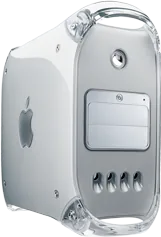
Apple Power Mac G4 (Mirrored Drive Doors 2002) vs Apple Power Macintosh 5260/120
Better figure, where one is clearly better
| ApplePower Mac G4 (Mirrored Drive Doors 2002) | ApplePower Macintosh 5260/120 | |
|---|---|---|
| Overview | ||
| Released | August 2002 | 1996 |
| Performance | ||
| Processor | 2 × PowerPC G4 867 MHz (Power Mac Mirrored Drive Doors 2002), 2 × PowerPC G4 1000 MHz (Power Mac Mirrored Drive Doors 2002) or 2 × PowerPC G4 1250 MHz (Power Mac Mirrored Drive Doors 2002) | PowerPC 603e 120 MHz (Power Macintosh 5260/120) |
| CPU cores | 2 | 1 |
| Graphics | NVIDIA GeForce4 MX (32 MB) or ATI Radeon 9000 Pro (64 MB) | – |
| Memory | 256 MB, 512 MB or 2 GB (better) | 16 MB |
| Storage | 60 GB to 120 GB (better) | 1.2 GB |
| CPU | Dual 867 MHz, dual 1 GHz or dual 1.25 GHz PowerPC G4 processors; each physical processor has 256 KB on-chip L2 cache. 867 MHz and 1 GHz have 1 MB DDR SRAM L3 per processor; 1.25 GHz has 2 MB. System bus 133 MHz on dual 867, 167 MHz on dual 1/1.25 GHz. CPU count describes physical processors; supplier is not inferred. | 120 MHz PowerPC 603e with integrated floating-point unit and 32 KB L1 cache. Exact original brochure and Apple support specify a 64-bit processor data path at 40 MHz. Optional 256 KB L2 High Power Macintosh Module M4849LL/A; it is not included as standard. |
| GPU | Dual 867 MHz: NVIDIA GeForce4 MX 32 MB DDR. Dual 1/1.25 GHz: ATI Radeon 9000 Pro 64 MB DDR. Optional NVIDIA GeForce4 Ti 128 MB; independent CTO options are not expanded into unsupported stock combinations. | 1 MB built-in DRAM framebuffer; exact support and shared service video-mode list support 640 × 480 with 16-bit colour. Other higher-resolution timing pages in the shared service do not establish those as supported modes for the built-in 14-inch display. |
| Memory type | Dual 867 MHz: 256 MB PC2100 DDR SDRAM at 266 MHz. Dual 1 GHz: 256 MB PC2700 DDR at 333 MHz; dual 1.25 GHz: 512 MB PC2700. Four DIMM slots support up to 2 GB. Configurations preserve stock processor/drive/graphics ties at base and maximum memory. | 16 MB standard, expandable to 64 MB using two 72-pin SIMM sockets; exact support and shared Service Source state no soldered RAM. Original exact brochure specifies 70 ns or faster noncomposite SIMMs, while current support and service specify 80 ns. The 5260-series user manual technical table and exact 5260/120 user-guide update instead state a 12 MB minimum in removable 70 ns fast-page SIMMs without an exact factory-order bundle. November 1996 Apple Facts claims 8 MB on board plus an 8 MB SIMM, contradicting exact support and service. No additional factory configuration is inferred from these disagreements. |
| Storage type | 60/80/120 GB 7200 rpm Ultra ATA/100 stock drives respectively. Dual 867 MHz has Combo DVD-ROM/CD-RW (CD-R 16x); faster models SuperDrive (DVD-R 2x, CD-R 8x). Four hard-drive bays support two ATA/100 and two ATA/66 drives, or up to four SCSI drives with a separately sold PCI card. Two optical bays, one occupied; optional second Combo drive. Maker optional storage choices remain in details rather than assumed CPU cross-pairs. | 1.2 GB IDE hard drive and 1.44 MB Apple SuperDrive floppy. Exact current support, TIL 20413 description and original education bundle list an 8× CD-ROM drive; shared Service Source identifies AppleCD 1200i. The September 1996 exact brochure and November 1996 Apple Facts instead say 4× CD-ROM. The optical-drive difference remains source-qualified rather than adding an undocumented factory configuration. |
| Expansion slots | Four open full-length 64-bit 33 MHz PCI slots and dedicated AGP 4x graphics slot. | LC-compatible PDS, 68040-bus communications slot for optional modem or Ethernet, optional video-input card and TV tuner bay. PDS is not a direct connection to the PowerPC processor; processor-dependent cache/FPU cards are not compatible. Optional MPEG Media System requires the video-input card. Video capture accepts NTSC, PAL and SECAM; tuner standard varies by region. |
| Display | ||
| Screen | None built in | 12.3″ |
| Resolution | – | 640 × 480 |
| Panel | – | CRT |
| Refresh rate | – | 66.67 Hz |
| Display type | – | Built-in 14-inch nominal shadow-mask colour CRT with 12.3-inch viewable diagonal in the exact original brochure and product description. Shared Service Source instead says 12.8-inch viewable; exact model wording is retained. Dot pitch 0.28 mm; tilt-and-swivel base. |
| Display features | – | 640 × 480 at 16-bit colour and 66.67 Hz in the exact original brochure. The shared service agrees on 66.7 Hz. This is a CRT raster mode, not an LCD fixed pixel grid. |
| Connections | ||
| Ports | 2 × USB-A, Ethernet, headphone jack | Headphone jack |
| Ethernet | 1 Gb/s | – |
| External displays | Up to 2 | – |
| Front ports | Headphone jack and built-in speaker. | Headphone output, push-button volume and display brightness controls, infrared remote receiver. |
| Back ports | Two FireWire 400, two USB chassis ports (maker four-port total includes two keyboard ports), Gigabit Ethernet, 56K V.92 modem, ADC/DVI, stereo audio line-in/out and Apple Pro Speakers minijack. Optional 11 Mbps AirPort 802.11b card. Bluetooth is a separately listed adapter, not built-in. No FireWire 800 in this 2002 generation. | ADB, external DB-25 SCSI, two RS-232/422 modem/printer serial ports with LocalTalk, PlainTalk-compatible sound input and stereo sound output. Ethernet requires an optional communications-slot card; no GeoPort. Original exact brochure and maker catalogue specify five external SCSI devices; the shared user manual gives six and shared service gives seven, so limits remain source-qualified. |
| External displays | Two displays in extended desktop or mirroring modes; ADC and DVI with included DVI-to-VGA adapter. Connecting two ADC displays requires a separately sold DVI-to-ADC adapter. | Optional Apple External Video Connector provides DB-15 mirroring, with a compatible display. Optional Apple Presentation System converts the mirrored output for television/projector or VCR use; it is not an independent extended desktop. |
| Speakers | Built-in speaker; optional Apple Pro Speakers. | Two built-in speakers and 16-bit stereo output. Shared service specifies 22 kHz playback and 11/22 kHz recording, with ordinary audio-CD playback. Stereo input connectors are combined to mono for recording/play-through; do not treat the connector as stereo capture. |
| Microphones | – | Built-in microphone for mono recording; rear microphone/line input supports PlainTalk-compatible microphones. |
| Keyboard and mouse | Apple Pro Keyboard, optical Apple Pro Mouse, DVI-to-VGA adapter and modem cable. | Original exact brochure and product description include a matching keyboard, mouse and necessary cables. External speakers, optional cache, Ethernet, video input/output, TV tuner and MPEG expansion are separate. Photos show the exact 5260/120 with keyboard and mouse. |
| Design and power | ||
| Type | Tower | All-in-one |
| Weight | 19.1 kg (better) | 20.5 kg |
| Width × depth × height | 227 × 468 × 432 mm | 383 × 406 × 445 mm |
| Operating system | macOS | macOS |
| Size and weight detail | Exact maker reference weight 19.1 kg varies with configuration and manufacturing process; height 43.2, width 22.7, depth 46.8 cm. These published dimensions differ slightly from earlier G4 sheets and are retained. | Exact original brochure gives 44.5 × 38.3 × 40.6 cm (height × width × depth), 20.5 kg/45 lb; current Apple support agrees on 16-inch depth and 45 lb. November 1996 Apple Facts instead gives 41.4 cm depth, with the same 20.5 kg and variation for installed devices. Shared service swaps width/depth and has inconsistent weight units. Exact original brochure measurements are retained. The shared 5260-series user manual instead lists 21.15 kg/47 lb; it agrees with the retained dimensions but not the exact brochure weight. |
| Power supply | 100–125 V AC or 200–240 V AC, 50–60 Hz. Maximum current 6.5 A at low voltage or 7.5 A at high voltage; maker publishes no maximum wattage here. | Exact current support gives 125 W maximum, 110–240 V AC at 50–60 Hz. Exact original brochure instead gives 240 W maximum at the same voltage and frequency; shared service gives 100–240 V 47–63 Hz, 240 W maximum and a separate 220 W all-line/load maximum. Ratings remain source-qualified; no universal operating consumption is assigned. Shared user manual agrees on 125 W maximum, with 100–240 V at 50–60 Hz. |
| In the box | Mac OS X 10.2 Jaguar as default startup system, plus bootable Mac OS 9.2.2; iMovie, iPhoto, iTunes and iDVD for SuperDrive. Maker August 13 release says dual 867/1 GHz available that week, so first sale uses August month precision. Actual dual-1.25 GHz shipping confirmed 18 September. January 2003 FireWire 800 models and June 2003 reissue are separate generations. | System 7.5.3 and 4 MB ROM in exact Apple support; original brochure calls the supplied software System 7.5. Apple records introduction on 1 October 1996. Contemporary original education ordering bundle and current November 1996 maker catalogue establish sale during 1996 but not a first-sale month; release remains year precision. Shared service explicitly identifies this model as the 120 MHz, 16 MB and AppleCD 1200i update to the 5260/100. North American Power Macintosh is kept distinct from international Performa 5260/120 and 5280 bundles. |

More comparisons
- Apple Mac Studio (M5 Max or M5 Ultra) vs Apple Power Mac G4 (Mirrored Drive Doors 2002)
- Apple Mac Pro (M2 Ultra) vs Apple Power Mac G4 (Mirrored Drive Doors 2002)
- Apple Mac Pro (2019) vs Apple Power Mac G4 (Mirrored Drive Doors 2002)
- Apple Mac Pro (2006) vs Apple Power Mac G4 (Mirrored Drive Doors 2002)
- Apple Power Mac G4 (Mirrored Drive Doors 2002) vs Apple Power Mac G5 (Late 2005)
- Apple Power Mac G5 (Late 2005) vs Apple Power Macintosh 5260/120
- Apple Power Mac G4 (Mirrored Drive Doors 2002) vs Apple Power Mac G5 (Early 2005)
- Apple Power Mac G5 (Early 2005) vs Apple Power Macintosh 5260/120
- Apple Power Mac G4 (Mirrored Drive Doors 2002) vs Apple Power Mac G5 (Late 2004)
- Apple Power Mac G5 (Late 2004) vs Apple Power Macintosh 5260/120
- Apple Power Mac G4 (Mirrored Drive Doors 2002) vs Apple Power Mac G5 (June 2004)
- Apple Power Mac G5 (June 2004) vs Apple Power Macintosh 5260/120
- Apple iMac G4 (20-inch, USB 2.0) vs Apple Power Mac G4 (Mirrored Drive Doors 2002)
- Apple Power Mac G4 (Mirrored Drive Doors 2002) vs Apple Power Mac G5 (2003)
- Apple Power Mac G5 (2003) vs Apple Power Macintosh 5260/120
- Apple Power Mac G4 (Mirrored Drive Doors 2002) vs Apple Power Mac G4 (Mirrored Drive Doors 2003)