Apple Power Mac G5 (Early 2005) vs Apple Power Macintosh 6500/250
Better figure, where one is clearly better
| ApplePower Mac G5 (Early 2005) | ApplePower Macintosh 6500/250 | |
|---|---|---|
| Overview | ||
| Released | April 2005 | 1997 |
| Performance | ||
| Processor | 2 × PowerPC G5 2000 MHz (Power Mac Early 2005), 2 × PowerPC G5 2300 MHz (Power Mac Early 2005) or 2 × PowerPC G5 2700 MHz (Power Mac Early 2005) | PowerPC 603e 250 MHz (Power Macintosh 6500/250) |
| CPU cores | 2 | 1 |
| Graphics | ATI Radeon 9600 (128 MB) or ATI Radeon 9650 (256 MB) | – |
| Memory | 512 MB, 4 GB or 8 GB (better) | 32 MB or 48 MB |
| Storage | 160 GB to 250 GB (better) | 4 GB |
| CPU | Two physical PowerPC G5 processors at 2, 2.3 or 2.7 GHz, each with 512 KB L2 cache and no L3 cache. Front-side bus per processor is 1, 1.15 or 1.35 GHz. The dual 2.7 GHz model uses liquid cooling. | 250 MHz PowerPC 603e with 32 KB L1 and 256 KB L2 cache and a 50 MHz system bus |
| GPU | Dual 2 and 2.3 GHz: ATI Radeon 9600 with 128 MB DDR and two single-link DVI outputs. Dual 2.7 GHz: ATI Radeon 9650 with 256 MB GDDR3, one single-link and one dual-link DVI output. Optional NVIDIA GeForce 6800 Ultra DDL with 256 MB has two dual-link DVI outputs and occupies the adjacent PCI slot. | Built-in video uses 2 MB SGRAM; Apple lists 24-bit colour up to 832 × 624 pixels and 8-bit colour at 1280 × 1024 |
| Memory type | Stock 512 MB PC3200 DDR400, installed in matched pairs. Dual 2 GHz has four DIMM slots and a 4 GB maximum. Dual 2.3 and 2.7 GHz have eight slots and an 8 GB maximum. Configuration rows keep the stock drives and graphics at base and maximum memory. | 32 or 48 MB in Apple's Canadian configurations, with two 168-pin DIMM slots and 128 MB maximum |
| Storage type | Stock 160 GB on dual 2 GHz and 250 GB on dual 2.3/2.7 GHz, all 7200 rpm Serial ATA. Two internal drive bays; optional 250 or 400 GB drives, including two 400 GB drives. One optical bay with 16x SuperDrive supporting DVD±R and up to 4x dual-layer DVD+R recording. | 4 GB internal ATA hard drive, 1.44 MB floppy and 12× CD-ROM in Apple's Canadian launch configurations; a Zip drive was fitted to some bundles |
| Expansion slots | AGP 8x Pro graphics slot. Dual 2 GHz has three 64-bit 33 MHz PCI slots. Dual 2.3 and 2.7 GHz have PCI-X: two 100 MHz slots and one 133 MHz slot. | Two PCI slots plus communications, TV and video-input expansion slots; the communications slot carried a modem in some configurations |
| Display | ||
| Screen | None built in | None built in |
| Connections | ||
| Ports | 3 × USB-A, Ethernet, headphone jack | Ethernet, headphone jack |
| Ethernet | 1 Gb/s | – |
| External displays | Up to 2 | – |
| Front ports | USB 2.0, FireWire 400 and headphone minijack. | – |
| Back ports | Two USB 2.0, FireWire 800, FireWire 400, Gigabit Ethernet, optical S/PDIF input/output and analogue audio line-in/out. Three chassis USB ports in total, plus keyboard USB 1.1 ports. AirPort Extreme, Bluetooth 2.0 + EDR and a V.92 modem are optional. | Apple Desktop Bus, DB-15 video, external DB-25 SCSI, two serial ports, 10BASE-T Ethernet, audio connections and front headphone jack |
| External displays | Two displays in extended desktop or mirrored modes. Radeon 9600 supports two displays up to 1920 × 1200; Radeon 9650 supports one 30-inch Apple Cinema HD Display via dual-link DVI. Optional 6800 Ultra DDL supports two 30-inch displays. DVI-to-VGA adapter included. | – |
| Speakers | Built-in speaker; analogue and optical audio connections. | Built-in stereo sound with integrated subwoofer, as described in Apple's Canadian launch notice |
| Keyboard and mouse | Apple Keyboard, Apple Mouse, USB extension cable and DVI-to-VGA adapter. | – |
| Design and power | ||
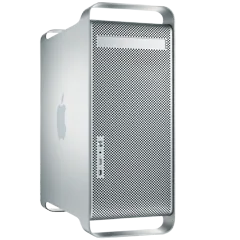
| Type | Tower | Tower |
| Weight | 20.2 kg | – |
| Operating system | macOS | macOS |
| Size and weight detail | The exact maker sheet labels height as 47.5 cm, width 20.6 cm and depth 51.1 cm. Earlier G5 sheets label height/depth in the opposite order; main dimensions are omitted because those published axes conflict. Maker reference weight is 20.2 kg and varies with configuration. | Apple lists 16 × 7.8 × 16.9 inches (height × width × depth) and 44.5 lb |
| Power supply | 450 W on dual 2/2.3 GHz; 600 W on dual 2.7 GHz, as stated by the maker. | – |
| Materials | Aluminium enclosure. | – |
| In the box | Mac OS X Tiger and iLife ’05. Apple’s 27 April 2005 launch says these models are available “this week”; first sale is kept at April precision rather than treating the announcement as a confirmed delivery day. The older single 1.8 GHz model retained in the launch range is represented separately as Late 2004. | Apple support lists 17 February 1997 as introduction. Its 4 April 1997 Canadian launch notice confirms the 6500/250 available immediately, but does not establish that as its first on-sale date; released is therefore year-only. The photographed seller unit's installed components were not used for the original configurations. |

More comparisons
- Apple Mac Studio (M4 Max or M3 Ultra) vs Apple Power Mac G5 (Early 2005)
- Apple Mac Pro (M2 Ultra) vs Apple Power Mac G5 (Early 2005)
- Apple Mac Pro (Early 2008) vs Apple Power Mac G5 (Early 2005)
- Apple Mac Pro (2006) vs Apple Power Mac G5 (Early 2005)
- Apple Power Mac G5 (Early 2005) vs Apple Power Mac G5 (Late 2005)
- Apple Power Mac G5 (Late 2005) vs Apple Power Macintosh 6500/250
- Apple iMac G5 (20-inch, Ambient Light Sensor) vs Apple Power Mac G5 (Early 2005)
- Apple Power Mac G5 (2003) vs Apple Power Mac G5 (Early 2005)
- Apple Power Mac G5 (Early 2005) vs Apple Power Mac G5 (June 2004)
- Apple Power Mac G5 (Early 2005) vs Apple Power Mac G5 (Late 2004)
- Apple Power Mac G4 (Mirrored Drive Doors 2003) vs Apple Power Mac G5 (Early 2005)
- Apple Power Mac G4 (FW800) vs Apple Power Mac G5 (Early 2005)
- Apple Power Mac G4 (Mirrored Drive Doors 2002) vs Apple Power Mac G5 (Early 2005)
- Apple Power Mac G4 (QuickSilver 2002) vs Apple Power Mac G5 (Early 2005)
- Apple Power Mac G4 (QuickSilver 2001) vs Apple Power Mac G5 (Early 2005)
- Apple Power Mac G4 (Digital Audio) vs Apple Power Mac G5 (Early 2005)