Apple Power Mac G5 (Late 2004) vs Apple Power Macintosh 6500/225
Better figure, where one is clearly better
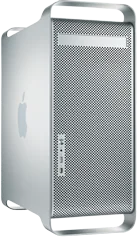
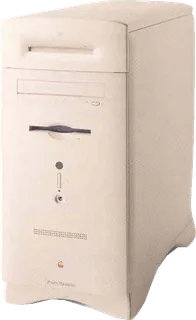
| ApplePower Mac G5 (Late 2004) | ApplePower Macintosh 6500/225 | |
|---|---|---|
| Overview | ||
| Released | October 2004 | 1997 |
| Performance | ||
| Processor | PowerPC G5 1800 MHz (Power Mac Late 2004) | PowerPC 603e 225 MHz (Power Macintosh 6500) |
| CPU cores | 1 | 1 |
| Graphics | NVIDIA GeForce FX 5200 Ultra (64 MB) | – |
| Memory | 256 MB or 4 GB (better) | 32 MB |
| Storage | 80 GB (better) | 2 GB to 3 GB |
| CPU | One 1.8 GHz PowerPC G5 with 512 KB L2 cache and a 600 MHz front-side bus. This is the new single-processor model; the dual-processor models also listed on the retained sheet are June 2004 carryovers. | 225 MHz PowerPC 603e with integrated floating-point unit, 32 KB L1 cache, 256 KB L2 cache and 64-bit 50 MHz bus. Shared service specifications use the name 603ev; exact support and original brochure use 603e. |
| GPU | Stock NVIDIA GeForce FX 5200 Ultra with 64 MB DDR in AGP 8x Pro. Optional ATI Radeon 9600 XT 128 MB, Radeon 9800 XT 256 MB, NVIDIA GeForce 6800 GT DDL 256 MB or 6800 Ultra DDL 256 MB. The 9800 XT and 6800 cards also occupy the adjacent PCI slot. | ATI 3D RAGE II with 2 MB built-in SGRAM, supporting QuickDraw 2D/3D and QuickTime/MPEG-1 acceleration; Apple's exact support table gives 24-bit colour through 832 × 624, 16-bit through 1152 × 870 and 8-bit at 1280 × 1024. The brochure's 24-bit headline ends at 800 × 600. |
| Memory type | Stock 256 MB PC3200 DDR400 in matched pairs; four DIMM slots support up to 4 GB. Configuration rows keep the stock graphics and drive at base and maximum supported memory. | 32 MB RAM, no soldered system memory; two 168-pin DIMM sockets permit up to 128 MB using 5 V buffered EDO DIMMs. Original brochure and service specify 60 ns or faster memory, while exact support database lists 70 ns; these published conditions are retained. |
| Storage type | Stock 80 GB 7200 rpm Serial ATA drive. Two 3.5-inch bays, each with a 150 MB/s interface. Optional 160 or 250 GB drives, including two 250 GB drives. One optical bay with 8x DVD-R SuperDrive; Combo drive is optional. | April 1997 US Home Edition M5611LL/A has 32 MB, a 3 GB IDE hard drive, 12× tray-loading CD-ROM, 1.44 MB SuperDrive floppy and no factory Zip drive in its exact ordering table. Exact support lists 2 or 3 GB and original 12× optical; shared service specifies a 2 GB 225 MHz configuration. Generic later family optical and storage choices are not assigned to this clock without exact configuration evidence. Shared family photographs show an optional Zip-equipped cabinet, unlike the original Home Edition blank bay. |
| Expansion slots | Three open full-length 64-bit 33 MHz PCI slots and occupied AGP 8x Pro graphics slot; no PCI-X on this single-processor model. | Two PCI 2.0 slots for approximately 7-inch cards with Macintosh drivers; Communications Slot II used by modem or Ethernet, video-input slot and TV/FM tuner position. Home Edition has a pre-cabled 5.25-inch SCSI bay for another internal SCSI device, used by Zip on some family configurations. Apple specifies six external SCSI devices, five when optional Zip is installed. |
| Display | ||
| Screen | None built in | None built in |
| Connections | ||
| Ports | 3 × USB-A, Ethernet, headphone jack | Headphone jack |
| Ethernet | 1 Gb/s | – |
| External displays | Up to 2 | – |
| Front ports | USB 2.0, FireWire 400 and headphone minijack. | 3.5 mm headphone output and volume buttons; infrared receiver for the remote supplied with the optional TV/FM Radio System. |
| Back ports | Two USB 2.0, FireWire 800, FireWire 400, Gigabit Ethernet, V.92 modem, optical Toslink input/output and analogue audio line-in/out. Three chassis USB ports in total, plus two keyboard USB 1.1 ports. AirPort Extreme 54 Mbps and Bluetooth 1.1 are optional. | ADB, DB-15 monitor output, external DB-25 SCSI, two GeoPort-compatible serial connectors, PlainTalk-compatible sound input and stereo line-level output. Original Home Edition has a 33.6 Kbit/s data/voice modem and 14.4 Kbit/s fax in Communications Slot II; it uses one serial port. Exact support lists 10BASE-T but notes some models have a modem in that slot, and later maker catalogue explicitly says Ethernet or modem varies by configuration. Ethernet is not assigned universally. Optional Apple Video System provides NTSC/PAL/SECAM input; Avid Cinema supplies video editing and NTSC/PAL output when installed. |
| External displays | Stock ADC and DVI with included DVI-to-VGA adapter, supporting two displays. Optional 6800 GT/Ultra DDL cards have two dual-link DVI connectors and support two 30-inch Apple Cinema HD Displays; a second ADC display on the stock card needs an adapter. | – |
| Speakers | Built-in speaker; optical and analogue connections for external audio. | Built-in full-range monophonic speaker acts as a subwoofer when external speakers are connected; balance adjustment operates only with external speakers. 16-bit stereo input/output and SRS 3D surround processing. |
| Keyboard and mouse | Apple Keyboard, Apple Mouse, USB extension cable, DVI-to-VGA adapter, modem cable and AirPort antenna. | US Home Edition M5611LL/A includes keyboard, mouse, cables, 33.6 Kbit/s modem and home software bundle. Monitor, Apple Video System, TV/FM Radio System and Avid Cinema are optional. Original 225 MHz ordering configuration has no Zip; photographs are explicitly shared 6500 family views showing the optional Zip-equipped cabinet and optional display, not proof of factory Home Edition equipment. |
| Design and power | ||
| Type | Tower | Tower |
| Weight | 16.4 kg | – |
| Width × depth × height | 206 × 475 × 511 mm | 198 × 428 × 406 mm |
| Operating system | macOS | macOS |
| Size and weight detail | Maker height 51.1 cm, width 20.6 cm, depth 47.5 cm. Published reference weight for the single 1.8 GHz model is 16.4 kg, distinct from the carryover dual-processor models; weight varies with configuration. | Maker brochure gives 40.6 × 19.8 × 42.8 cm (height × width × depth) and 20.2 kg, varying with installed devices. The shared service manual gives 20.18 kg without the CD-ROM; standard complete-unit weight remains unresolved and the headline mass is omitted. Gallery monitor is optional. |
| Power supply | – | Exact support database and original brochure give 220 W maximum continuous, 100–125 or 200–240 V AC at 47–63 Hz. The shared Service Source instead gives 140 W for the 6500 and 90–130 or 180–264 V; the conflicting ratings are retained, and neither is treated as measured operating consumption. |
| Materials | Aluminium enclosure. | – |
| In the box | The October 2004 release includes Mac OS X Panther and iLife ’04. Apple’s retained specification sheet later lists iLife ’05; that later software listing does not change the hardware’s October 2004 first sale. | Exact support lists original System 7.5.5 and Enabler 411, with introduction on 17 February 1997. April 1997 current Home Edition ordering brochure establishes sale in 1997; exact first-sale month remains unresolved. Later shared family software varies, and is not treated as the original 225 MHz bundle. |
More comparisons
- Apple Mac mini (M4 or M4 Pro) vs Apple Power Mac G5 (Late 2004)
- Apple Mac Pro (2006) vs Apple Power Mac G5 (Late 2004)
- Apple Power Mac G5 (Late 2004) vs Apple Power Mac G5 (Late 2005)
- Apple Power Mac G5 (Late 2005) vs Apple Power Macintosh 6500/225
- Apple Power Mac G5 (Early 2005) vs Apple Power Mac G5 (Late 2004)
- Apple Power Mac G5 (Early 2005) vs Apple Power Macintosh 6500/225
- Apple Mac mini (2005) vs Apple Power Mac G5 (Late 2004)
- Apple Power Mac G5 (2003) vs Apple Power Mac G5 (Late 2004)
- Apple Power Mac G5 (June 2004) vs Apple Power Mac G5 (Late 2004)
- Apple iMac G5 (17-inch, 2004) vs Apple Power Mac G5 (Late 2004)
- Apple Power Mac G4 (FW800) vs Apple Power Mac G5 (Late 2004)
- Apple Power Mac G4 (Mirrored Drive Doors 2003) vs Apple Power Mac G5 (Late 2004)
- Apple Power Mac G4 (Mirrored Drive Doors 2002) vs Apple Power Mac G5 (Late 2004)
- Apple Power Mac G4 (QuickSilver 2002) vs Apple Power Mac G5 (Late 2004)
- Apple Power Mac G4 (QuickSilver 2001) vs Apple Power Mac G5 (Late 2004)
- Apple Power Mac G4 (Digital Audio) vs Apple Power Mac G5 (Late 2004)