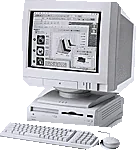
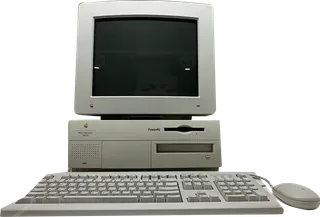
Apple Power Macintosh 6300/120 vs Apple Power Macintosh 7200/120
Better figure, where one is clearly better
| ApplePower Macintosh 6300/120 | ApplePower Macintosh 7200/120 | |
|---|---|---|
| Overview | ||
| Released | June 1996 | 1996 |
| Performance | ||
| Processor | PowerPC 603e 120 MHz (Power Macintosh 6300/120) | PowerPC 601 120 MHz (Power Macintosh 7200/120) |
| CPU cores | 1 | 1 |
| Memory | 16 MB | 16 MB |
| Storage | 1.2 GB | 1.2 GB |
| CPU | 120 MHz PowerPC 603e with integrated floating-point unit, 32 KB L1 cache and standard 256 KB L2 cache. Exact English support lists a 64-bit processor data path at 40 MHz; this is not a claim that every memory or I/O bus is 64-bit. | 120 MHz PowerPC 601 with integrated floating-point unit, 32 KB L1 cache and 256 KB L2 cache |
| GPU | 1 MB built-in DRAM framebuffer, independent of system RAM. DB-15 monitor output supports 640 × 480 with 16-bit colour or 800 × 600 and 832 × 624 with 8-bit colour. Exact English support states video input is not supported at 832 × 624. | Built-in video with 1 MB VRAM standard, expandable to 4 MB; standard VRAM supports 832 × 624 at 16-bit colour and 1024 × 768 at 8-bit colour |
| Memory type | 16 MB standard, expandable to 64 MB using two 72-pin noncomposite SIMM slots with 80 ns or faster DRAM. No RAM soldered on the board in exact English support; SIMMs can be installed individually. Original Japanese accessory list also advertises an 8 MB 70 ns memory kit. | Four 168-pin DIMM slots; 16 MB standard, expandable to 256 MB with 70 ns memory |
| Storage type | 1.2 GB internal IDE hard drive, Apple SuperDrive 1.44 MB floppy and 4× AppleCD 600i CD-ROM drive in the exact Japanese factory configuration. | 1.2 GB internal SCSI hard drive, 1.44 MB floppy drive and 4× AppleCD 600i CD-ROM drive in Apple's listed configuration |
| Expansion slots | LC-compatible 68030 processor-direct expansion slot, communications slot for optional Ethernet or modem, optional video-input card and TV tuner connector. No PCI. Optional Apple TV/FM Radio System requires the Apple Video System; NTSC, PAL and SECAM capture are available with the relevant expansion card. | Three PCI slots and a bay for another internal storage device |
| Display | ||
| Screen | None built in | None built in |
| Connections | ||
| Ports | 2 × headphone jack | Ethernet |
| Front ports | Front headphone output and push-button volume controls; infrared receiver for compatible optional remote control. | – |
| Back ports | DB-15 display output, one ADB port, two RS-232/422 serial ports for printer/modem and AppleTalk, DB-25 SCSI, microphone/line input and stereo sound output. Ethernet requires an optional communications card; these serial ports are not GeoPort. | DB-15 monitor output, Apple Desktop Bus, external DB-25 SCSI, two GeoPort serial connections, AAUI and 10BASE-T Ethernet, 16-bit stereo audio input and output |
| External displays | No built-in display. Original Japanese page supports Apple monitors from 13 to 20 inches and compatible VGA/SVGA monitors using the appropriate video cable. Contemporary special bundle includes an Apple Multiple Scan 1705 17-inch monitor; the base computer does not include it. | Built-in video supports up to 1280 × 1024 pixels with 4 MB VRAM; the standard 1 MB allocation reaches 1024 × 768 at 8-bit colour |
| Speakers | Built-in speaker; muted when a sound-output port is used. 16-bit monophonic audio input and 16-bit stereo output. Front and rear headphone/output jacks cannot be used simultaneously, according to the exact Japanese specifications. | – |
| Microphones | Supports an external microphone or line input; Apple PlainTalk microphone is a separate accessory. | – |
| Keyboard and mouse | Japanese configuration includes Apple Desktop Bus Mouse II, power cable, manuals, warranty information and KanjiTalk 7.5.1, Apple Internet Starter Kit and ClarisWorks 2.0J CDs. Keyboard is sold separately. The contemporary photo also shows an external monitor and keyboard; these are not built into the desktop. | – |
| Design and power | ||
| Type | Compact | Compact |
| Weight | 8.6 kg | – |
| Width × depth × height | 320 × 419.5 × 109.5 mm | – |
| Operating system | macOS | macOS |
| Size and weight detail | Exact Japanese maker page gives 109.5 × 320 × 419.5 mm (height × width × depth), 8.6 kg for the computer. English support gives 4.3 × 12.6 × 16.5 inches and 19 lb, rounded equivalents. External monitor, keyboard and mouse are excluded. | – |
| Power supply | Exact Japanese maker page specifies 82 W maximum excluding the monitor, 100–240 V AC at 50–60 Hz. Exact English support and archived Apple Spec Database instead give 55 W maximum, 110–240 V at 50–60 Hz. Clock battery is described as lithium in the Japanese page and 4.5 V alkaline in the English table. Conflicts remain explicit; no universal operating-consumption headline or inferred battery type. | Apple's Japanese model sheet lists 215 W maximum continuous and 300 W peak; the PC Compatible variant has a different figure and is excluded here |
| In the box | KanjiTalk/System 7.5.1 and 4 MB ROM. Apple records introduction on 27 June 1996; PC Watch’s contemporary 2 July retailer survey explicitly reports sale from 27 June, corroborating that date. English maker table states this system was not sold in the US. The 120 MHz Power Macintosh is distinct from the existing 100 MHz Macintosh Performa 6300CD; no unverified official predecessor link is assigned. | Original System Software 7.5.3. Apple's Japanese technical sheet lists the 16 MB/1.2 GB/4× CD-ROM configuration; a distinct first-sale date was not established. |
More comparisons
- Apple Power Mac G5 (Late 2005) vs Apple Power Macintosh 6300/120
- Apple Power Mac G5 (Late 2005) vs Apple Power Macintosh 7200/120
- Apple Power Mac G5 (Early 2005) vs Apple Power Macintosh 6300/120
- Apple Power Mac G5 (Early 2005) vs Apple Power Macintosh 7200/120
- Apple Power Mac G5 (Late 2004) vs Apple Power Macintosh 6300/120
- Apple Power Mac G5 (Late 2004) vs Apple Power Macintosh 7200/120
- Apple Power Mac G5 (June 2004) vs Apple Power Macintosh 6300/120
- Apple Power Mac G5 (June 2004) vs Apple Power Macintosh 7200/120
- Apple Power Mac G5 (2003) vs Apple Power Macintosh 6300/120
- Apple Power Mac G5 (2003) vs Apple Power Macintosh 7200/120
- Apple Power Mac G4 (Mirrored Drive Doors 2003) vs Apple Power Macintosh 6300/120
- Apple Power Mac G4 (Mirrored Drive Doors 2003) vs Apple Power Macintosh 7200/120
- Apple Power Mac G4 (FW800) vs Apple Power Macintosh 6300/120
- Apple Power Mac G4 (FW800) vs Apple Power Macintosh 7200/120
- Apple Power Mac G4 (Mirrored Drive Doors 2002) vs Apple Power Macintosh 6300/120
- Apple Power Mac G4 (Mirrored Drive Doors 2002) vs Apple Power Macintosh 7200/120