Apple Macintosh PowerBook 2400c/180 vs Apple Macintosh PowerBook Duo 2300c/100
Better figure, where one is clearly better
| AppleMacintosh PowerBook 2400c/180 | AppleMacintosh PowerBook Duo 2300c/100 | |
|---|---|---|
| Overview | ||
| Released | May 1997 | August 1995 |
| Display | ||
| Screen size | 10.4″ | 9.5″ |
| Resolution | 800 × 600 (better) | 640 × 480 |
| Touchscreen | No | No |
| Display type | 10.4-inch backlit TFT active-matrix colour LCD, displaying thousands of colours at 800 × 600 | 9.5-inch backlit active-matrix colour LCD; 256 colours at 640 × 480 or 32,768 colours at 640 × 400. |
| Performance | ||
| Processor | PowerPC 603e 180 MHz (PowerBook 2400c) | PowerPC 603e 100 MHz (PowerBook Duo 2300c/100) |
| CPU cores | 1 | 1 |
| Memory | 16 MB | 20 MB (better) |
| Storage | 1.3 GB (better) | 1.1 GB |
| CPU | 180 MHz PowerPC 603e with integrated floating-point unit, 32 KB L1 cache and 256 KB L2 cache | 100 MHz PowerPC 603e with 32 KB L1 cache and 33 MHz data path. |
| Memory type | 16 MB on the logic board with one SO-DIMM expansion slot | Japanese 20 MB factory configuration, expandable to 56 MB; 8 MB on the logic board and one Duo RAM slot. |
| Storage type | 1.3 GB internal ATA hard drive; supplied external 1.4 MB Apple SuperDrive floppy drive | 1.1 GB internal hard drive in the Japanese configuration; external floppy drive and CD-ROM access require accessories or a dock. |
| Battery and size | ||
| Battery life (maker's claim) | Up to 4 hours | Up to 4 hours |
| Battery capacity | 29 Wh | – |
| Weight | 2 kg (better) | 2.2 kg |
| Thickness | 47 mm | 38 mm (better) |
| Width × depth | 267 × 213 mm | 277 × 216 mm |
| Battery life detail | Removable 29 Wh lithium-ion battery; Apple stated an average 2–4 hours of operation | Removable Type III nickel-metal hydride battery; Apple quoted two to four hours per charge. |
| Connections | ||
| Operating system | macOS | macOS |
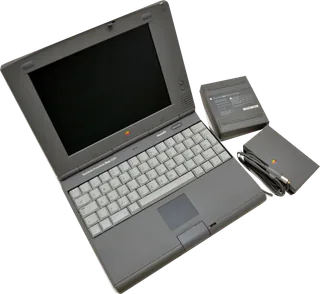
| Port detail | ADB, HDI-30 SCSI, serial, HDI-15 video, infrared, stereo audio input/output and external floppy connector; two Type II or one Type III PC Card slot | RS-422 serial/LocalTalk, 152-pin Duo dock connector, power input and built-in 14.4 kbps Express modem in the Japanese configuration; no built-in Ethernet. |
| External displays | Built-in video output through the HDI-15 connector | – |
| Keyboard | Built-in keyboard with 12 function keys | – |
| Trackpad | Built-in Apple trackpad | – |
| Speakers | Built-in speaker and microphone; 16-bit stereo audio input/output | Built-in mono speaker and microphone; stereo output through an optional Duo Dock. |
| In the box | External floppy drive, power adapter and lithium-ion battery | Japanese 20 MB/1.1 GB configuration supplied with KanjiTalk 7.5.2, Express modem, Type III battery and power adapter. |
More comparisons
- Apple MacBook Air 13″ (M5) vs Apple Macintosh PowerBook 2400c/180
- Apple MacBook Air 13″ (M5) vs Apple Macintosh PowerBook Duo 2300c/100
- Apple Macintosh PowerBook 2400c/180 vs Apple PowerBook G4 (15-inch, Double-Layer SD)
- Apple Macintosh PowerBook 2400c/180 vs Apple PowerBook G4 (17-inch, Double-Layer SD)
- Apple Macintosh PowerBook Duo 2300c/100 vs Apple PowerBook G4 (15-inch, Double-Layer SD)
- Apple Macintosh PowerBook Duo 2300c/100 vs Apple PowerBook G4 (17-inch, Double-Layer SD)
- Apple Macintosh PowerBook 2400c/180 vs Apple PowerBook G4 (15-inch, 1.67/1.5GHz)
- Apple Macintosh PowerBook 2400c/180 vs Apple PowerBook G4 (17-inch, 1.67GHz)
- Apple Macintosh PowerBook Duo 2300c/100 vs Apple PowerBook G4 (15-inch, 1.67/1.5GHz)
- Apple Macintosh PowerBook Duo 2300c/100 vs Apple PowerBook G4 (17-inch, 1.67GHz)
- Apple Macintosh PowerBook 2400c/180 vs Apple PowerBook G4 (12-inch, 1.5GHz)
- Apple Macintosh PowerBook Duo 2300c/100 vs Apple PowerBook G4 (12-inch, 1.5GHz)
- Apple Macintosh PowerBook 2400c/180 vs Apple PowerBook G4 (12-inch, 1.33GHz)
- Apple Macintosh PowerBook 2400c/180 vs Apple PowerBook G4 (15-inch, 1.5/1.33GHz)
- Apple Macintosh PowerBook Duo 2300c/100 vs Apple PowerBook G4 (12-inch, 1.33GHz)
- Apple Macintosh PowerBook Duo 2300c/100 vs Apple PowerBook G4 (15-inch, 1.5/1.33GHz)