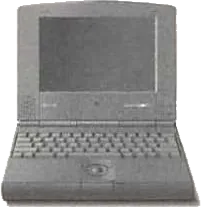
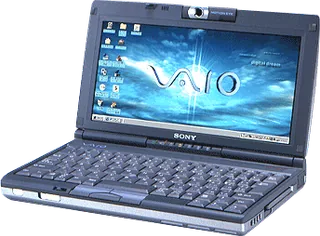
Apple Macintosh PowerBook Duo 210 vs Sony VAIO PCG-C1
Better figure, where one is clearly better
| AppleMacintosh PowerBook Duo 210 | SonyVAIO PCG-C1 | |
|---|---|---|
| Overview | ||
| Released | October 1992 | September 1998 |
| Display | ||
| Screen size | 9″ | 8.9″ |
| Resolution | 640 × 400 | 1024 × 480 (better) |
| Touchscreen | No | No |
| Display type | Backlit supertwist passive-matrix LCD with 16 grey levels | TFT LCD; approximately 16.7 million colours using dithering |
| Performance | ||
| Processor | Motorola 68030 25 MHz (PowerBook 145B) | Intel Mobile Pentium MMX 233 MHz |
| CPU cores | 1 | 1 |
| CPU threads | – | 1 |
| Graphics | – | NeoMagic MagicMedia256AV |
| Memory | 4 MB | 64 MB (better) |
| Storage | 80 MB | 3.2 GB (better) |
| CPU | 25 MHz Motorola 68030 | 233 MHz mobile Pentium MMX; 32KB internal cache; Intel 430TX chipset; 256KB external cache |
| GPU | – | NeoMagic MagicMedia256AV; 2.5MB video memory |
| Memory type | 4 MB on the logic board and one expansion slot; Apple states a 24 MB maximum using a third-party memory card | 64MB SDRAM supplied; maximum 96MB by replacing the removable 32MB module with 64MB |
| Storage type | Internal 80 MB hard drive; optional external 1.4 MB floppy drive requires a Duo Floppy Adapter or Duo MiniDock | 3.2GB Ultra ATA hard disk |
| Battery and size | ||
| Battery life (maker's claim) | Up to 4.5 hours | Up to 3 hours |
| Weight | 1.9 kg | 1.1 kg (better) |
| Thickness | 36 mm (better) | 38 mm |
| Width × depth | 277 × 216 mm | 240 × 140 mm |
| Battery life detail | Nickel-metal hydride battery; Apple claims an average of 2–4.5 hours | Sony claims 1.5–3 hours with the supplied S battery and 3.5–6.5 hours with the optional L battery in power-saving mode. Running the camera application reduces these ranges to 1–2.5 and 2.5–5.5 hours respectively. Weight includes the S battery. |
| Connections | ||
| Ports | – | USB-A, headphone jack |
| Webcam | – | Motion Eye; 0.27MP 1/6-inch CCD; 2.8 mm f/2.8 lens |
| Operating system | macOS | Windows |
| Port detail | Serial/LocalTalk, docking connector, power input and internal modem expansion; desktop video and additional connections require a compatible dock | USB; mini VGA connector with supplied 15-pin adapter; 4-pin S200 i.LINK; IrDA 1.1 and ASK; mono microphone input and stereo headphone output; one Type II PC Card slot with CardBus and ZV support; K56flex modem with up to 56kbps incoming and 33.6kbps outgoing data. V.90 was a planned upgrade, rather than the supplied modem mode. |
| Keyboard | – | 87-key Japanese keyboard; 17 mm key pitch |
| Trackpad | – | Pointing stick with scrolling support |
| Speakers | Built-in microphone and speaker; mono sound input/output | Built-in mono speaker |
| Microphones | – | Built-in microphone |
| In the box | Power adapter; an internal fax/data modem and docking accessories are optional | Windows 98; AC adapter; S battery; VGA adapter; recovery CD; external USB floppy drive and cables. Optional PC Card CD-ROM drive sold separately. |
More comparisons
- Apple MacBook Air 13″ (M5) vs Apple Macintosh PowerBook Duo 210
- Lenovo ThinkPad X1 Carbon Gen 14 vs Sony VAIO PCG-C1
- Sony VAIO P (VPCP11S1E) vs Sony VAIO PCG-C1
- Sony VAIO P (VGN-P11Z) vs Sony VAIO PCG-C1
- Apple Macintosh PowerBook Duo 210 vs Apple PowerBook G4 (15-inch, Double-Layer SD)
- Apple Macintosh PowerBook Duo 210 vs Apple PowerBook G4 (17-inch, Double-Layer SD)
- Apple Macintosh PowerBook Duo 210 vs Apple PowerBook G4 (15-inch, 1.67/1.5GHz)
- Apple Macintosh PowerBook Duo 210 vs Apple PowerBook G4 (17-inch, 1.67GHz)
- Apple Macintosh PowerBook Duo 210 vs Apple PowerBook G4 (12-inch, 1.5GHz)
- Apple Macintosh PowerBook Duo 210 vs Apple PowerBook G4 (12-inch, 1.33GHz)
- Apple Macintosh PowerBook Duo 210 vs Apple PowerBook G4 (15-inch, 1.5/1.33GHz)
- Apple Macintosh PowerBook Duo 210 vs Apple PowerBook G4 (17-inch, 1.5GHz)
- Apple Macintosh PowerBook Duo 210 vs Apple Macintosh PowerBook Duo 280c
- Apple Macintosh PowerBook Duo 210 vs Apple Macintosh PowerBook Duo 280
- Apple Macintosh PowerBook Duo 210 vs Apple Macintosh PowerBook Duo 250
- Apple Macintosh PowerBook Duo 210 vs Apple Macintosh PowerBook Duo 270c