ASUS ROG Ally X (2024) vs MSI Claw A1M
Better figure, where one is clearly better
| ASUSROG Ally X (2024) | MSIClaw A1M | |
|---|---|---|
| Overview | ||
| Released | July 2024 | March 2024 |
| Performance | ||
| Type | Handheld | Handheld |
| CPU | AMD Ryzen Z1 Extreme, 8 cores | Intel Core Ultra 5 135H or Core Ultra 7 155H |
| GPU | AMD Radeon Graphics, RDNA 3 | Intel Arc Graphics (integrated) |
| GPU compute | 8.6 TFLOPS | – |
| Memory | 24 GB (better) | 16 GB |
| Storage | 1 TB, 2 TB (better) | 512 GB, 1 TB |
| Disc drive | No | No |
| CPU | Zen 4, 4 nm, 8 cores / 16 threads, 24 MB total cache and up to 5.10 GHz; 9–30 W processor power range | UK models use Intel Core Ultra 7 155H or Core Ultra 5 135H, with Intel AI Boost NPU. MSI lists up to 4.8 GHz for the 155H and up to 4.6 GHz for the 135H in its US configuration table. |
| GPU | RDNA 3, 12 compute units and up to 2.7 GHz; graphics share system memory | Integrated Intel Arc Graphics with shared system memory; MSI lists 8 Xe cores for both US processor variants and supports Intel XeSS upscaling |
| Memory detail | 24 GB on board, dual channel; launch announcement specifies LPDDR5X-7500, while current maker tables say LPDDR5 | 16 GB LPDDR5-6400 on-board dual-channel memory in the listed UK and US models. The current global page states a maximum of 32 GB, but does not identify a matching configuration. |
| Storage detail | PCIe 4.0 NVMe M.2 2280 SSD; 1 TB in the global sheet and an additional 2 TB configuration in the US sheet; availability varies by market | One NVMe PCIe 4.0 M.2 2230 SSD slot; MSI's US table confirms Core Ultra 5 with 512 GB, and Core Ultra 7 with 512 GB or 1 TB. Configuration availability varies by market. First US sale on 8 March 2024 is documented by GamersNexus; dates differed by region. |
| Storage expansion | Replaceable M.2 2280 SSD and UHS-II microSD reader for SD, SDHC and SDXC | microSD card reader |
| Display and video | ||
| Built-in screen | 7″ LCD, 1920 × 1080, 120 Hz | 7″ LCD, 1920 × 1080, 120 Hz |
| Built-in screen | IPS-level, anti-glare and low-reflection; 500 nits, 100% sRGB and 75.35% Adobe RGB; 7 ms response; 10-point touch; Gorilla Glass Victus | IPS-level touchscreen, 1920 × 1080 at 120 Hz; MSI states typical 100% sRGB coverage and typical 500 nits brightness |
| Video output | DisplayPort over both USB-C ports; USB4 port specifies DisplayPort 1.4 and FreeSync support; no maximum external resolution or frame rate published in the sheets used | Thunderbolt 4 USB-C supports DisplayPort; MSI's separately sold Nest docking station provides HDMI 2.0 at 4K 60 Hz |
| Variable refresh rate | AMD FreeSync Premium on the built-in display | – |
| Audio | Two speakers with Smart Amplifier, Dolby Atmos, headphone Hi-Res certification, array microphone and AI noise cancelling | Two 2 W speakers with Hi-Res Audio support, array microphone and 3.5 mm microphone/headphone socket |
| Design and power | ||
| Weight | 678 g | 675 g (better) |
| Battery life detail | 80 Wh, four-cell lithium-ion; no claimed gaming runtime | 53 Wh six-cell lithium-polymer battery. MSI's January 2024 announcement claims two hours under full workload, without publishing the game or test conditions. |
| Power use | 65 W USB-C adapter, 20 V / 3.25 A; whether a charger is included varies by country and model | 65 W USB-C Power Delivery adapter. While running or sleeping, MSI states charging support from 45 W at 20 V to 65 W; charging speed and performance depend on power source and battery state. Cooler Boost HyperFlow uses dual fans and heat pipes. |
| Colours | Black; maker dimensions 28.0 × 11.1 × 2.47–3.69 cm (W × D × H) | Black; 294 × 117 × 21.2 mm and 675 g including battery |
| In the box | – | 65 W power adapter; accessories vary by country. MSI sells its travel case, Nest dock and screen protector separately. |
| Connections | ||
| Ports | USB4 Type-C with Thunderbolt 4 compliance and Power Delivery 3.0; USB 3.2 Gen 2 Type-C with DisplayPort and power delivery; 3.5 mm combo jack; UHS-II microSD reader | One Thunderbolt 4 USB-C port with DisplayPort and Power Delivery 3.0; one microSD reader; one 3.5 mm audio combo socket |
| Wi-Fi and Bluetooth | Wi-Fi 6E, tri-band 2 × 2; current maker sheets specify Bluetooth 5.4 and say the version may vary with the operating system | Intel Killer Wi-Fi 7 BE1750 and Bluetooth 5.4; wireless performance depends on configuration and local spectrum availability |
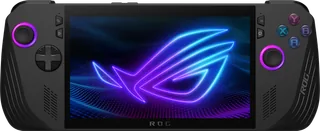
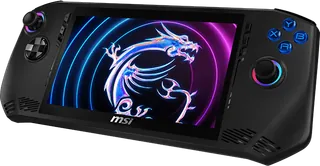
| Controller | Two full-size analogue sticks, Hall effect triggers, bumpers, D-pad, A/B/X/Y, View, Menu, Command Center, Armoury Crate and two assignable grip buttons; HD haptics, six-axis gyro, Aura Sync lighting and fingerprint sensor; launch announcement rates the redesigned joysticks for five million cycles | Hall effect analogue sticks and triggers, D-pad, RGB ABXY buttons, left and right bumpers, View and Menu buttons, MSI Center M and Quick Settings buttons, two rear macro buttons and HD haptics |
| Backward compatibility | Windows 11 Home with Armoury Crate SE; PC game stores and launchers subject to each game's requirements. Maker product-security update support runs to 31 December 2028. | Windows 11 Home with MSI Center M and supported PC game stores; MSI App Player supports compatible Android games. The current maker page also offers Xbox Full Screen Experience for Claw models. |
More comparisons
- MSI Claw 8 EX AI+ vs MSI Claw A1M
- ASUS ROG Ally X (2024) vs MSI Claw 8 EX AI+
- ASUS ROG Ally X (2024) vs ASUS ROG Xbox Ally X
- ASUS ROG Ally X (2024) vs ASUS ROG Xbox Ally
- ASUS ROG Xbox Ally vs MSI Claw A1M
- ASUS ROG Ally X (2024) vs Lenovo Legion Go Gen 2
- ASUS ROG Ally X (2024) vs MSI Claw A8
- MSI Claw A1M vs MSI Claw A8
- ASUS ROG Ally X (2024) vs MSI Claw 8 AI+
- MSI Claw 8 AI+ vs MSI Claw A1M
- MSI Claw 7 AI+ vs MSI Claw A1M
- ASUS ROG Ally X (2024) vs MSI Claw 7 AI+
- ASUS ROG Ally X (2024) vs Valve Steam Deck OLED
- ASUS ROG Ally X (2024) vs Valve Steam Deck LCD
- ASUS ROG Ally (2023) vs ASUS ROG Ally X (2024)
- ASUS ROG Ally X (2024) vs Lenovo Legion Go (2023)