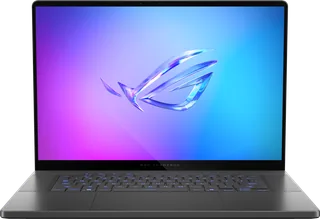
ASUS ROG Zephyrus G16 (2025, Intel) vs Lenovo Legion 5i Gen 10 (15IAX10)
Better figure, where one is clearly better
| ASUSROG Zephyrus G16 (2025, Intel) | LenovoLegion 5i Gen 10 (15IAX10) | |
|---|---|---|
| Overview | ||
| Released | March 2025 | May 2025 |
| Display | ||
| Screen size | 16″ | 15.1″ |
| Resolution | 2560 × 1600 | 2560 × 1600 |
| Panel | OLED | OLED |
| Refresh rate | 240 Hz (better) | 165 Hz |
| Brightness | – | 500 nits |
| HDR peak brightness | – | 1,000 nits |
| Touchscreen | No | No |
| Display type | 16-inch 2.5K OLED, 16:10; non-touch confirmed by Windows Central's exact GU605C review | 15.1-inch WQXGA OLED, 16:10, non-touch; Lenovo's launch table says 15.3-inch but current exact-platform PSREF specifies 15.1-inch |
| Colour range | 100% DCI-P3; Pantone Validated | 100% DCI-P3 |
| Screen finish | Glossy | Glossy |
| Display features | NVIDIA G-SYNC; MUX switch and Advanced Optimus | Dolby Vision, DisplayHDR True Black 600, X-Rite factory colour calibration; TÜV Rheinland Low Blue Light and Flicker Free |
| Performance | ||
| Processor | Intel Core Ultra 9 285H | Intel Core Ultra 7 255HX or Intel Core Ultra 9 275HX |
| CPU cores | 16 | 20 or 24 |
| CPU threads | 16 | 20 or 24 |
| Graphics | NVIDIA GeForce RTX 5070 Laptop GPU | NVIDIA GeForce RTX 5050 Laptop GPU, NVIDIA GeForce RTX 5060 Laptop GPU or NVIDIA GeForce RTX 5070 Laptop GPU |
| AI engine (NPU) | 13 TOPS | 13 TOPS |
| Memory | 16 GB or 32 GB | 16 GB or 32 GB |
| Storage | 1 TB | 1 TB |
| CPU | Intel Core Ultra 9 285H, 16 cores and 16 threads | Core Ultra 7 255HX or Core Ultra 9 275HX; Intel HM870 chipset |
| GPU | RTX 5070 Laptop GPU in the listed UK models, 8 GB GDDR7, up to 105 W including 15 W Dynamic Boost, 1595 MHz in Turbo mode; the global range also offers RTX 5070 Ti, 5080 and 5090 | RTX 5050, 5060 or 5070 Laptop GPU, each 8 GB GDDR7 at 115 W TGP; DLSS 4 |
| AI engine | Intel AI Boost NPU | Intel AI Boost NPU, up to 13 TOPS; Lenovo LA3 AI chip |
| Memory type | 16 or 32 GB onboard LPDDR5X-7467 in the listed UK models; not upgradable | Two DDR5 SODIMM slots, dual-channel capable; DDR5-4800 or DDR5-5600; Lenovo offers up to 32 GB |
| Storage type | 1 TB PCIe 4.0 NVMe M.2 SSD in the listed UK models; two M.2 PCIe slots including the installed drive | Two M.2 2280 PCIe 4.0 x4 slots; factory 2242 SSD offerings of 512 GB or 1 TB per drive |
| Cooling | Cooling arrangement varies by GPU configuration; higher GPU models use a vapour chamber | – |
| Battery and size | ||
| Battery life (maker's claim) | – | Up to 10.8 hours |
| Battery capacity | 90 Wh (better) | 80 Wh |
| Weight | 1.85 kg (better) | 1.9 kg |
| Thickness | 16.4 mm (better) | 21.54 mm |
| Width × depth | 354 × 246 mm | 344.9 × 255.35 mm |
| Battery life detail | 90 Wh, 4-cell Li-ion | 80 Wh; MobileMark 30 at 250 nits up to 4.4 hours, local 1080p video at 150 nits up to 10.8 hours (Lenovo) |
| Charger | 200 W adapter for the listed RTX 5070 UK models; inclusion varies by region | 245 W slim-tip adapter; standard USB-C PD at 95–100 W, or 140 W with a compatible Lenovo proprietary adapter |
| Fast charging | – | Super Rapid Charge, 0–30% in 10 minutes, 0–70% in 30 minutes and 0–100% in 80 minutes (Lenovo) |
| Materials | Aluminium chassis; listed UK RTX 5070 models weigh 1.85 kg and are 14.9–16.4 mm thick; higher GPU models differ | Aluminium top cover and PC-ABS bottom; starting weight 1.9 kg; thickness 19.95–21.54 mm |
| Colours | Eclipse Gray; Platinum White (availability varies by SKU) | Eclipse Black |
| Connections | ||
| Ports | Thunderbolt 4, USB-C, 2 × USB-A, HDMI, SD card slot, headphone jack | Thunderbolt 4, USB-C, 3 × USB-A, HDMI, Ethernet, headphone jack |
| Wi-Fi | Wi-Fi 7 | Wi-Fi 6 or Wi-Fi 7, depending on configuration |
| Bluetooth | 5.4 | 5.2 or 5.4, depending on configuration |
| Webcam | 1080p with IR for Windows Hello | 720p or 5MP with electronic shutter, depending on configuration |
| Operating system | Windows | Windows |
| Port detail | Thunderbolt 4 with display and power delivery, 40 Gbps; USB-C 10 Gbps with display and power delivery; 2 × USB-A 10 Gbps; HDMI 2.1 FRL; SD UHS-II up to 312 MB/s; 3.5 mm combo audio | Thunderbolt 4 / USB4 40 Gbps with DisplayPort 2.1; USB-C 10 Gbps with PD 95–100 W and DisplayPort 2.1; 3 × USB-A 5 Gbps, one Always On; HDMI 2.1 up to 8K 60 Hz; Gigabit Ethernet; 3.5 mm combo audio; slim-tip power |
| External displays | – | Up to three external displays; HDMI up to 8K 60 Hz, USB-C up to 5K 60 Hz; maximum resolution requires DSC |
| Keyboard | RGB backlit chiclet keyboard with Copilot key; Slash Lighting on the lid | Six-row keyboard with numeric keypad, 1.6 mm key travel and Copilot key; 24-zone RGB or white backlight depending on SKU |
| Trackpad | – | Mylar Precision TouchPad, 75 × 120 mm |
| Speakers | Four force-cancelling woofers and two tweeters, Smart Amplifier and Dolby Atmos | Two 2 W speakers, HARMAN audio and Nahimic |
| Microphones | Three-microphone array with AI noise cancellation | Two-microphone array |
| Biometrics | IR camera for Windows Hello | No fingerprint reader or IR camera |

More comparisons
- Lenovo Legion 5i Gen 10 (15IAX10) vs Microsoft Surface Laptop 15″ (8th Edition)
- Lenovo Legion 5a Gen 11 (15AGP11) vs Lenovo Legion 5i Gen 10 (15IAX10)
- ASUS ROG Zephyrus G16 (2025, Intel) vs Razer Blade 16 (2026)
- ASUS ROG Strix G16 (2026) G615 vs ASUS ROG Zephyrus G16 (2025, Intel)
- ASUS ROG Zephyrus G16 (2025, Intel) vs ASUS ROG Zephyrus G16 (2026) GU606
- ASUS ROG Zephyrus G14 (2026) GU405 vs ASUS ROG Zephyrus G16 (2025, Intel)
- Lenovo Legion 5i Gen 10 (15IAX10) vs MSI Cyborg 15 (B2RW)
- ASUS ROG Zephyrus G16 (2025, Intel) vs Lenovo Yoga Pro 9i Gen 10 Aura Edition (16IAH10)
- Lenovo Legion 5i Gen 10 (15IAX10) vs Lenovo Legion Pro 7i Gen 10
- ASUS ROG Zephyrus G14 (2025) vs ASUS ROG Zephyrus G16 (2025, Intel)
- ASUS ROG Zephyrus G16 (2025, Intel) vs Lenovo Legion Pro 7i Gen 10