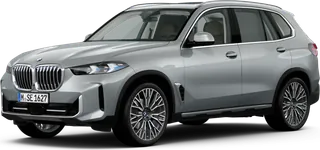
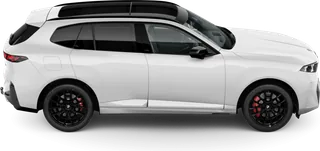
BMW X5 vs BMW X5 (2027)
Better figure, where one is clearly better
| BMWX5 | BMWX5 (2027) | |
|---|---|---|
| Overview | ||
| Released | November 2018 | Coming spring 2027 (early information) |
| Performance | ||
| Powertrain | Mild hybrid, Plug-in hybrid | Mild hybrid, Plug-in hybrid |
| Power | 294–617 bhp (better) | 308–603 bhp |
| 0–62 mph | 3.9–6.1 s (better) | 4.5–6.1 s |
| Top speed | 145–155 mph | 143–155 mph |
| Engine or motors | xDrive30d: 2,993 cc six-cylinder diesel with 48 V mild hybrid, 219 kW (298 hp); xDrive40d: same engine, 259 kW (352 hp); xDrive50e: 2,998 cc six-cylinder petrol plus electric motor, 360 kW (489 hp) system output; M60i xDrive: 4,395 cc V8 with 48 V mild hybrid, 390 kW (530 hp); X5 M Competition: 4,395 cc V8, 460 kW (625 hp); bhp converted from BMW's kW figures | 40d xDrive: 2,993 cc six-cylinder diesel with 48 V mild hybrid, 230 kW (313 hp); 50e xDrive and M60e xDrive: 2,998 cc six-cylinder petrol plus electric motor, 360 kW (489 hp) and 450 kW (612 hp) system output respectively; bhp converted from BMW's kW figures |
| Torque | 670 Nm (xDrive30d), 720 Nm (xDrive40d), 700 Nm (xDrive50e), 750 Nm (M60i, X5 M Competition) | 670 Nm (40d xDrive), 700 Nm (50e xDrive), 800 Nm (M60e xDrive) |
| Gearbox | 8-speed automatic | 8-speed Steptronic automatic |
| Drive | xDrive all-wheel drive | xDrive all-wheel drive |
| Range and charging | ||
| Zero-emission range (WLTP) | 64 miles (better) | 61–63 miles |
| Battery | 25.7 kWh | 26.5 kWh (better) |
| Economy (WLTP) | 22.1–313.9 mpg (better) | 49.6–54.3 mpg |
| Range detail | xDrive50e WLTP electric range 61–64 miles; electric top speed 87 mph | Provisional WLTP electric range up to 63 miles (50e xDrive) or 61 miles (M60e xDrive) |
| Charging | xDrive50e: 25.7 kWh usable battery; current BMW UK specifications list 11 kW AC and 0–100% in 2 hours 45 minutes | Plug-in hybrids: 11 kW AC; 0–100% in 3 hours at 11 kW; 26.5 kWh usable battery |
| Efficiency | WLTP combined: 36.2–39.2 mpg (xDrive30d), 36.2–38.2 mpg (xDrive40d), 282.5–313.9 mpg and 2.2–2.3 miles/kWh (xDrive50e), 23.5–23.7 mpg (M60i), 21.9–22.1 mpg (X5 M Competition) | Provisional WLTP combined: 47.1–54.3 mpg (50e xDrive), 45.6–49.6 mpg (M60e xDrive); 40d xDrive UK EU7 figure to be confirmed. The current BMW UK model page labels its plug-in hybrid consumption values as mpg but shows the l/100 km numbers; the BMW UK press kit gives the mpg figures used here. |
| CO2 emissions | 189–205 g/km (diesels), 20–22 g/km (xDrive50e), 270–274 g/km (M60i), 289–292 g/km (X5 M Competition), WLTP combined | Provisional WLTP combined 118–136 g/km (50e xDrive), 129–141 g/km (M60e xDrive); 40d xDrive UK EU7 figure to be confirmed |
| Practicality | ||
| Body | SUV | SUV |
| Seats | 5 | 5 |
| Boot | 650 litres | 525–655 litres (better) |
| Length | 4,935 mm | 4,994 mm |
| Width | 2,004 mm | 2,000 mm |
| Weight | – | From 2,355 kg |
| Boot | 650–1,870 litres; 500–1,720 litres (xDrive50e) | 655–1,850 litres (40d xDrive); 525–1,680 litres (plug-in hybrids) |
| Towing | With optional trailer coupling, 3,500 kg braked (diesels, M60i), 2,700 kg (xDrive50e), 3,000 kg (X5 M Competition) | Up to 3,000 kg braked (40d xDrive) or 3,300 kg (plug-in hybrids) |
| Size | 4,935 mm long, 2,004 mm wide (2,218 mm with mirrors), 1,765 mm high; 2,975 mm wheelbase; X5 M Competition 4,948 mm long, 2,015 mm wide, 1,762 mm high; EC unladen weight including a 75 kg driver is 2,295 kg (xDrive30d) to 2,495 kg (xDrive50e) | 40d xDrive and 50e xDrive: 4,994 mm long, 2,000 mm wide, 1,751 mm high; M60e xDrive: 4,998 mm long; 3,035 mm wheelbase. DIN kerb weight is 2,355 kg (40d), 2,565 kg (50e) or 2,640 kg (M60e). |
| Tech and safety | ||
| Infotainment | – | BMW Panoramic iDrive with Central Display and Panoramic Vision; Passenger Screen optional |
| Driver assistance | – | Driving Assistant Plus and Parking Assistant standard; Motorway Assistant and Parking Assistant Professional optional |