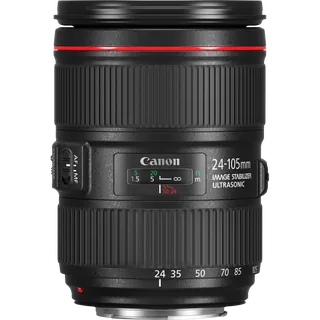
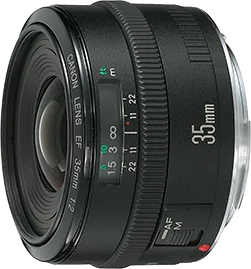
Canon EF 24–105mm f/4L IS II USM vs Canon EF 35mm f/2
Better figure, where one is clearly better
| CanonEF 24–105mm f/4L IS II USM | CanonEF 35mm f/2 | |
|---|---|---|
| Overview | ||
| Released | 2016 | October 1990 |
| Optics | ||
| Lens type | Zoom | Prime |
| Focal length | 24–105 mm | 35 mm |
| Maximum aperture | f/4 | f/2 |
| Minimum aperture | f/22 | f/22 |
| Optical construction | Seventeen elements in twelve groups | Seven elements in five groups |
| Special elements | Four aspherical elements | – |
| Coatings | Air Sphere Coating; front and rear fluorine coating according to The Digital Picture | – |
| Diaphragm | Ten blades with a circular aperture | Five blades according to Canon Camera Museum |
| Angle of view | 84°–23°20′ diagonal, 74°–19°20′ horizontal and 53°–13° vertical | 63° diagonal, 54° horizontal and 38° vertical according to Canon's manual |
| Mount and compatibility | ||
| Mounts | Canon EF | Canon EF |
| Image circle | Full frame | Full frame |
| Compatibility | Canon EF full-frame and APS-C DSLRs; EOS M cameras require an EF-EOS M mount adaptor | Canon EF cameras with full-frame or APS-C sensors |
| Teleconverter support | Canon's manual excludes extenders | – |
| Adaptor support | EF12 II gives 0.60–0.50× at 24 mm and 0.41–0.12× at 105 mm; EF25 II is incompatible at 24 mm and gives 0.61–0.27× at 105 mm | – |
| Focus and stabilisation | ||
| Autofocus | Yes | Yes |
| Minimum focus distance | 0.45 m | 0.25 m |
| Maximum magnification | 0.24× | 0.23× |
| Optical stabilisation | Yes | No |
| Autofocus detail | USM autofocus with full-time manual focusing. Canon's manual specifies turning the ring with the shutter half-pressed after One Shot AF | Non-USM autofocus without full-time manual override according to The Digital Picture; Canon's manual requires the MF switch position for manual focus |
| Focus distance detail | Internal focusing according to The Digital Picture; Canon instructs users to finish zooming before focusing | Lens extends towards close focus but its front element does not rotate according to Photozone |
| Stabilisation detail | Canon claims four-stop optical stabilisation. The exact manual describes automatic adjustment for still subjects and panning, with correction perpendicular to the panning direction | No optical stabilisation according to The Digital Picture's exact-model specification table |
| Design | ||
| Dust and moisture resistant | Yes | No |
| Filter diameter | 77 mm | 52 mm |
| Maximum diameter | 83.5 mm | 67.4 mm |
| Length | 118 mm | 42.5 mm |
| Weight | 795 g | 210 g (better) |
| Controls | AF/MF and stabilisation switches, separate focus and zoom rings, distance window, infrared index and transport lock at 24 mm | AF/MF switch, focus ring, distance window, depth-of-field scale and infrared focus index |
| Zoom design | Extending barrel; zoom lock holds the shortest 24 mm position | – |
| Weather resistance | Canon UK describes dust and moisture sealing; the manual identifies a rubber mount ring. The Digital Picture recommends a protective filter to complete front sealing | No weather sealing according to The Digital Picture's exact-model specification table |
| Dimensions detail | Maximum diameter × retracted length; size and 795 g weight are lens-only. Caps add 24.2 mm to length according to Canon's manual | 67.4 mm maximum diameter × 42.5 mm length; dimensions and 210 g weight are lens-only. Front and rear caps add 21.5 mm according to Canon's manual |
| Lens hood | EW-83M hood with release button; reversible for storage | EW-65 II clip-on reversible hood according to Canon's manual; optional according to Photozone and The Digital Picture |
| In the box | Lens, E-77 II front cap, Dust Lens Cap E, EW-83M hood, LP1219 case and manual according to Canon UK | – |
| Release detail | Canon Camera Museum's exact-model table records October 2016 marketing; its later RF 24–105mm page retrospectively says November 2016. The year is used because the maker gives conflicting months without explaining a regional difference | Canon Camera Museum records October 1990 marketing; no first-sale day is given |
More comparisons
- Canon EF 24–105mm f/4L IS II USM vs Canon RF 28–70mm F2.8 IS STM
- Canon EF 35mm f/2 vs Canon RF 35mm F1.4 L VCM
- Canon EF 35mm f/2 vs Canon RF 35mm F1.8 MACRO IS STM
- Canon EF 24–105mm f/4L IS II USM vs Canon RF 24–105mm F4L IS USM
- Canon EF 24–105mm f/4L IS II USM vs Canon EF 70–200mm f/2.8L IS III USM
- Canon EF 35mm f/2 vs Canon EF 70–200mm f/2.8L IS III USM
- Canon EF 24–105mm f/4L IS II USM vs Canon EF 70–200mm f/4L IS II USM
- Canon EF 35mm f/2 vs Canon EF 70–200mm f/4L IS II USM
- Canon EF 24–105mm f/4L IS II USM vs Canon EF 85mm f/1.4L IS USM
- Canon EF 35mm f/2 vs Canon EF 85mm f/1.4L IS USM
- Canon EF 24–105mm f/4L IS II USM vs Canon EF-S 35mm f/2.8 Macro IS STM
- Canon EF 35mm f/2 vs Canon EF-S 35mm f/2.8 Macro IS STM
- Canon EF 24–105mm f/4L IS II USM vs Canon EF-S 18–55mm f/4–5.6 IS STM
- Canon EF 35mm f/2 vs Canon EF-S 18–55mm f/4–5.6 IS STM
- Canon EF 16–35mm f/2.8L III USM vs Canon EF 24–105mm f/4L IS II USM
- Canon EF 16–35mm f/2.8L III USM vs Canon EF 35mm f/2