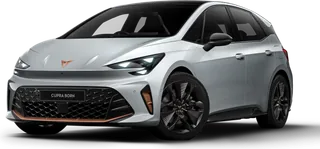
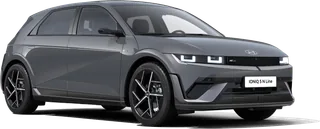
CUPRA Born vs Hyundai IONIQ 5
Better figure, where one is clearly better
| CUPRABorn | HyundaiIONIQ 5 | |
|---|---|---|
| Overview | ||
| Released | December 2021 | 2021 |
| Performance | ||
| Powertrain | Electric | Electric |
| Power | 187–322 bhp (better) | 168–320 bhp |
| 0–62 mph | 5.6–8 s | 5.3–8.5 s (better) |
| Top speed | 99–124 mph (better) | 114 mph |
| Engine or motors | Single rear motor, 190 PS (140 kW), 231 PS (170 kW) or 326 PS (240 kW, VZ with APP550 drive); bhp converted from CUPRA's PS figures | Rear permanent-magnet motor, 125 or 168 kW; AWD adds a front motor for 239 kW combined. Bhp converted from Hyundai's PS figures. |
| Torque | 545 Nm (VZ) | 350 Nm RWD; 605 Nm AWD |
| Gearbox | Single-speed automatic | Single-speed automatic |
| Drive | Rear-wheel drive | Rear-wheel drive or all-wheel drive |
| Range and charging | ||
| Zero-emission range (WLTP) | 300–392 miles (better) | 273–354 miles |
| Battery | 58–79 kWh | – |
| Fastest charging | 105–183 kW | 260 kW (better) |
| Range detail | WLTP combined: 297–300 miles (58 kWh), 385–389 miles (79 kWh 231 PS), 389–392 miles (VZ) | WLTP combined 273 miles (63 kWh); 354 miles (84 kWh Advance/Premium RWD), 329 miles (Ultimate RWD), 320 miles (N Line/N Line S RWD), 311 miles (Ultimate AWD) or 307 miles (N Line/N Line S AWD). |
| Charging | 58 kWh LFP (61 kWh gross) or 79 kWh NMC (84 kWh gross); DC 10–80% in 26 minutes at 105 kW (58 kWh) or 29 minutes at 183 kW (79 kWh); 11 kW AC 0–100% in 6 h 30 min or 8 h 30 min | Hyundai states battery capacities of 63 and 84 kWh without identifying usable capacity. Up to 260 kW DC; estimated 10–80% in 18 minutes on a 350 kW charger. 10.5 kW AC onboard charger. |
| Efficiency | WLTP combined: 142.5–143.9 Wh/km (58 kWh), 144.4–145.7 Wh/km (79 kWh 231 PS), 142.6 Wh/km (VZ) | – |
| CO2 emissions | 0 g/km at the tailpipe | – |
| Practicality | ||
| Body | Hatchback | Hatchback |
| Seats | 5 | 5 |
| Boot | 385 litres | 520 litres (better) |
| Length | 4,336 mm | 4,655 mm |
| Width | 1,809 mm | 1,890 mm |
| Weight | From 1,899 kg | From 1,880 kg |
| Boot | 385 litres | 520 litres with rear seats up; 1,580 litres folded |
| Towing | Bike rack towing hook optional | 750 kg braked with 63 kWh battery; 1,600 kg with 84 kWh battery |
| Size | 4,336 mm long, 1,809 mm wide, 1,543 mm high; 10.5 m turning circle; kerb weight with driver 1,899 kg (58 kWh), 1,964 kg (79 kWh), 2,004 kg (VZ) | 4,655 mm long, 1,890 mm wide, 1,605 mm high; 3,000 mm wheelbase; 11.98 m turning circle |
| Tech and safety | ||
| Infotainment | 12.9-inch touchscreen; augmented-reality head-up display available; Sennheiser AMBEO sound system | 12.3-inch touchscreen navigation and 12.3-inch driver display |
| Driver assistance | – | Adaptive cruise control, lane keeping and forward collision avoidance; higher trims add blind-spot monitoring and Highway Drive Assist 2.0 |
| Warranty | 5 years or 90,000 miles (2 years unlimited mileage); battery 8 years or 100,000 miles | – |