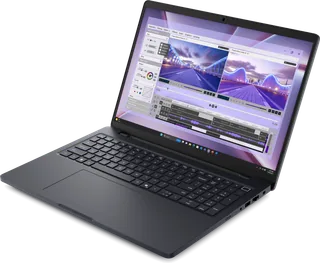
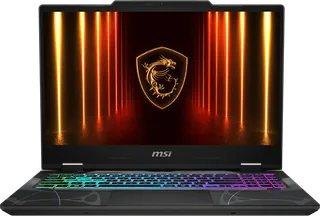
Dell Dell Pro Max 16 MC16250 vs MSI Cyborg 15 (B2RW)
Better figure, where one is clearly better
| DellDell Pro Max 16 MC16250 | MSICyborg 15 (B2RW) | |
|---|---|---|
| Overview | ||
| Released | March 2025 | November 2025 |
| Display | ||
| Screen size | 16″ | 15.6″ |
| Resolution | 1920 × 1200 or 2560 × 1600 (better) | 1920 × 1080 |
| Panel | IPS LCD | IPS LCD |
| Refresh rate | 60 Hz or 120 Hz | 144 Hz (better) |
| Brightness | 400 nits | – |
| Touchscreen | No | No |
| Display type | 16-inch FHD+ (1920 × 1200), 60 Hz, 300 or 400 nits, touch or non-touch; or QHD+ (2560 × 1600), 120 Hz, 300 or 400 nits, non-touch; all anti-glare | FHD (1920 × 1080) IPS-level, 16:9, anti-glare (MSI Japan) |
| Pixel density | 142 ppi (FHD+); 189 ppi (QHD+) | – |
| Colour range | 45% NTSC (FHD+); 100% sRGB (QHD+) | – |
| Screen finish | Anti-glare | – |
| Display features | 1000:1 contrast; 35 ms response; ComfortView Plus on one QHD+ panel | – |
| Performance | ||
| Processor | Intel Core Ultra 5 235H or Intel Core Ultra 9 285H | Intel Core 5 210H or Intel Core 7 240H |
| CPU cores | 14 or 16 | 8 or 10 |
| CPU threads | 14 or 16 | 12 or 16 |
| Graphics | Intel Arc 140T or NVIDIA RTX PRO 2000 Blackwell | NVIDIA GeForce RTX 5050 Laptop GPU or NVIDIA GeForce RTX 5060 Laptop GPU |
| AI engine (NPU) | 13 TOPS | – |
| Memory | 16 GB or 64 GB (better) | 16 GB |
| Storage | 256 GB to 2 TB (better) | 512 GB to 1 TB |
| CPU | Intel Core Ultra 5 235H (14 cores, vPro), Core Ultra 7 255H, Core Ultra 7 265H (vPro) or Core Ultra 9 285H (vPro), 16 cores; 45 W | Core 5 210H (8 cores, 12 threads, up to 4.8 GHz, 12 MB cache) or Core 7 240H (10 cores, 16 threads, up to 5.2 GHz, 24 MB cache) |
| GPU | Intel Graphics or Intel Arc Pro Graphics; or NVIDIA RTX PRO 500 Blackwell (6 GB GDDR7), RTX PRO 1000 Blackwell (8 GB GDDR7) or RTX PRO 2000 Blackwell (8 GB GDDR7) | NVIDIA GeForce RTX 5050 Laptop GPU (8 GB GDDR7, up to 1500 MHz, 45 W) or RTX 5060 Laptop GPU (8 GB GDDR7, up to 1455 MHz, 55 W), including Dynamic Boost |
| AI engine | Intel AI Boost NPU | – |
| Memory type | DDR5, two slots; SODIMM at 5600 MT/s or CSODIMM at 6400 MT/s; 16 to 64 GB | DDR5-5600 in two slots; up to 96 GB |
| Storage type | Two M.2 PCIe NVMe slots (one 2230/2280, one 2230 or 2280); 256 GB to 2 TB, Gen 4 or Gen 5, optional self-encrypting drives and RAID 0 or 1 | One M.2 NVMe PCIe Gen4 slot |
| Battery and size | ||
| Battery capacity | 96 Wh (better) | 55.2 Wh |
| Weight | 2.11 kg | 2.1 kg (better) |
| Thickness | 19.08 mm (better) | 23.15 mm |
| Width × depth | 358 × 256 mm | 359.3 × 245.25 mm |
| Battery life detail | 4-cell 64 Wh or 6-cell 96 Wh lithium-ion polymer, with Long Cycle Life versions | 55.2 Wh, 4-cell; JEITA 3.0 up to 5 hours video playback, 10 hours idle (MSI Japan) |
| Charger | 100 W or 130 W USB-C adapter | 120 W adapter; USB Power Delivery 3.0 over USB-C |
| Materials | – | Translucent Black chassis |
| Fast charging | ExpressCharge and ExpressCharge Boost | – |
| Colours | Magnetite | Translucent Black |
| Connections | ||
| Ports | 2 × Thunderbolt 4, 2 × USB-A, HDMI, Ethernet, microSD slot, headphone jack | USB-C, 2 × USB-A, HDMI, Ethernet, headphone jack |
| Wi-Fi | Wi-Fi 6E or Wi-Fi 7 | Wi-Fi 6E |
| Bluetooth | 5.3 or 5.4 | 5.3 |
| Webcam | 1080p HDR with IR and privacy shutter, or 8MP with IR | 720p |
| Operating system | Windows | Windows |
| Port detail | 2 × Thunderbolt 4 (40 Gbps) with Power Delivery and DisplayPort; 2 × USB 3.2 Gen 1 USB-A (one with PowerShare); HDMI 2.1; RJ45 gigabit Ethernet; microSD card reader; 3.5 mm headset jack; wedge lock slot; optional smart card reader, NFC and nano-SIM | USB-C (USB 3.2 Gen 2) with DisplayPort and Power Delivery 3.0; 2 × USB 3.2 Gen 2 Type-A; HDMI 2.1 (4K 60 Hz); Gigabit Ethernet; 3.5 mm combo jack |
| External displays | Up to 3 with the laptop screen on, or 4 with it off | – |
| Keyboard | Backlit or non-backlit keyboard with numeric keypad and Copilot key | 4-zone RGB gaming keyboard with Copilot key |
| Trackpad | 125 × 88 mm | – |
| Speakers | Two speakers, 2 W each (2.5 W peak), Waves MaxxAudio Pro | 2 × 2 W, DTS Audio Processing, Hi-Res Audio ready |
| Microphones | Dual-array digital microphones | Array microphone |
| Biometrics | Optional fingerprint reader in the power button; optional IR camera for Windows Hello with presence detection | None; webcam shutter |
More comparisons
- Lenovo Legion 5a Gen 11 (15AGP11) vs MSI Cyborg 15 (B2RW)
- Lenovo LOQ Essential 15ARP11 vs MSI Cyborg 15 (B2RW)
- Dell Dell Pro Max 16 MC16250 vs Lenovo LOQ Essential 15ARP11
- Dell Dell Pro Max 16 MC16250 vs Lenovo ThinkBook 16 Gen 9 (Intel)
- Dell Dell Pro Max 16 MC16250 vs Lenovo IdeaPad Pro 5i Gen 11 (16″)
- Lenovo ThinkPad T510 vs MSI Cyborg 15 (B2RW)
- Lenovo Legion 5i Gen 10 (15IAX10) vs MSI Cyborg 15 (B2RW)
- Dell Dell Pro Max 16 MC16250 vs Lenovo Yoga Pro 9i Gen 10 Aura Edition (16IAH10)