Garmin fēnix 2 vs Garmin fēnix 8 Solar
Better figure, where one is clearly better
| Garminfēnix 2 | Garminfēnix 8 Solar | |
|---|---|---|
| Overview | ||
| Released | March 2014 | August 2024 |
| Display | ||
| Case sizes | 49 mm | 47 mm or 51 mm |
| Panel | LCD | Memory-in-pixel |
| Always-on display | Yes | Yes |
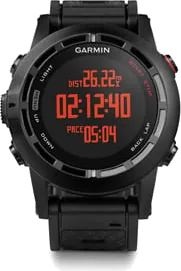
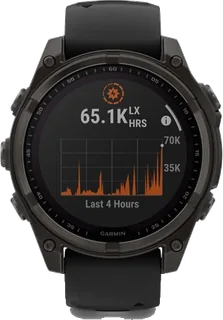
| Display detail | Transflective monochrome LCD, 31 mm diameter and 70 × 70 pixels; negative display with red LED backlight and physical buttons. | Always-visible sunlight-readable transflective colour memory-in-pixel (MIP) touchscreen, five leakproof inductive buttons. 47 mm: 33 mm (1.3 inch), 260 x 260 pixels. 51 mm: 35.56 mm (1.4 inch), 280 x 280 pixels. |
| Screen protection | – | Power Sapphire solar charging lens |
| Health and fitness | ||
| ECG | No | Yes |
| Blood oxygen | No | Yes |
| Skin temperature | No | Yes |
| Sleep apnoea alerts | No | No |
| High blood pressure alerts | No | No |
| Body composition | No | No |
| Fall detection | No | No |
| Crash detection | No | No |
| GPS | Single-band | Dual-band (L1 and L5) |
| Water resistance | 50 m | 100 m (better) |
| Sensors | High-sensitivity GPS receiver, barometric altimeter, three-axis compass and accelerometer. Optional ANT+ heart-rate, HRM-Run, foot-pod, speed/cadence, power and tempe temperature sensors; no optical wrist heart-rate sensor. | GPS, GLONASS, Galileo, QZSS and BeiDou; SatIQ automatic multi-band selection; Garmin Elevate wrist heart rate, Pulse Ox, barometric altimeter, compass, gyroscope, accelerometer, thermometer, ambient light and depth sensor to 40 m. |
| Health features | – | Garmin ECG App where regionally available with compatible phone and watch software; Pulse Ox availability varies by country. HRV status, Body Battery, health status/snapshot, skin temperature, sleep coach/score/alignment, breathing variations, nap detection, stress/respiration tracking, lifestyle logging, jet lag adviser and menstrual-cycle/pregnancy tracking. Current maker table includes smart wake alarm and past ovulation estimates. |
| Fitness features | Running, cycling, pool and open-water swimming, multisport, hiking and skiing profiles; advanced workouts, Virtual Partner, Training Effect, VO2 max estimates, race prediction and recovery advice. Running dynamics require an HRM-Run chest strap; indoor pace and distance use the accelerometer. | Training readiness/status, training load/focus/effect, endurance and hill scores, running tolerance, running power/dynamics, PacePro, ClimbPro, real-time stamina and recovery time. Running economy and step speed loss require a compatible accessory. Garmin running, cycling, strength and triathlon coaching. Scuba single-gas air/nitrox (21–40% oxygen) and apnea modes, EN 13319 depth sensor to 40 m; dive rating is distinct from 10 ATM surface water resistance. Golf, ski, climbing, cycling, swimming, multisport and strength activity profiles. Preloaded TopoActive maps on these Sapphire versions, downloadable regional maps over Wi-Fi, dynamic round-trip routing, NextFork, routes and turn-by-turn directions; golf and SkiView maps. Optional Outdoor Maps+ subscription adds premium maps. No need for a phone to follow stored maps/routes. |
| Safety features | Breadcrumb routes, waypoint navigation and TracBack to retrace the recorded route; no preloaded base maps. | LED flashlight with white/red light and strobe. Incident detection, assistance, LiveTrack and live event sharing require a compatible paired phone and appropriate connectivity. Can control a separate compatible inReach device; LTE/satellite/SOS built into fēnix 8 Pro are not features of this Solar model. |
| Battery and connections | ||
| Battery life (maker's claim) | Up to 35 days | Up to 30 days |
| In low-power mode | – | Up to 48 days |
| Mobile data option | No | No |
| Works with | iPhone and Android | iPhone and Android |
| Storage | – | 32 GB |
| Battery life detail | Rechargeable 500 mAh lithium-ion battery; up to five weeks in watch mode, sixteen hours with normal GPS recording or fifty hours in UltraTrac with one-minute GPS polling, according to the owner's manual. | Headline figures are 51 mm without solar: up to 30 days smartwatch and 48 days battery-saver watch mode. 47 mm: smartwatch 21 days/28 with solar; saver 34/58 days; GPS-only 67/92 h; all satellites 48/59 h on current UK web table (September 2026 owner guide instead says 49 h with solar); multi-band 37/43 h; all satellites plus music 13 h; maximum-battery GPS 132/283 h; expedition 34/58 days. 51 mm: smartwatch 30/48 days; saver 48/107 days; GPS-only 95/149 h; all satellites 68/92 h; multi-band 52/65 h; music 18 h; maximum-battery GPS 186/653 h; expedition 50/118 days. Solar watch/saver/expedition claims assume all-day wear with three hours daily outside at 50,000 lux; GPS solar claims assume use outside at 50,000 lux, with typical SatIQ use for multi-band. Actual battery life depends on enabled features. |
| Charging | USB contact charging/data cradle and AC adapter. | Garmin proprietary plug cable to USB-C computer port or AC adaptor rated at least 5 W, per current owner guide. Lithium-ion battery. Solar charging stops when fully charged or connected to external power. |
| Connectivity | Bluetooth Smart phone notifications, Garmin Connect uploads and LiveTrack; USB computer transfer and ANT+ sensor connections. Garmin's 2015 catalogue confirms iPhone 4S or later and most Bluetooth Smart Android devices running Android 4.3 or later. The manual says ANT+ sensors cannot connect while Bluetooth is enabled. | Bluetooth, ANT+ and Wi-Fi. Calls use a paired phone; offline watch voice commands and voice notes use the built-in microphone/speaker. Garmin Messenger requires a paired phone/app for ordinary messages. Garmin Pay with supported banks; downloaded local music or supported subscription music services; Connect IQ apps and Garmin Share. |
| Storage | 20 MB internal memory; up to 1,000 waypoints, fifty routes, 10,000 track points and 100 saved tracks. | – |
| Design | ||
| Weight (lightest version) | 90.6 g | 80 g (better) |
| Software | Garmin | Garmin |
| Case materials | Curved mineral-glass lens, shock-resistant housing and polyurethane wristband; 5 ATM water rating. | Titanium bezel (natural or Carbon Grey DLC), fibre-reinforced polymer case and metal rear cover; silicone band. |
| Size | 49 × 49 × 17 mm; 90.6 g. | 47 mm: 47 x 47 x 15.2 mm. 51 mm: 51 x 51 x 15.4 mm. Silicone wrist fit: 125–208 mm (47 mm), 127–210 mm (51 mm). QuickFit 22 mm and 26 mm bands respectively. 47 mm 80 g with band, 57 g case only; 51 mm 95 g with band, 67 g case only. Headline weight describes 47 mm with supplied silicone band. |
| Reference and release detail | – | Maker announced 27 August 2024; its Italian launch page states both Solar sizes were available that day. UK first shipping day is not independently established. |
| Bands | Polyurethane wristband; additional hook-and-loop fabric strap accommodates larger wrists or wearing over a jacket. | – |
| In the box | Watch, fabric wrist-strap kit, USB charging/data cable, AC adapter and quick-start manual; HRM-Run chest strap included in the Performer Bundle. | – |
More comparisons
- Garmin fēnix 8 Solar vs Garmin fēnix 9
- Garmin fēnix 2 vs Garmin fēnix 9
- Garmin fēnix 8 Solar vs Garmin Instinct 3 AMOLED
- Garmin Enduro 3 vs Garmin fēnix 8 Solar
- Garmin fēnix 8 Solar vs Garmin fēnix E
- Garmin fēnix 8 AMOLED (47 mm, Sapphire) vs Garmin fēnix 8 Solar
- Garmin fēnix 7 vs Garmin fēnix 8 Solar
- Garmin fēnix 6 vs Garmin fēnix 8 Solar
- Garmin fēnix 5 Plus vs Garmin fēnix 8 Solar
- Garmin fēnix 5 vs Garmin fēnix 8 Solar
- Garmin fēnix 5S vs Garmin fēnix 8 Solar
- Garmin fēnix 5X vs Garmin fēnix 8 Solar
- Garmin fēnix 3 HR vs Garmin fēnix 8 Solar
- Garmin fēnix 3 vs Garmin fēnix 8 Solar
- Garmin fēnix 2 vs Garmin fēnix E
- Garmin fēnix vs Garmin fēnix 8 Solar