Garmin fēnix 5S vs Garmin Forerunner 35
Better figure, where one is clearly better
| Garminfēnix 5S | GarminForerunner 35 | |
|---|---|---|
| Overview | ||
| Released | March 2017 | 2016 |
| Display | ||
| Case sizes | 42 mm | 40.7 mm |
| Panel | – | Memory-in-pixel |
| Always-on display | Yes | Yes |
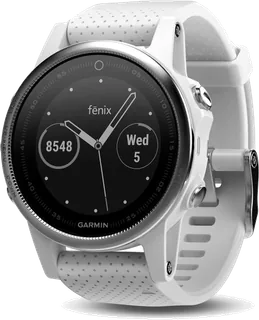
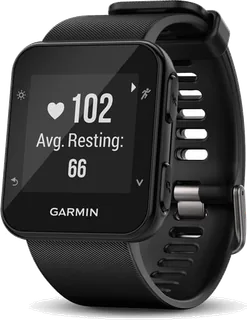
| Display detail | Always-on transflective colour Garmin Chroma display, 1.1 inches (27.94 mm), 218 × 218 pixels, with LED backlight and button controls. | 0.93 × 0.93-inch (23.5 × 23.5 mm) monochrome, transflective memory-in-pixel display, 128 × 128 pixels; button controls and a backlight. |
| Screen protection | – | Chemically strengthened glass. |
| Health and fitness | ||
| ECG | No | No |
| Blood oxygen | No | No |
| Skin temperature | No | No |
| Sleep apnoea alerts | No | No |
| High blood pressure alerts | No | No |
| Body composition | No | No |
| Fall detection | No | No |
| Crash detection | No | No |
| GPS | Single-band | Single-band |
| Water resistance | 100 m (better) | 50 m |
| Sensors | GPS, GLONASS, Garmin Elevate optical wrist heart rate, barometric altimeter, three-axis compass, gyroscope, accelerometer and thermometer. | Built-in GPS, Garmin Elevate optical heart-rate sensor and accelerometer; supports ANT+ heart-rate and cycling sensors. |
| Health features | – | Continuous heart rate, steps, calories, distance, sleep and intensity-minute tracking, with inactivity alerts and Move IQ activity recognition. |
| Fitness features | Running, cycling, pool and open-water swimming, skiing, golf and paddle-sport profiles; training status, aerobic and anaerobic training effect, VO2 max estimates, recovery advice and race prediction. Additional running dynamics require a compatible chest strap. | Outdoor and indoor running, walking, cycling and cardio profiles; virtual pacing, intervals, personal records and vibration alerts. No swim-tracking profile. |
| Safety features | Course navigation, breadcrumb trails, TracBack and waypoint guidance; no preloaded detailed maps. Connected LiveTrack and GroupTrack require a paired phone. | LiveTrack shares a run's location when paired with a compatible smartphone. |
| Battery and connections | ||
| Battery life (maker's claim) | Up to 9 days | Up to 9 days |
| Mobile data option | No | No |
| Works with | iPhone and Android | iPhone and Android |
| Battery life detail | Up to nine days in smartwatch mode, twelve hours in GPS mode or twenty-eight hours in UltraTrac with wrist heart rate on, according to the Singapore specification; the European launch release quotes fourteen hours GPS and thirty-five hours UltraTrac. | Up to nine days with notifications, activity tracking and wrist heart rate, or 13 hours in GPS training mode. |
| Charging | Rechargeable lithium-ion battery with USB charging/data cable. | Rechargeable lithium-ion battery with a USB charging clip. |
| Connectivity | Bluetooth and ANT+, smartphone notifications, Garmin Connect uploads, Connect IQ apps and phone music controls. Wi-Fi is included in Sapphire editions. | Bluetooth and ANT+; paired-phone notifications, music controls, automatic Garmin Connect uploads and Find My Phone. No Connect IQ app support or music storage. |
| Storage | 64 MB total, with 37 MB available; up to 1,000 waypoints, thirty routes and 200 hours of activity data. | Seven activities of on-watch history. |
| Design | ||
| Weight (lightest version) | 67 g | 37.3 g (better) |
| Software | Garmin | Garmin |
| Case materials | Stainless-steel bezel, buttons and rear case; 10 ATM water rating. Sapphire-glass editions available. | Silicone strap and 5 ATM water rating. |
| Size | 42 × 42 × 14.5 mm; 67 g with silicone band. | 35.5 × 40.7 × 13.3 mm; 37.3 g. The longest case dimension is used in the size comparison. |
| Bands | QuickFit interchangeable bands. | Fits wrists 140–200 mm. |
| Colours | White model pictured; other case and band colours and Sapphire editions available. | Black case and band; Garmin also sold limelight, frost blue and white versions. |
More comparisons
- Garmin fēnix 5S vs Garmin fēnix 9
- Garmin Forerunner 170 vs Garmin Forerunner 35
- Garmin Forerunner 170 Music vs Garmin Forerunner 35
- Garmin Forerunner 35 vs Garmin Forerunner 70
- Garmin Forerunner 35 vs Garmin Forerunner 570
- Garmin Forerunner 35 vs Garmin Forerunner 970
- Garmin fēnix 5S vs Garmin fēnix 8 Solar
- Garmin fēnix 5S vs Garmin fēnix E
- Garmin fēnix 5S vs Garmin fēnix 8 AMOLED (47 mm, Sapphire)
- Garmin Forerunner 165 vs Garmin Forerunner 35
- Garmin Forerunner 165 Music vs Garmin Forerunner 35
- Garmin Forerunner 265 vs Garmin Forerunner 35
- Garmin fēnix 5S vs Garmin fēnix 7
- Garmin fēnix 5S vs Garmin fēnix 6
- Garmin fēnix 5 Plus vs Garmin fēnix 5S
- Garmin fēnix 5S vs Garmin Forerunner 645