Garmin Forerunner 110 vs Garmin Forerunner 170 Music
Better figure, where one is clearly better
| GarminForerunner 110 | GarminForerunner 170 Music | |
|---|---|---|
| Overview | ||
| Released | 2010 | May 2026 |
| Display | ||
| Case sizes | 45 mm | 42.6 mm |
| Panel | – | OLED |
| Always-on display | Yes | Yes |
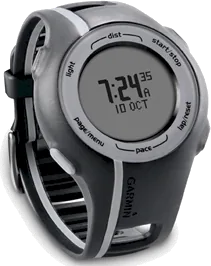
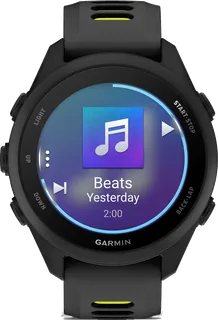
| Display detail | Backlit monochrome screen with 25.1 mm diagonal; fixed training pages and four physical buttons. Garmin's manuals do not specify panel technology or pixel resolution. | 1.2-inch (30.4 mm diameter) colour AMOLED touchscreen, 390 x 390 pixels; optional always-on display and large-font setting; five physical buttons |
| Screen protection | – | Chemically strengthened glass |
| Health and fitness | ||
| ECG | No | No |
| Blood oxygen | No | Yes |
| Skin temperature | No | No |
| Sleep apnoea alerts | No | No |
| High blood pressure alerts | No | No |
| Body composition | No | No |
| Fall detection | No | No |
| Crash detection | No | No |
| GPS | Single-band | Single-band |
| Water resistance | – | 50 m |
| Sensors | High-sensitivity GPS receiver with HotFix satellite prediction; optional ANT+ heart-rate chest strap. No optical wrist sensor or foot-pod support. | Garmin Elevate wrist heart rate; Pulse Ox; barometric altimeter; compass; gyroscope; accelerometer; thermometer; ambient light sensor; thermometer measures activity/ambient temperature, not overnight skin temperature |
| Health features | – | Continuous heart rate with high/low alerts; HRV status; Body Battery; stress and respiration; advanced sleep, sleep coach, breathing variations and nap detection; meditation; smart wake alarm; Health Snapshot; lifestyle logging; Health Status; women's health tracking via Garmin Connect; no ECG app |
| Fitness features | Time, distance, calories and lap-average or run-average pace; Auto Lap and manual laps. No interval or custom workouts. | More than 80 sports apps; training readiness, status, load, load focus and recovery time; Garmin running, cycling and strength coaching; daily suggested running workouts and quick workouts; wrist-based running dynamics and running power; ground-contact balance requires a compatible accessory; PacePro and grade-adjusted pace; VO2 max and race predictions; cycling power-meter and Varia radar/light support; pool and open-water swimming; no dedicated triathlon mode; Breadcrumb course navigation, point-to-point navigation, back-to-start and TracBack; elevation profile, future elevation plot and Up Ahead; no full routable offline maps |
| Safety features | – | Incident detection during selected activities, assistance and LiveTrack require a paired compatible smartphone; live event sharing is Android-only; screen flashlight, not a separate LED torch |
| Battery and connections | ||
| Battery life (maker's claim) | Up to 8 hours | Up to 10 days |
| In low-power mode | Up to 21 days | Up to 19 days |
| Mobile data option | No | No |
| Works with | No phone pairing | iPhone and Android |
| Storage | – | 4 GB |
| Battery life detail | Rechargeable 200 mAh lithium-ion battery; up to eight hours with GPS, three weeks in power-save mode or one week with forty-five minutes of GPS training each day. | Smartwatch up to 10 days, or 4 days with display always on; battery saver smartwatch up to 19 days; GPS-only GNSS up to 20 hours; all-systems GNSS up to 14 hours; with music, GPS-only up to 7.5 hours and all-systems up to 6.5 hours (exact series manual; UK web table mislabels 7.5 hours as days); actual life depends on enabled features and usage |
| Charging | USB contact charging clip and AC adapter. | Garmin proprietary plug charging/data cable; rechargeable built-in lithium-ion battery; USB charging temperature 0–45 °C |
| Connectivity | USB mass-storage activity transfers to a computer and Garmin Connect; ANT+ heart-rate sensors. No direct phone pairing. | Bluetooth, ANT+ and Wi-Fi; GPS, GLONASS and Galileo; no multi-band GNSS; Garmin Pay contactless payments; Android-only text responses and notification images; Connect IQ apps/watch faces/data fields; Garmin Share; controls smartphone music and plays downloaded personal audio or supported music-service content through compatible Bluetooth headphones; third-party services may require subscriptions; no speaker/microphone calls or cellular connection |
| Storage | Approximately 180 hours of activity history, according to the owner's manuals; oldest data is overwritten when full. | 4 GB memory/history with offline music support |
| Design | ||
| Weight (lightest version) | 52 g | 41 g (better) |
| Software | Garmin | Garmin |
| Case materials | IPX7 immersion protection, one metre for thirty minutes; the English manual says the watch is not intended for swimming. | Fibre-reinforced polymer bezel; silicone band; chemically strengthened glass; 5 ATM water rating; operating/storage temperature –20–60 °C |
| Size | 45 × 69 × 14 mm and 52 g, as listed in Garmin Slovakia's manual. Width is used as the case size. | 42.6 x 42.6 x 11.9 mm; Garmin lists 41 g without a separate body-only weight |
| Bands | – | Standard 20 mm quick-release two-tone silicone band; fits 126–203 mm wrists |
| Colours | – | Black with Black/Amp Yellow band; Whitestone with Whitestone/Cloud Blue band; Teal Green with Teal Green/Citron band; Red Pink with Red Pink/Mango band |
| In the box | Watch, charging/data cable, AC adapter and documentation; heart-rate strap included in some bundles. | Forerunner 170 Music; charging cable; documentation |
More comparisons
- Garmin Forerunner 170 vs Garmin Forerunner 170 Music
- Garmin Approach J1 vs Garmin Forerunner 170 Music
- Garmin Forerunner 170 Music vs Garmin Forerunner 70
- Garmin Forerunner 170 Music vs Garmin Forerunner 570
- Garmin Forerunner 170 Music vs Garmin Forerunner 970
- Garmin Forerunner 165 vs Garmin Forerunner 170 Music
- Garmin Forerunner 165 Music vs Garmin Forerunner 170 Music
- Garmin Forerunner 170 Music vs Garmin Forerunner 265
- Garmin Forerunner 170 Music vs Garmin Forerunner 965
- Garmin Forerunner 170 Music vs Garmin Forerunner 255
- Garmin Forerunner 170 Music vs Garmin Forerunner 955
- Garmin Forerunner 170 Music vs Garmin Forerunner 55
- Garmin Forerunner 170 Music vs Garmin Forerunner 745
- Garmin Forerunner 170 Music vs Garmin Forerunner 45
- Garmin Forerunner 170 Music vs Garmin Forerunner 45S
- Garmin Forerunner 170 Music vs Garmin Forerunner 245