Garmin Forerunner 265 vs Garmin Forerunner 305
Better figure, where one is clearly better
| GarminForerunner 265 | GarminForerunner 305 | |
|---|---|---|
| Overview | ||
| Released | March 2023 | 2006 |
| Display | ||
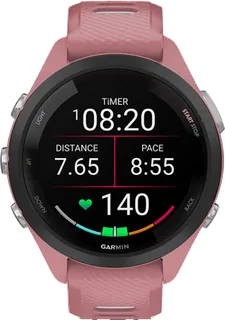
| Case sizes | 42 mm or 46 mm | 53.3 mm |
| Panel | OLED | – |
| Always-on display | Yes | Yes |
| Display detail | Forerunner 265S has a 1.1″ (28.1 mm) AMOLED touchscreen, 360 x 360 pixels; Forerunner 265 has a 1.3″ (32.5 mm) AMOLED touchscreen, 416 x 416 pixels; five buttons; optional always-on mode | Backlit 33 × 20.3 mm monochrome display, 160 × 100 pixels; configurable training screens and physical buttons. Panel technology is not specified by Garmin. |
| Screen protection | Corning Gorilla Glass 3 | – |
| Health and fitness | ||
| ECG | No | No |
| Blood oxygen | Yes | No |
| Skin temperature | No | No |
| Sleep apnoea alerts | No | No |
| High blood pressure alerts | No | No |
| Body composition | No | No |
| Fall detection | No | No |
| Crash detection | No | No |
| GPS | Dual-band (L1 and L5) | Single-band |
| Water resistance | 50 m | – |
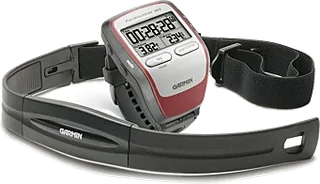
| Sensors | Garmin Elevate wrist heart rate monitor; Pulse Ox blood oxygen monitor; barometric altimeter; compass; gyroscope; accelerometer; thermometer; ambient light sensor | High-sensitivity SiRFstarIII GPS receiver, included wireless heart-rate chest strap and optional GSC 10 cycling speed/cadence sensor; no optical wrist sensor. |
| Health features | High and low heart rate alerts; HRV status; Body Battery; all-day stress; sleep score, sleep coach and nap detection; breathing variations; respiration rate; Health Snapshot; menstrual cycle and pregnancy tracking; jet lag adviser | – |
| Fitness features | Training readiness and training status; training load, load ratio and load focus; training effect, VO2 max and recovery time; wrist-based running power and dynamics; PacePro; race predictor; Garmin Coach running, cycling and strength plans; daily suggested running and cycling workouts; triathlon and open-water swimming; course navigation with a breadcrumb trail, TracBack and Up Ahead | Running, cycling and other-sport profiles; quick, interval and advanced workouts, course racing, Virtual Partner, Auto Pause, Auto Lap and heart-rate, pace, time and distance alerts. |
| Safety features | Incident detection during select activities; assistance; LiveTrack; spectator messaging; live event sharing (Android only); these features require a paired phone | Stores 100 locations and 50 routes; basic route display, direction to a stored location and navigation back to the start. No base maps. |
| Battery and connections | ||
| Battery life (maker's claim) | Up to 15 days | Up to 10 hours |
| Mobile data option | No | No |
| Works with | iPhone and Android | No phone pairing |
| Storage | 8 GB | – |
| Battery life detail | Forerunner 265S up to 15 days in smartwatch mode, 24 hours GPS only, 18 hours SatIQ (AutoSelect), 15 hours All-Systems + Multi-Band; with music up to 7.5, seven and six hours respectively. Forerunner 265 up to 13 days in smartwatch mode, 20 hours GPS only, 16 hours SatIQ, 14 hours All-Systems + Multi-Band; with music up to seven, 6.5 and six hours respectively | Internal rechargeable lithium-ion battery; ten hours of typical use. |
| Charging | Garmin proprietary plug charger; USB-C charging/data cable included | Docking cradle with AC charger and USB cable. |
| Connectivity | Bluetooth, ANT+ and Wi-Fi; multi-band GPS with GPS, GLONASS, Galileo, QZSS, BeiDou and SatIQ; Garmin Pay; offline music from Spotify, Deezer and Amazon Music (premium subscription required); Connect IQ; notifications and Android text responses; Garmin Share | USB computer transfer through the cradle; Garmin Training Center software and MotionBased analysis were supplied at launch. Wireless heart-rate and cycling sensor connections; no direct phone pairing. |
| Storage | – | Up to 1,000 laps; smart recording or one-second recording. |
| Design | ||
| Weight (lightest version) | 39 g (better) | 77 g |
| Software | Garmin | Garmin |
| Case materials | Fibre-reinforced polymer bezel; silicone band; 5 ATM water rating | IPX7 immersion protection, one metre for thirty minutes; the owner's manual says it is not intended for swimming. |
| Size | Forerunner 265S is 41.7 x 41.7 x 12.9 mm and 39 g; Forerunner 265 is 46.1 x 46.1 x 12.9 mm and 47 g; Garmin does not publish case-only weights | 53.3 × 68.6 × 17.8 mm and 77 g. Width is used as the case size. |
| Bands | Quick-release 18 mm bands for the 265S, fitting 115–178 mm wrists; quick-release 22 mm bands for the 265, fitting 135–205 mm wrists | Vinyl wrist strap with an expander strap; fabric strap available separately. |
| In the box | Forerunner 265 or 265S, USB-C charging/data cable, documentation | Watch, heart-rate chest strap, wrist and expander straps, docking cradle, AC charger, USB cable, Garmin Training Center software and documentation. |
More comparisons
- Garmin Forerunner 170 vs Garmin Forerunner 265
- Garmin Forerunner 170 Music vs Garmin Forerunner 265
- Garmin Forerunner 265 vs Garmin Forerunner 70
- Garmin Forerunner 170 vs Garmin Forerunner 305
- Garmin Forerunner 170 Music vs Garmin Forerunner 305
- Garmin Forerunner 305 vs Garmin Forerunner 70
- Garmin Forerunner 265 vs Garmin Forerunner 570
- Garmin Forerunner 265 vs Garmin Forerunner 970
- Garmin Forerunner 305 vs Garmin Forerunner 970
- Garmin Forerunner 305 vs Garmin Forerunner 570
- Garmin Forerunner 165 vs Garmin Forerunner 265
- Garmin Forerunner 165 Music vs Garmin Forerunner 265
- Garmin Forerunner 165 vs Garmin Forerunner 305
- Garmin Forerunner 165 Music vs Garmin Forerunner 305
- Garmin Forerunner 265 vs Garmin Venu 3
- Garmin Approach S70 vs Garmin Forerunner 265