Garmin Forerunner 935 vs Garmin Forerunner 970
Better figure, where one is clearly better
| GarminForerunner 935 | GarminForerunner 970 | |
|---|---|---|
| Overview | ||
| Released | March 2017 | May 2025 |
| Display | ||
| Case sizes | 47 mm | 47 mm |
| Panel | Memory-in-pixel | OLED |
| Always-on display | Yes | Yes |
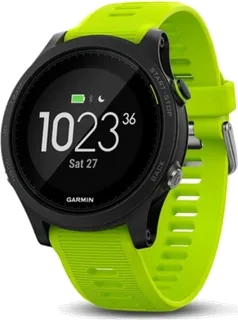
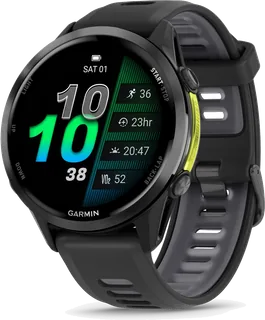
| Display detail | 1.2-inch (30.4 mm) sunlight-readable transflective colour MIP display, 240 x 240 pixels, with button controls. | 1.4″ (35.3 mm) AMOLED colour touchscreen, 454 x 454 pixels; five buttons |
| Screen protection | Glass lens. | Sapphire crystal lens |
| Health and fitness | ||
| ECG | No | Yes |
| Blood oxygen | No | Yes |
| Skin temperature | No | Yes |
| Sleep apnoea alerts | No | No |
| High blood pressure alerts | No | No |
| Body composition | No | No |
| Fall detection | No | No |
| Crash detection | No | No |
| GPS | Single-band | Dual-band (L1 and L5) |
| Water resistance | 50 m | 50 m |
| Sensors | GPS, GLONASS, Garmin Elevate wrist heart rate, barometric altimeter, compass, gyroscope and accelerometer. | Garmin Elevate wrist heart rate monitor; Pulse Ox blood oxygen monitor; barometric altimeter; compass; gyroscope; accelerometer; thermometer; ambient light sensor |
| Health features | All-day heart rate, steps, sleep and intensity minutes. | Garmin ECG App (atrial fibrillation); Pulse Ox spot checks, with optional all-day acclimation and sleep readings; skin temperature; high and low heart rate alerts; HRV status; health status; sleep score, sleep coach, sleep alignment and nap detection; breathing variations; Body Battery; all-day stress; Health Snapshot; lifestyle logging; women's health tracking with past ovulation estimates; jet lag adviser |
| Fitness features | Running, cycling, pool and open-water swimming, triathlon, skiing, hiking and golf profiles; auto multisport switching, training status and load, aerobic and anaerobic training effect, VO2 max, recovery time and course guidance. Running dynamics require a compatible strap or Running Dynamics Pod. | Training readiness and training status; running tolerance; running economy and step speed loss (with HRM 600); wrist-based running dynamics and running power; VO2 max, endurance score and hill score; race predictor and projected race time; PacePro; ClimbPro; real-time stamina; Garmin Coach and Garmin Triathlon Coach plans; daily suggested workouts; quick workouts; built-in maps with turn-by-turn directions, dynamic round-trip routing and Up Ahead; triathlon and multisport profiles |
| Safety features | – | Incident detection during select activities; assistance; LiveTrack; live event sharing (Android only); LED flashlight |
| Battery and connections | ||
| Battery life (maker's claim) | Up to 14 days | Up to 15 days |
| Mobile data option | No | No |
| Works with | iPhone and Android | iPhone and Android |
| Storage | – | 32 GB |
| Battery life detail | Up to two weeks in smartwatch mode, 21 hours in GPS/heart-rate mode or 44 hours in UltraTrac without wrist heart rate per Garmin Singapore's exact specification table. Garmin's US launch release instead stated 24 GPS hours and 50 UltraTrac hours without matching those conditions. | Smartwatch mode up to 15 days; GPS only up to 26 hours; SatIQ (AutoSelect) up to 23 hours; All-Systems + Multi-Band up to 21 hours; with music up to 14, 13 and 12 hours in the same modes |
| Charging | Rechargeable lithium-ion battery with Garmin charging cable. | Garmin charging cable with proprietary plug |
| Connectivity | Bluetooth Smart, ANT+ and Wi-Fi; smart notifications, Connect IQ, Garmin Connect, LiveTrack and phone music controls. | Bluetooth, ANT+ and Wi-Fi; multi-band GPS with GPS, GLONASS, Galileo, QZSS and BeiDou and SatIQ; Garmin Pay; speaker and microphone for calls and the phone's voice assistant with a paired phone; hands-free voice control |
| Storage | 64 MB memory/history. | – |
| Design | ||
| Weight (lightest version) | 49 g | – |
| Software | Garmin | Garmin |
| Case materials | Fibre-reinforced polymer case and bezel with silicone band; 5 ATM water rating. | Titanium bezel; sapphire crystal lens; 5 ATM water rating (swim); operating temperature –20 °C to 60 °C |
| Size | 47 x 47 x 13.9 mm; 49 g. | 47 x 47 x 12.9 mm; 56 g (Garmin doesn't give a case-only weight) |
| Bands | QuickFit 22 mm interchangeable band. | 22 mm silicone band; takes QuickFit 22 bands; fits 135–205 mm wrists |
| Colours | Black case with force yellow band. | Carbon Grey DLC Titanium with Black case and Black/Translucent Whitestone band; Titanium with Whitestone case and Whitestone/Translucent Amp Yellow band; Soft Gold Titanium with French Grey case and French Grey/Translucent Indigo band |
| In the box | – | Forerunner 970, charging cable, documentation |
More comparisons
- Garmin Forerunner 170 vs Garmin Forerunner 970
- Garmin Forerunner 170 Music vs Garmin Forerunner 970
- Garmin Forerunner 70 vs Garmin Forerunner 970
- Garmin Forerunner 170 vs Garmin Forerunner 935
- Garmin Forerunner 170 Music vs Garmin Forerunner 935
- Garmin Forerunner 70 vs Garmin Forerunner 935
- Garmin Forerunner 970 vs Garmin Instinct Crossover AMOLED
- Garmin Forerunner 970 vs Garmin Instinct Crossover AMOLED Tactical
- Garmin Forerunner 570 vs Garmin Forerunner 970
- Garmin Forerunner 265 vs Garmin Forerunner 970
- Garmin Forerunner 201 vs Garmin Forerunner 970
- Garmin Forerunner 10 vs Garmin Forerunner 970
- Garmin Forerunner 15 vs Garmin Forerunner 970
- Garmin Forerunner 110 vs Garmin Forerunner 970
- Garmin Forerunner 210 vs Garmin Forerunner 970
- Garmin Forerunner 205 vs Garmin Forerunner 970