Intel Core i7-6700K vs Intel Core i7-6800K
Better figure, where one is clearly better
| IntelCore i7-6700K | IntelCore i7-6800K | |
|---|---|---|
| Overview | ||
| Released | August 2015 | May 2016 |
| Cores and clocks | ||
| Cores | 4 | 6 (better) |
| Threads | 8 | 12 (better) |
| Base clock | 4 GHz | 3.4 GHz |
| Boost clock | 4.2 GHz (better) | 3.8 GHz |
| L3 cache | 8 MB | 15 MB (better) |
| Cores | Four cores with Hyper-Threading; Intel Turbo Boost 2.0 supported. | Broadwell-E; 6 cores with Hyper-Threading. The unlocked multiplier is confirmed by the exact-model reviews. |
| Clocks | Maximum turbo is a single-core frequency; overclocking requires an appropriate motherboard and cooling. Intel publishes TDP without a separate maximum turbo-power figure. | Turbo Boost Max 3.0 up to 3.80 GHz on the preferred core; ordinary Turbo Boost 2.0 up to 3.60 GHz. The main boost field uses Intel’s highest published frequency. May availability follows Tom’s Hardware’s 31 May 2016 report, attributing immediate sale of all four models to Intel. Intel’s family record is dated 30 May and ARK gives Q2 2016; the announcement day is not treated as an exact first-sale day. |
| Graphics and AI | ||
| Built-in graphics | Yes | No |
| Graphics | Intel HD Graphics 530; 350 MHz base, up to 1.15 GHz; three displays; Quick Sync Video. DisplayPort and eDP up to 4096×2304 at 60 Hz; HDMI up to 4096×2304 at 24 Hz. | No processor graphics, confirmed by Intel’s exact-model comparison-chart row; a separate graphics solution is required. |
| Platform | ||
| Socket | LGA1151 | LGA2011-v3 |
| Base power | 91 W | 140 W |
| Unlocked | Yes | Yes |
| Cooler in the box | No | No |
| Memory support | Up to 64 GB; two channels; DDR4-1866/2133 or DDR3L-1333/1600 at 1.35 V; 34.1 GB/s maximum bandwidth; ECC not supported. | Up to 128 GB; four channels of DDR4-2133/2400; no ECC. |
| PCIe | PCIe 3.0; 16 CPU lanes, configured as 1×16, 2×8 or 1×8+2×4. PC Gamer describes the Z170 platform's faster DMI 3.0 chipset link and expanded storage connectivity. | 28 CPU lanes; PCIe 3.0 |
| Chipsets | – | X99 and LGA2011-v3, distinguished by Intel’s exact-model comparison chart and the reviews. Current ARK abbreviates the socket as FCLGA2011; this is not compatible with the older X79 LGA2011 platform. |
| Process | 14 nm; Skylake; 37.5 × 37.5 mm package; Intel lists a 64°C Tcase limit, which is a case-temperature specification rather than a junction-temperature limit. | 14 nm; Broadwell-E. |
| Cooler | Boxed processor includes no fan or heatsink. Requires a compatible Intel 100-series motherboard; the launch notice names the Z170 chipset for unlocked processors. | Intel explicitly excludes a fan and heatsink from the boxed product; a separate compatible cooler is required. |
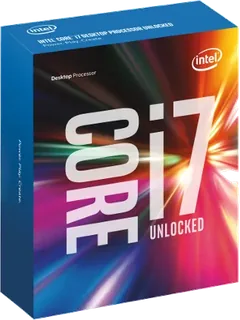
More comparisons
- Intel Core i7-6800K vs Intel Core i9-14900KS
- Intel Core i7-6700K vs Intel Core i9-14900KS
- Intel Core i5-14400F vs Intel Core i7-6800K
- Intel Core i5-14500 vs Intel Core i7-6800K
- Intel Core i5-14400F vs Intel Core i7-6700K
- Intel Core i5-14500 vs Intel Core i7-6700K
- Intel Core i5-14600K vs Intel Core i7-6800K
- Intel Core i7-14700K vs Intel Core i7-6800K
- Intel Core i7-6800K vs Intel Core i9-14900K
- Intel Core i5-14600K vs Intel Core i7-6700K
- Intel Core i7-14700K vs Intel Core i7-6700K
- Intel Core i7-6700K vs Intel Core i9-14900K
- Intel Core i7-6800K vs Intel Core i9-13900KS
- Intel Core i7-6700K vs Intel Core i9-13900KS
- Intel Core i3-13100F vs Intel Core i7-6800K
- Intel Core i3-13100F vs Intel Core i7-6700K