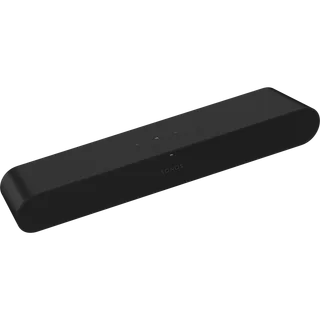
JBL Bar 2.1 Deep Bass (MK2) vs Sonos Ray
Better figure, where one is clearly better
| JBLBar 2.1 Deep Bass (MK2) | SonosRay | |
|---|---|---|
| Overview | ||
| Released | 2022 | June 2022 |
| Sound | ||
| Type | Soundbar | Soundbar |
| Channels | 2.1 | Stereo |
| Dolby Atmos | No | No |
| Drivers | Four racetrack drivers and two 1-inch tweeters in the soundbar; 6.5-inch wireless subwoofer. No dedicated centre or rear speakers | Two tweeters and two midwoofers, with a bass reflex port |
| Amplifiers | 300 W maximum total output at 1% THD: 2 × 50 W soundbar and 200 W subwoofer; maximum, not continuous RMS output | Four class-D digital amplifiers |
| Frequency response | 40 Hz–20 kHz, maker specification without a stated tolerance | – |
| Audio formats | Dolby Digital with JBL Surround Sound processing; no Dolby Atmos or DTS:X | Stereo PCM, Dolby Digital, DTS Digital Surround |
| Room tuning | Smart mode applies preset EQ and JBL Surround Sound, with Standard mode available through the remote. Low, middle and high subwoofer levels and audio/video sync adjustment; Smart mode resets on power-up | Trueplay (iOS device required); bass, treble and loudness adjustable; Speech Enhancement; Night Sound |
| Connections | ||
| Wi-Fi | No | Yes |
| Bluetooth | Yes | No |
| AirPlay | No | Yes |
| HDMI eARC | No | No |
| Voice assistants | None | None |
| Wi-Fi | – | 802.11b/g/n, 2.4 GHz |
| Bluetooth | Bluetooth 4.2; A2DP 1.3 and AVRCP 1.5 profiles | – |
| Ports | One HDMI 1.4 source input, one HDMI ARC output to the TV, optical input and USB-A for service/updates in the UK. USB music playback is US-only. No eARC; manual warns Apple TV 4K HDMI 2.0 formats are unsupported | Optical audio input; 10/100 Ethernet; IR receiver |
| Streaming | Bluetooth stereo streaming; no Wi-Fi, AirPlay or network streaming services | Apple AirPlay 2; Spotify Connect; Sonos Radio |
| Multi-room | – | Groups with other Sonos products over Wi-Fi; add a Sonos Sub and rear speakers; TV Audio Swap to Sonos Ace headphones |
| App | – | Sonos app (iOS and Android); works with the TV remote |
| Design | ||
| Weight | 2.14 kg | 1.9 kg (better) |
| Controls | Top power, volume and source buttons, front status display and remote with two AAA batteries. HDMI CEC and IR TV remote learning; no built-in voice assistant | Capacitive touch controls (play, pause, skip, replay, volume) |
| Microphones | – | None |
| Mounting | Included wall-mount bracket kit and screws | M5 threaded socket; Ray Wall Mount sold separately |
| Size | Soundbar: 965 × 56 × 85 mm (width × height × depth), 2.14 kg. Subwoofer: 5.61 kg; maker UK page and manual print 240 × 240 × 379 mm under width × height × depth, despite the pictured taller cabinet. Packaged weight: 10.32 kg | 70 × 557 × 93 mm (H × W × D) |
| Colours | Black | Black, White |
| In the box | Soundbar, wireless subwoofer, remote with batteries, region-specific power cords, HDMI cable, wall-mount kit and documentation | Ray, power cable (2 m), optical audio cable (1.5 m), documentation |

More comparisons
- Sonos Beam Ultra vs Sonos Ray
- Bose TV Speaker (2nd Gen) vs Sonos Ray
- Samsung HW-B400F vs Sonos Ray
- JBL Bar 2.1 Deep Bass (MK2) vs JBL Cinema SB510
- Sennheiser AMBEO Soundbar Mini vs Sonos Ray
- JBL Bar 2.0 All-in-one (MK2) vs Sonos Ray
- Bose Solo Soundbar 2 vs Sonos Ray
- JBL Bar 2.0 All-in-one (MK2) vs JBL Bar 2.1 Deep Bass (MK2)
- JBL Bar 2.1 Deep Bass (MK2) vs Polk Audio React