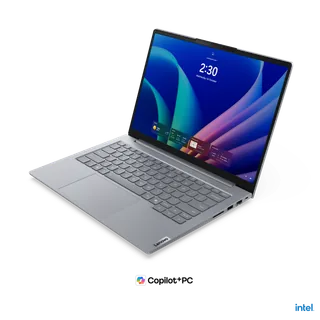
Lenovo ThinkBook 14 Gen 9 (Intel) vs Microsoft Surface Laptop 13.8″ (8th Edition)
Better figure, where one is clearly better
| LenovoThinkBook 14 Gen 9 (Intel) | MicrosoftSurface Laptop 13.8″ (8th Edition) | |
|---|---|---|
| Overview | ||
| Released | January 2026 | June 2026 |
| Display | ||
| Screen size | 14″ | 13.8″ |
| Resolution | 1920 × 1200 or 2880 × 1800 (better) | 2304 × 1536 |
| Panel | IPS LCD | IPS LCD |
| Refresh rate | 60 Hz or 120 Hz | 120 Hz |
| Brightness | 400 nits or 500 nits | 600 nits (better) |
| HDR peak brightness | – | 600 nits |
| Touchscreen | No | Yes |
| Display type | WUXGA IPS (non-touch or in-cell touch) or 2.8K (2880 × 1800) IPS, all 16:10; 90% screen-to-body ratio | PixelSense Flow touchscreen LCD, 3:2, 1300:1 contrast; dynamic refresh up to 120 Hz; strengthened glass; 10-point multi-touch |
| Pixel density | – | 201 ppi |
| Colour range | 45% NTSC (WUXGA); 100% sRGB (2.8K) | SDR mode sRGB and Vivid; HDR mode; individually colour-calibrated |
| Screen finish | Anti-glare | – |
| Display features | Contrast 1,000:1 (WUXGA non-touch), 1,200:1 (WUXGA touch) or 1,500:1 (2.8K); 2.8K is 500 nits and 120 Hz; Eyesafe Certified 2.0 or TÜV Rheinland Low Blue Light | Dolby Vision IQ; adaptive colour; adaptive contrast; auto colour management |
| Performance | ||
| Processor | Intel Core Ultra 5 325 or Intel Core Ultra 7 355 | Qualcomm Snapdragon X2 Plus X2P-64-100 |
| CPU cores | 8 | 10 |
| CPU threads | 8 | – |
| Graphics | Intel Graphics | Qualcomm Adreno X2-45 |
| AI engine (NPU) | 47 TOPS or 49 TOPS | 80 TOPS (better) |
| Memory | 16 GB or 32 GB | 16 GB, 24 GB or 32 GB |
| Storage | 512 GB to 1 TB (better) | 512 GB |
| CPU | Core Ultra 5 322 or 332 (2 P-cores, 4 LP E-cores), Core Ultra 5 325 or Core Ultra 7 355 (4 P-cores, 4 LP E-cores); 12 MB cache | Snapdragon X2 Plus X2P-64-100, 10 cores (6 prime at up to 4.0 GHz and 4 performance cores); also sold with a 12-core Snapdragon X2 Elite, whose exact model Microsoft doesn't name |
| GPU | Integrated Intel Graphics, shared memory, DirectX 12 Ultimate | Qualcomm Adreno GPU |
| AI engine | Copilot+ PC; NPU up to 49 TOPS | Qualcomm Hexagon NPU, 80 TOPS; Copilot+ PC |
| Memory type | DDR5-5600 in two SODIMM slots, dual-channel capable; up to 64 GB | LPDDR5x, 16, 24, 32 or 64 GB |
| Storage type | One M.2 2242 PCIe 4.0 x4 NVMe SSD (256 GB to 1 TB) plus an empty M.2 2280 PCIe 4.0 x4 slot; up to two drives | Removable Gen 4 SSD, 256 GB to 2 TB |
| Battery and size | ||
| Battery life (maker's claim) | Up to 18.97 hours | Up to 20 hours |
| Battery capacity | 48 Wh | 54 Wh (better) |
| Weight | 1.36 kg | 1.342 kg (better) |
| Thickness | 17.5 mm | 17.5 mm |
| Width × depth | 313.5 × 224 mm | 301 × 220 mm |
| Battery life detail | 48 Wh, MobileMark 30 up to 11.81 hr and local 1080p video up to 18.97 hr; 64 Wh, MobileMark 30 up to 13.88 hr and local video up to 24.45 hr | 54 Wh (Notebookcheck's Snapdragon X2 Plus review); up to 20 hours of local video playback or 16 hours of active web use (Microsoft test, X2 Plus, 16 GB, 512 GB) |
| Charger | 65 W USB-C (PD 3.0) adapter, 3-pin or slim wall-mount; offerings vary by country | None in the UK box; Surface 65W Power Supply sold separately |
| Fast charging | Rapid Charge Pro to 50% in 30 minutes (48 Wh battery, when off, in standby or hibernating) | Fast charging with a Surface Power Supply of at least 65 W or a USB-C PD charger of at least 60 W |
| Materials | Aluminium top; PC-ABS or aluminium bottom; MIL-STD-810H tested | Anodised aluminium; 64% recycled content in the enclosure, including 100% recycled aluminium alloy |
| Colours | Arctic Grey (dual-tone) | Jade, Dune, Black, Platinum |
| Connections | ||
| Ports | 2 × Thunderbolt 4, 2 × USB-A, HDMI, SD card slot, Ethernet, headphone jack | 2 × USB4, USB-A, headphone jack |
| Wi-Fi | Wi-Fi 6 or Wi-Fi 7 | Wi-Fi 7 |
| Bluetooth | 5.3 or 5.4 | 5.4 |
| Webcam | 1080p with IR, or 5MP; privacy shutter | 1080p Full HD with Windows Hello face camera |
| Operating system | Windows | Windows |
| Port detail | 2 × Thunderbolt 4 with USB PD 45–65 W and DisplayPort 2.1; 2 × USB-A 5 Gbps (one Always On); HDMI 2.1 up to 4K 60 Hz; Gigabit Ethernet (RJ-45); SD card reader; 3.5 mm headphone/mic combo jack | 2 × USB-C USB4 (charging, data, DisplayPort 1.4); USB-A 3.2; 3.5 mm audio jack; Surface Connect |
| External displays | Up to three external displays via HDMI and Thunderbolt (four including the built-in); Thunderbolt up to 5120 × 3200 at 60 Hz, HDMI up to 4K 60 Hz | Up to three 4K monitors at 60 Hz |
| Keyboard | 6-row, spill-resistant; 1.5 mm key travel; Copilot key; optional backlight | Backlit, full row of function keys, Copilot key |
| Trackpad | Buttonless Mylar surface, Precision TouchPad, 75 × 120 mm | Surface precision haptic touchpad with adaptive touch mode |
| Speakers | Stereo 2 W × 2, Dolby Audio | Omnisonic speakers with Dolby Atmos |
| Microphones | Dual-microphone array with noise cancelling | Dual Studio Mics with voice focus |
| Biometrics | Optional fingerprint reader in the power button (match-on-chip); optional IR camera for Windows Hello | Windows Hello face recognition |
| In the box | – | Surface Laptop, Quick Start Guide, safety and warranty documents |

More comparisons
- Dell XPS 14 DA14260 vs Microsoft Surface Laptop 13.8″ (8th Edition)
- Lenovo ThinkPad E14 Gen 7 (Intel) vs Microsoft Surface Laptop 13.8″ (8th Edition)
- Microsoft Surface Laptop 13.8″ (8th Edition) vs Microsoft Surface Laptop 15″ (8th Edition)
- Microsoft Surface Laptop 13″ (1st Edition) vs Microsoft Surface Laptop 13.8″ (8th Edition)
- Lenovo ThinkBook 14 2-in-1 Gen 6 vs Lenovo ThinkBook 14 Gen 9 (Intel)
- Dell XPS 14 DA14260 vs Lenovo ThinkBook 14 Gen 9 (Intel)
- Lenovo ThinkBook 14 Gen 9 (Intel) vs Samsung Galaxy Book6 Pro (14″)
- ASUS ROG Zephyrus G14 (2026) GU405 vs Lenovo ThinkBook 14 Gen 9 (Intel)
- Lenovo ThinkBook 14 Gen 9 (Intel) vs Lenovo ThinkBook 16 Gen 9 (Intel)
- Lenovo ThinkBook 14 Gen 9 (Intel) vs Lenovo ThinkBook Plus Gen 6 Rollable