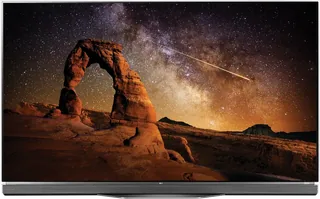
LG OLED E6 (2016) vs LG OLED evo G1
Better figure, where one is clearly better
| LGOLED E6 (2016) | LGOLED evo G1 | |
|---|---|---|
| Overview | ||
| Released | 2016 | March 2021 |
| Display | ||
| Panel | OLED | OLED |
| Panel detail | – | Self-lit OLED evo panel with pixel dimming and Ultra Luminance Pro |
| Resolution | 3840 × 2160 (4K) | 3840 × 2160 (4K) |
| Refresh rate | 120 Hz | 120 Hz |
| HDR formats | Dolby Vision, HDR10 | Dolby Vision, HDR10, HLG |
| HDR extras | LG's Austrian OLED55E6V page says its OLED HDR feature was due by software update; the Italian 65E6V page explicitly lists HDR10 and Dolby Vision. Availability may have varied with firmware and region. | – |
| Picture processing | Picture-on-Glass flat OLED with pixel dimming, 4K upscaling and Ultra Luminance; passive CINEMA 3D with two pairs of glasses supplied. | AI Picture Pro, AI upscaling, AI Brightness Control, auto genre selection and Filmmaker Mode |
| Motion handling | Native 120Hz panel in RTINGS' US E6 review; HDMI accepts 4K up to 60Hz. TruMotion interpolation is separate from input refresh. | Native 120Hz panel; OLED Motion Pro |
| Sizes | ||
| Sizes | 55, 65″ | 55, 65, 77″ |
| Largest size | 65″ | 77″ (better) |
| Gaming | ||
| HDMI ports | 4 (0 HDMI 2.1 at 4K 120 Hz+) | 4 (all HDMI 2.1 at 4K 120 Hz+) (better) |
| Variable refresh rate | None | HDMI VRR, FreeSync, G-Sync Compatible |
| Auto low latency mode | – | Yes |
| HDMI detail | Four HDMI 2.0a inputs, one with ARC, with 4K 60Hz, HDR and HDCP 2.2 support (AVForums); no HDMI 2.1. | Four HDMI inputs support 4K 120Hz, VRR and ALLM; eARC on HDMI 2. What Hi-Fi? identifies 40Gbps ports. |
| Input lag | 34–42 ms in Game mode on AVForums' OLED65E6V review sample. | – |
| Game features | Game picture mode; no VRR or HDMI 120Hz input. | Game Optimiser, HGiG, NVIDIA G-SYNC Compatible and AMD FreeSync Premium |
| Smart TV and sound | ||
| Smart TV platform | webOS | webOS |
| Processor | Quad-core (LG Austria) | α9 Gen4 AI Processor 4K |
| Speakers | 40 W, 2.2 channels | 60 W, 4.2 channels (better) |
| Dolby Atmos | – | Yes |
| eARC | – | Yes |
| Wi-Fi | Wi-Fi 5 (802.11ac) | Wi-Fi 5 (802.11ac) |
| Bluetooth | – | 5.0 |
| Speaker detail | 40 W, 2.2-channel Harman Kardon-designed integrated soundbar in the stand. | Down-firing 4.2-channel speakers; 20 W woofer output within the 60 W total |
| Audio features | OLED Surround, Magic Sound Tuning, Clear Voice III, DTS-HD decoding and optical/wireless Sound Sync. | AI Sound Pro with virtual 5.1.2 up-mixing, acoustic tuning, Clear Voice Pro, Bluetooth Surround Ready and WiSA 5.1 support |
| Voice assistants | – | LG voice search, Google Assistant and Amazon Alexa |
| Casting | Miracast and DLNA supported; Bluetooth supported, version unpublished. | AirPlay 2, Apple HomeKit, screen sharing and ThinQ app |
| Software updates | webOS 3.0 with Magic Zoom and Magic Mobile Connection. LG's 24 May 2016 US release confirms the E6 series already at retailers, but does not establish its first sale month; release is therefore recorded at year precision. | webOS 6.0. LG's March 24, 2021 US release confirms G1 available online, with 65/77-inch models in March and the 55-inch model listed for April; release uses the first confirmed series month rather than a universal size-specific day. What Hi-Fi?'s pre-launch review describes Freeview Play as forthcoming, while Tech Advisor's April review confirms its return. |
| TV tuners | DVB-T2/C/S2 and CI+; USB recording and time shift for digital TV. | UK DVB-T/T2, DVB-C and DVB-S2; CI+ 1.4, eight-day programme guide and USB recording/time shift |
| USB | Three USB ports, one USB 3.0 and two USB 2.0 (LG Italy; LG Austria's total reads one despite this breakdown). | Three USB ports |
| Ethernet | Ethernet LAN port. | Ethernet LAN port |
| Optical audio out | Optical digital audio output, plus headphone/line output. | Optical digital audio output and shared headphone/line output |
| Design and power | ||
| Size | Without stand (W × H × D), LG Austria: 55″ 1237 × 767 × 56.7 mm; 65″ 1461 × 893 × 56.7 mm. | Without stand (W × H × D): 55″ 1225 × 706 × 23.1 mm; 65″ 1446 × 830 × 19.9 mm; 77″ 1721 × 991 × 24.1 mm |
| Stand | Integrated soundbar stand; with stand (W × H × D), LG Austria: 55″ 1237 × 767 × 175 mm; 65″ 1461 × 893 × 200 mm. | Flush-fit wall mount supplied; tabletop feet sold separately. With optional feet (W × H × D): 55″ 1225 × 765 × 271 mm; 65″ 1446 × 888 × 284 mm; 77″ 1721 × 1050 × 323 mm |
| VESA pattern | 400 × 200 mm for both sizes. | – |
| Power use | LG Austria lists 145 W operating and 0.5 W standby for each size. | Under 0.5 W standby; 100–240 V AC, 50–60Hz supply |
| In the box | Magic Motion Remote Control and two pairs of passive 3D glasses; What Hi-Fi? also reports a slim second remote on its 65-inch review unit. | Flush wall mount, MR21N Magic Remote, two AA batteries, IR blaster cable and attached power cable |

More comparisons
- LG OLED evo G1 vs Samsung OLED S95H
- LG OLED evo G1 vs LG OLED evo G6
- LG OLED E6 (2016) vs LG OLED evo C6
- LG OLED B6 vs LG OLED evo G1
- LG OLED B6 vs LG OLED E6 (2016)
- LG OLED evo G1 vs Sony BRAVIA 8 II
- Hisense A85Q vs LG OLED E6 (2016)
- LG OLED B5 vs LG OLED evo G1
- LG OLED B5 vs LG OLED E6 (2016)
- LG OLED B4 vs LG OLED evo G1
- LG OLED evo G1 vs LG OLED evo G4
- LG OLED B4 vs LG OLED E6 (2016)
- LG OLED E6 (2016) vs LG OLED evo G4
- LG OLED evo G1 vs Panasonic MZ2000
- LG OLED B3 vs LG OLED evo G1
- LG OLED B3 vs LG OLED E6 (2016)