LG OLED EG9600 vs LG OLED evo C6
Better figure, where one is clearly better
| LGOLED EG9600 | LGOLED evo C6 | |
|---|---|---|
| Overview | ||
| Released | 2015 | March 2026 |
| Display | ||
| Panel | OLED | OLED |
| Panel detail | Curved WRGB OLED with passive Cinema 3D and Ultra Luminance | WOLED; 77″ and 83″ use a Primary RGB Tandem panel with Hyper Radiant Colour Tech |
| Resolution | 3840 × 2160 (4K) | 3840 × 2160 (4K) |
| Refresh rate | – | 165 Hz |
| HDR formats | None | Dolby Vision, HDR10, HLG |
| HDR extras | – | Dolby Vision IQ |
| Screen finish | – | Glossy |
| Peak brightness | – | 1,251 nits in HDR on a 10% window, 65″ (Tom's Guide) |
| Picture processing | Triple XD Engine, 4K upscaling, Real Cinema 24p and HEVC decoding up to 4K 60p, per the exact European maker tables | AI Picture Pro, AI HDR Remastering, Brightness Booster; 77″ and 83″ add Hyper Radiant Colour Tech (up to 3.2x peak brightness) |
| Picture modes | – | FILMMAKER MODE with Ambient Light Compensation, Creator Original mode |
| Motion handling | Native panel refresh rate unconfirmed; Absolute Motion Clarity and 4K 60p input compatibility are not native-Hz figures. | – |
| Sizes | ||
| Sizes | 55, 65″ | 42, 48, 55, 65, 77, 83″ |
| Largest size | 65″ | 83″ (better) |
| Gaming | ||
| HDMI ports | 3 (0 HDMI 2.1 at 4K 120 Hz+) | 4 (all HDMI 2.1 at 4K 120 Hz+) (better) |
| Variable refresh rate | None | HDMI VRR, G-Sync Compatible, FreeSync Premium |
| Auto low latency mode | – | Yes |
| HDMI detail | Three HDMI inputs; maker table specifically lists two side inputs supporting 4K 60p. HDTVTest identifies HDMI 1 and 2 as HDMI 2.0 with HDCP 2.2; ARC support confirmed by both exact UK reviews. AVForums claims MHL, conflicting with the French maker table's No, so MHL support is not asserted. | 4K 120 Hz on all four ports; eARC, VRR, ALLM, QMS and QFT |
| Game features | – | Up to 4K 165 Hz; G-SYNC Compatible, FreeSync Premium, HGiG, VESA ClearMR 10000, 0.1 ms response; Game Dashboard and Optimiser; Bluetooth Ultra Low Latency controllers (under 2.5 ms) |
| Cloud gaming | – | NVIDIA GeForce NOW (4K 120 Hz HDR) |
| Input lag | 49 ms in Game mode (HDTVTest); 52 ms (AVForums) | – |
| Smart TV and sound | ||
| Smart TV platform | webOS | webOS |
| Processor | Tru Ultra HD Engine | alpha 11 AI Processor 4K Gen3 (Dual AI Engine) |
| Dolby Atmos | – | Yes |
| DTS:X | – | No |
| eARC | – | Yes |
| Speakers | 20 W, 2.0 channels | – |
| Wi-Fi | Built-in Wi-Fi | Wi-Fi 6 |
| Bluetooth | – | 5.3 |
| Speaker detail | Harman Kardon 20 W, 2.0-channel system with tweeters and Ultra Surround | 42″ 20 W, 2.0 ch; 48″ to 83″ 40 W, 2.2 ch |
| Audio features | Dolby Digital and DTS decoding, Clear Voice II, optical and wireless Sound Sync; aptX encoder listed by LG France | Virtual 11.1.2 ch, AI Sound, AI Object Remastering Ultra, Dolby Atmos |
| Voice assistants | Voice control through the Magic Remote | – |
| Casting | DLNA, WiDi and Miracast | – |
| Software updates | webOS 2.0. The UK launch reviews describe no HDR support; a bounded exact European firmware search did not verify its later availability. Separately, LG's US September 2015 release confirms EG9600 HDR streaming after a firmware update, and Japan's November release confirms network/USB HDR with HDMI explicitly unsupported. Japan's current page names HDR10. Those regional updates are not assigned to the UK EG960V main HDR fields. First-sale year remains 2015: the UK April review confirms retail availability, but an exact first worldwide sale month remains unresolved. | webOS 26; webOS Re:New Program upgrades for up to 5 years |
| TV tuners | DVB-T2, DVB-C and DVB-S2; CI+ 1.3; HbbTV and USB hard-drive recording/time shift. UK Freeview HD and satellite reception confirmed by the exact reviews. | – |
| USB | Three USB inputs, one USB 3.0 and two USB 2.0 | 2 × USB 2.0 |
| Ethernet | Ethernet LAN port | – |
| Optical audio out | Optical digital audio output and headphone output | – |
| Design and power | ||
| Size | Without stand (W × H × D): 55″ 1226 × 719 × 49.9 mm; 65″ 1447 × 826 × 49.9 mm | Without stand, 42″ 932 × 540 × 41.1 mm; 48″ 1071 × 620 × 46.9 mm; 55″ 1222 × 703 × 45.1 mm; 65″ 1441 × 826 × 45.1 mm; 77″ 1711 × 982 × 47.1 mm; 83″ 1842 × 1055 × 52.9 mm |
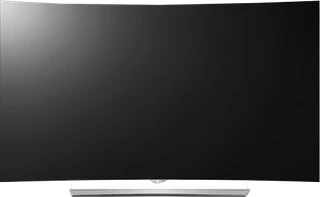
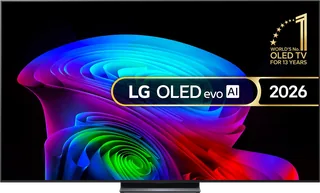
| Stand | With stand (W × H × D; weight): 55″ 1226 × 760 × 213 mm, 18.9 kg; 65″ 1447 × 884 × 237 mm, 25.1 kg. Fixed curved metal base with transparent support; no swivel. | Central pedestal stand; 65″ stands 880 mm tall on it, stand footprint 470 × 230 mm |
| VESA pattern | – | 48″, 55″ and 65″ 300 × 200 mm; 83″ 400 × 400 mm |
| Warranty | – | OLED Care+ covers the panel for 5 years |
| Power use | Maker European energy-table on-mode/standby: 55″ 134/0.3 W; 65″ 142/0.3 W; 100–240 V AC, 50–60Hz supply. The pages' annual-consumption unit is inconsistent, so no annual figure is copied. | – |
| In the box | MR15 Magic Remote and two pairs of F310 passive 3D glasses in the European maker table; AVForums' review sample also included two clip-on pairs, which is not assumed for every retail package | – |
More comparisons
- LG OLED evo C6 vs LG OLED evo W6
- LG OLED evo C6 vs Samsung OLED S90H
- LG OLED evo C3 vs LG OLED evo C6
- LG OLED evo C2 vs LG OLED evo C6
- LG OLED C1 vs LG OLED evo C6
- LG OLED CX vs LG OLED evo C6
- LG OLED B3 vs LG OLED evo C6
- LG OLED evo C6 vs Samsung OLED S95C
- LG OLED C9 vs LG OLED evo C6
- LG OLED C8 vs LG OLED evo C6
- LG OLED B8 vs LG OLED evo C6
- LG OLED C7 vs LG OLED evo C6
- LG OLED C6 (2016) vs LG OLED evo C6
- LG OLED evo C4 vs LG OLED evo C6
- LG OLED evo C5 vs LG OLED evo C6
- LG OLED evo C6 vs Sony A80J