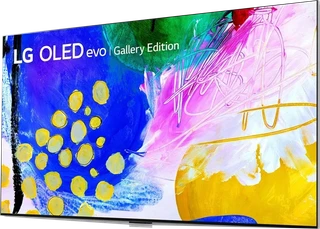
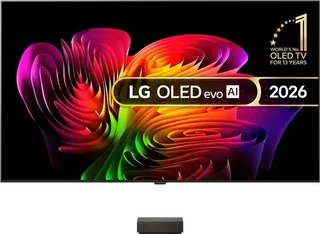
LG OLED evo G2 vs LG OLED evo W6
Better figure, where one is clearly better
| LGOLED evo G2 | LGOLED evo W6 | |
|---|---|---|
| Overview | ||
| Released | March 2022 | July 2026 |
| Display | ||
| Panel | OLED | OLED |
| Panel detail | OLED evo with pixel dimming and Brightness Booster Max | Hyper Radiant Colour Tech with Brightness Booster Ultra; pixel dimming |
| Resolution | 3840 × 2160 (4K) | 3840 × 2160 (4K) |
| Refresh rate | 120 Hz | 165 Hz (better) |
| HDR formats | Dolby Vision, HDR10, HLG | Dolby Vision, HDR10, HLG |
| Screen finish | – | Reflection Free Premium anti-reflection treatment |
| Peak brightness | – | LG claims up to 3.9 times the peak brightness of conventional OLED on a 3% window in its internal measurements; no absolute nit figure published |
| Colour range | – | DCI-P3 colour gamut volume met or exceeded, verified by Intertek; 100% Colour Fidelity certification |
| HDR extras | Dolby Vision IQ; Dynamic Tone Mapping Pro | – |
| Picture processing | AI Picture Pro, AI 4K Upscaling, AI Brightness Control and Filmmaker Mode | AI Picture Pro, AI HDR Remastering, Dynamic Tone Mapping Ultra and Alpha 11 AI Super Upscaling 4K; automatic brightness control and auto calibration |
| Picture modes | – | Nine modes, including FILMMAKER MODE |
| Motion handling | UK 55″ to 83″ sheets label 100Hz native with 4K 120fps HFR; the 97″ sheet labels 120Hz. The main rate records highest native-resolution support. | OLED Motion |
| Sizes | ||
| Sizes | 55, 65, 77, 83, 97″ | 77, 83″ |
| Largest size | 97″ (better) | 83″ |
| Gaming | ||
| HDMI ports | 4 (all HDMI 2.1 at 4K 120 Hz+) | 4 (all HDMI 2.1 at 4K 120 Hz+) |
| Variable refresh rate | HDMI VRR, FreeSync, G-Sync Compatible | HDMI VRR, G-Sync Compatible, FreeSync Premium |
| Auto low latency mode | Yes | Yes |
| HDMI detail | Four 4K 120Hz inputs; the 97″ maker sheet explicitly confirms all four. The exact UK 65″ review by Trusted Reviews confirms four HDMI 2.1 inputs with VRR/ALLM and eARC on HDMI 2; UK smaller-size maker pages omit this connectivity table. | Four HDMI inputs on the Zero Connect Box support 4K 120Hz, VRR, ALLM, QMS and QFT; eARC on HDMI 3. Box transmits video and audio wirelessly up to 10 m from the screen |
| Variable refresh range | – | Up to 165 Hz; LG lists a 120 Hz native refresh rate with 165 Hz VRR |
| Game features | HGiG, Game Optimiser and Game Dashboard; FreeSync Compatible and G-Sync Compatible | HGiG, Game Optimiser and Dashboard, Dolby Vision gaming at 4K 120Hz; under 0.1 ms pixel response time (LG). Bluetooth Ultra Low Latency controller support |
| Cloud gaming | – | NVIDIA GeForce NOW supports 4K 120Hz HDR with a compatible subscription |
| Smart TV and sound | ||
| Smart TV platform | webOS | webOS |
| Processor | α9 Gen5 AI Processor 4K | Alpha 11 AI Processor 4K Gen3 with Dual AI Engine |
| Speakers | – | 60 W, 4.2 channels |
| Dolby Atmos | Yes | Yes |
| eARC | Yes | Yes |
| Wi-Fi | – | Wi-Fi 6E |
| Bluetooth | – | 5.3 |
| Speaker detail | Reviewed 65″: 60 W, 4.2 channels (What Hi-Fi?); maker 97″: 60 W, 4.2 channels. | Down-firing speakers |
| Audio features | Dolby Atmos; AI Sound Pro virtual 7.1.2 up-mix. Trusted Reviews reports no DTS passthrough on its 65″ sample. | Alpha 11 AI Sound Pro with virtual 11.1.2-channel up-mixing, AI Object Remastering Ultra, Clear Voice Pro, adaptive acoustic tuning, WOW Orchestra and LG Sound Sync |
| Voice assistants | – | Hands-free voice control, AI Voice ID and Google Gemini through AI Search; features vary by region |
| Casting | Apple AirPlay 2; Apple HomeKit listed on 55″ to 83″ UK sheets | Apple AirPlay and Google Cast; Apple Home, Google Home and LG ThinQ support |
| Software updates | Launch webOS 22; UK maker lists security updates until 31 December 2026 | webOS 26; webOS Re:New upgrades for up to five years. LG lists security updates until 31 December 2030 for the 77″ model |
| TV tuners | – | DVB-T2, DVB-C and DVB-S2; two RF inputs and one CI slot |
| USB | – | 2 × USB 2.0 |
| Ethernet | – | One Ethernet port |
| Optical audio out | – | One optical digital audio output |
| Design and power | ||
| Size | Without stand (W × H × D): 55″ 1222 × 698 × 27.2 mm; 65″ 1441 × 821 × 24.3 mm; 77″ 1712 × 976 × 24.8 mm; 83″ 1847 × 1052 × 28.0 mm; 97″ 2155 × 1225 × 28.2 mm | Screen, 77″ 1713 × 988 × 9.95 mm; 83″ 1844 × 1061 × 9.95 mm (W × H × D) |
| Stand | Flush-fit wall mount supplied; tabletop stand optional. The 97″ version joined the range later than the March 2022 first availability of 65″ and 77″. | Flush wall mounting with the supplied dedicated mount; no tabletop stand |
| Power use | – | Standby under 0.5 W; screen and Zero Connect Box require separate power connections |
| Energy class | – | F (UK and EU labels) |
| Warranty | – | Five-year limited panel warranty |
| In the box | – | Screen, Zero Connect Box, flush wall mount, AI Magic Remote and power connections |
| VESA pattern | 55″ 300 × 200 mm; 65″ 300 × 300 mm; 83″ 400 × 400 mm; UK 97″ sheet leaves VESA unpublished | – |
More comparisons
- LG OLED evo W6 vs Samsung OLED S90H
- LG OLED evo W6 vs Samsung OLED S95F
- LG OLED evo W6 vs Samsung OLED S90D
- LG OLED evo C6 vs LG OLED evo W6
- LG OLED evo G6 vs LG OLED evo W6
- LG OLED evo C5 vs LG OLED evo W6
- LG OLED evo G5 vs LG OLED evo W6
- LG OLED evo C4 vs LG OLED evo W6
- LG OLED evo C3 vs LG OLED evo W6
- LG OLED evo G3 vs LG OLED evo W6
- LG OLED evo C2 vs LG OLED evo W6
- LG OLED evo G2 vs Samsung OLED S95H
- LG OLED evo G2 vs LG OLED evo G6
- LG OLED evo C6 vs LG OLED evo G2
- LG OLED evo G2 vs Sony BRAVIA 8 II
- LG OLED evo G2 vs LG OLED evo G5