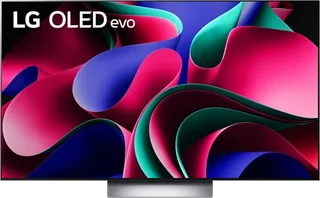
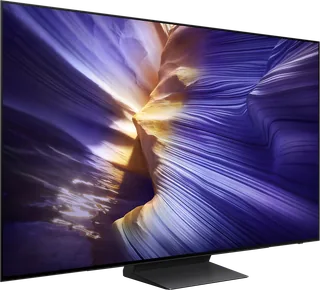
LG OLED evo G3 vs Samsung OLED S90F
Better figure, where one is clearly better
| LGOLED evo G3 | SamsungOLED S90F | |
|---|---|---|
| Overview | ||
| Released | March 2023 | May 2025 |
| Display | ||
| Panel | OLED | OLED (42, 48, 55, 77, 83″), QD-OLED (65″) |
| Panel detail | Self-lit OLED with pixel dimming and Brightness Booster Max; the brightness boost and anti-reflection treatment differ by size | Samsung doesn't say which panel each size uses; RTINGS reports the UK 65″ (QE65S90FATXXU) as QD-OLED and the "AE" models as WOLED |
| Resolution | 3840 × 2160 (4K) | 3840 × 2160 (4K) |
| Refresh rate | 120 Hz | 144 Hz (better) |
| HDR formats | Dolby Vision, HDR10, HLG | HDR10, HDR10+, HLG |
| HDR extras | OLED Dynamic Tone Mapping Pro | OLED HDR+ (OLED HDR on 42″ and 48″); HDR10+ Adaptive and HDR10+ Gaming |
| Screen finish | – | Anti Reflection; glossy (RTINGS) |
| Colour range | – | Pantone Validated |
| Peak brightness | LG states a brightness increase against its B3 of up to 70% on 55″, 65″ and 77″ G3, and 30% on 83″; these are relative maker claims, not measured luminance. Super Anti Reflective treatment applies to 55″, 65″ and 77″. | – |
| Picture processing | AI Picture Pro, AI Super Upscaling 4K, AI Genre Selection and AI Brightness Control | 4K AI Upscaling Pro, AI Motion Enhancer Pro, Real Depth Enhancer, Auto HDR Remastering Pro, HDR Brightness Optimizer; Color Booster Pro on 42″ |
| Picture modes | – | Filmmaker Mode; Smart Calibration (Basic); EyeComfort Mode on 42″ |
| Motion handling | LG UK labels the panel 100Hz native and explicitly supports 4K 120fps HFR and 4K 120Hz HDMI input; 120Hz records the highest supported native-resolution rate. | Motion Xcelerator 144Hz |
| Viewing angle | – | Ultra Viewing Angle |
| Sizes | ||
| Sizes | 55, 65, 77, 83″ | 42, 48, 55, 65, 77, 83″ |
| Largest size | 83″ | 83″ |
| Gaming | ||
| HDMI ports | 4 (all HDMI 2.1 at 4K 120 Hz+) | 4 (all HDMI 2.1 at 4K 120 Hz+) |
| Variable refresh rate | HDMI VRR, FreeSync, G-Sync Compatible | HDMI VRR, FreeSync Premium Pro |
| Auto low latency mode | Yes | Yes |
| HDMI detail | 4 × HDMI with 4K 120Hz, VRR, ALLM and QMS on all ports; eARC on HDMI 2. QMS requires a compatible source. | 4K 144Hz on HDMI 1/2/3/4; eARC; Anynet+ (HDMI-CEC) |
| Game features | HGiG, Game Optimiser, Game Dashboard, FreeSync Compatible and G-Sync Compatible | FreeSync Premium Pro (FreeSync Premium on 42″ and 48″), HGiG, Game Motion Plus, Dynamic Black EQ, Super Ultra Wide Game View, Mini Map Zoom |
| Cloud gaming | – | Samsung Gaming Hub |
| Smart TV and sound | ||
| Smart TV platform | webOS | Tizen |
| Processor | α9 AI Processor 4K Gen6 | NQ4 AI Gen3 Processor |
| Speakers | 60 W, 4.2 channels | – |
| Dolby Atmos | Yes | Yes |
| eARC | Yes | Yes |
| Wi-Fi | Wi-Fi 6 | Wi-Fi 5 |
| Bluetooth | 5.0 | 5.3 |
| Speaker detail | 60 W, 4.2-channel down-firing speakers | 42″ 20 W, 2ch; 65″ 40 W, 2.1ch, OTS Lite; 48″, 55″, 77″ and 83″ 60 W, 2.1.2ch, OTS |
| Audio features | AI Sound Pro virtual 9.1.2 up-mix, Clear Voice Pro, AI Acoustic Tuning and Bluetooth Surround Ready | Q-Symphony, Adaptive Sound Pro, 360 Audio, Audio Pre-selection Descriptor |
| Voice assistants | – | Bixby and Alexa built in, with far-field voice; works with Alexa and Google Assistant speakers |
| Casting | Apple AirPlay 2 | Apple AirPlay, Tap View and screen or sound mirroring from Samsung phones |
| Software updates | Launch software webOS 23; UK maker lists security updates until 31 December 2027 | Security updates until at least 31 December 2030 |
| TV tuners | – | Twin DVB-T2/C/S2 and analogue; CI+ 1.4 slot; HbbTV 2.0.4 |
| USB | 3 × USB 2.0 | 2 × USB-A |
| Ethernet | 1 × Ethernet | 1 × LAN |
| Optical audio out | 1 × optical | 1 × optical |
| Design and power | ||
| Size | Without stand (W × H × D): 55″ 1222 × 703 × 27.2 mm; 65″ 1441 × 826 × 24.3 mm; 77″ 1712 × 982 × 24.8 mm; 83″ 1847 × 1057 × 28.0 mm | Without stand, 42″ 934.4 × 542.6 × 39.5 mm; 48″ 1069.3 × 619.9 × 39.6 mm; 55″ 1225.4 × 708.6 × 39.9 mm; 65″ 1444.3 × 831.7 × 39.9 mm; 77″ 1718.5 × 987.6 × 44.9 mm; 83″ 1851.0 × 1062.8 × 44.9 mm |
| Stand | Designed for wall mounting; tabletop stand sold separately | Blade stand; footprint 652.5 × 206.3 mm (42″), 366 × 265.2 mm (48″ to 65″), 366 × 359 mm (77″, 83″) |
| VESA pattern | 55″ 300 × 200 mm; 65″ and 77″ 300 × 300 mm; 83″ 400 × 400 mm | 42″ 200 × 200 mm; 48″ to 65″ 300 × 200 mm; 77″ and 83″ 400 × 300 mm |
| Power use | Under 0.5 W standby | Typical/max, 42″ 52/195 W; 48″ 64.7/230 W; 55″ 80/380 W; 65″ 89/420 W; 77″ 125/630 W; 83″ 150/740 W; 0.5 W standby |
| Energy class | – | G (42″, 48″, 55″); F (65″, 77″, 83″) |
| Colours | – | Graphite Black |
| In the box | Magic Remote, 2 AA batteries, IR blaster cable and attached power cable | Remote controls TM2560E and TM1240A (UK), power cable, user manual |
More comparisons
- LG OLED evo G3 vs LG OLED evo W6
- Samsung OLED S90F vs Samsung OLED S90H
- LG OLED evo G3 vs Samsung OLED S95H
- Samsung OLED S90F vs Samsung OLED S95H
- LG OLED evo G3 vs LG OLED evo G6
- LG OLED B6 vs Samsung OLED S90F
- LG OLED evo C6 vs LG OLED evo G3
- LG OLED evo C6 vs Samsung OLED S90F
- LG OLED evo G3 vs Sony BRAVIA 8 II
- Samsung OLED S90C vs Samsung OLED S90F
- LG OLED evo C4 vs Samsung OLED S90F
- LG OLED evo C5 vs Samsung OLED S90F
- Samsung OLED S90D vs Samsung OLED S90F
- Samsung OLED S90F vs Samsung OLED S95C
- Samsung OLED S90F vs Samsung OLED S95B
- LG OLED B5 vs Samsung OLED S90F