Marshall Stanmore III vs Sonos Five
Better figure, where one is clearly better
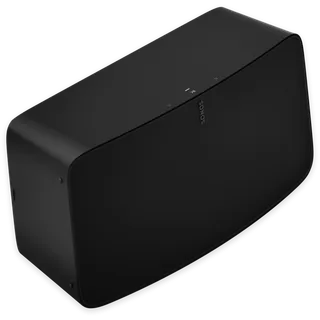
| MarshallStanmore III | SonosFive | |
|---|---|---|
| Overview | ||
| Released | June 2022 | June 2020 |
| Sound | ||
| Type | Speaker | Speaker |
| Channels | Stereo | Stereo lying flat; mono upright |
| Dolby Atmos | No | No |
| Drivers | One woofer and two tweeters angled outwards, with updated waveguides; bass-reflex cabinet | Three tweeters (one centre, two angled) and three midwoofers, in a sealed cabinet |
| Amplifiers | One 50 W class D for the woofer, two 15 W class D for the tweeters | Six class-D digital amplifiers |
| Frequency response | 45 Hz – 20 kHz; up to 97 dB at 1 m | – |
| Room tuning | Placement Correction in the Marshall Bluetooth app; bass and treble knobs on the speaker | Trueplay (iOS device required); bass, treble and loudness adjustable in the Sonos app |
| Connections | ||
| Wi-Fi | No | Yes |
| Bluetooth | Yes | No |
| AirPlay | No | Yes |
| HDMI eARC | No | – |
| Voice assistants | None | None |
| Wi-Fi | – | 802.11a/b/g/n, 2.4 GHz and 5 GHz |
| Bluetooth | Bluetooth 5.2, LE Audio-ready; 10 m range | – |
| Ports | RCA in, 3.5 mm in, mains power | 3.5 mm line-in; 10/100 Ethernet |
| Streaming | – | Apple AirPlay 2; direct control from apps such as Spotify and TIDAL; Sonos Radio |
| Multi-room | None; Marshall says it can't be used in pairs or groups | Groups with other Sonos products over Wi-Fi; two make a stereo pair, upright or lying flat |
| App | Marshall Bluetooth app (iOS and Android), with over-the-air updates | Sonos app (iOS and Android) |
| Design | ||
| Weight | 4.25 kg (better) | 6.3 kg |
| Controls | Source button, volume, bass and treble knobs, play/pause and skip control, power switch | Capacitive touch controls (play, pause, skip, replay, volume) that adapt to orientation |
| Microphones | None | None |
| Size | 350 × 203 × 188 mm (W × H × D) | 203 × 364 × 154 mm (H × W × D) |
| Colours | Black, Cream, Brown | Black, White |
| In the box | Stanmore III, mains lead, user manual and legal and safety information | Five, power cable (2 m), documentation |

More comparisons
- Marshall Stanmore III vs Marshall Stanmore IV
- Bowers & Wilkins Zeppelin Pro Edition vs Sonos Five
- Marshall Stanmore III vs Sonos Era 300
- Marshall Stanmore III vs Sonos Era 100
- Marshall Acton III vs Marshall Stanmore III
- Marshall Woburn III vs Sonos Five
- Bowers & Wilkins Zeppelin vs Marshall Stanmore III
- Bowers & Wilkins Zeppelin vs Sonos Five
- Apple HomePod (1st generation) vs Sonos Five