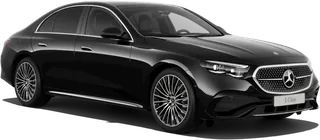
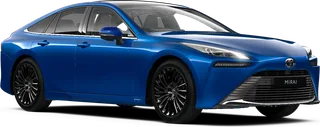
Mercedes-Benz E-Class Saloon vs Toyota Mirai
Better figure, where one is clearly better
| Mercedes-BenzE-Class Saloon | ToyotaMirai | |
|---|---|---|
| Overview | ||
| Released | 2023 | May 2021 |
| Performance | ||
| Powertrain | Mild hybrid, Plug-in hybrid | Hydrogen fuel cell |
| Power | 194–308 bhp (better) | 180 bhp |
| 0–62 mph | 6.4–7.6 s (better) | 9.2 s |
| Top speed | 146–149 mph (better) | 108 mph |
| Engine or motors | E 200: 1,999 cc four-cylinder turbo petrol, 150 kW (204 hp) plus 17 kW mild-hybrid motor; E 220 d: 1,993 cc four-cylinder diesel, 145 kW (197 hp) plus 17 kW; E 300 e and E 300 de: the same engines plus a 95 kW (129 hp) electric motor, 230 kW (313 hp) system output; bhp converted from Mercedes' kW figures | Hydrogen fuel cell electric: polymer electrolyte fuel cell stack (FCB130, 330 cells), 172 bhp (174 DIN hp, 128 kW); rear permanent-magnet synchronous motor, 180 bhp (182 DIN hp, 134 kW); lithium-ion buffer battery, 84 cells, 310.8 V, 4.0 Ah |
| Torque | 320 Nm (E 200), 440 Nm (E 220 d), 550 Nm system (E 300 e), 700 Nm system (E 300 de) | 300 Nm |
| Gearbox | 9G-TRONIC 9-speed automatic | Single-speed reduction gear (11.691:1) |
| Drive | Rear-wheel drive | Rear-wheel drive (0–62 mph in 9.2 s on the Toyota UK site; 9.0 s in Toyota's November 2024 press specifications) |
| Range and charging | ||
| Zero-emission range (WLTP) | 65–67 miles | 400 miles (better) |
| Battery | 19.53 kWh | – |
| Fastest charging | 55 kW | – |
| Economy (WLTP) | 43.5–176.6 mpg | – |
| Range detail | WLTP electric range 67 miles (E 300 e) or 65 miles (E 300 de); equivalent all-electric range 71 miles | Up to 400 miles on a full 5.6 kg (142.2-litre) load of hydrogen in three tanks |
| Charging | Plug-in hybrids: 19.53 kWh usable battery; 11 kW AC (0–100% in 2 hours); DC up to 55 kW (10–80% in 20 minutes) | Refuels with hydrogen in about five minutes; no plug-in charging |
| Efficiency | WLTP combined: 43.5 mpg (E 200), 58.9 mpg (E 220 d), 134.6 mpg (E 300 e), 176.6 mpg (E 300 de); plug-in hybrids 14.7 kWh/100 km | WLTP combined: 0.79 kg hydrogen/100 km (19-inch wheels), 0.89 kg/100 km (20-inch wheels) |
| CO2 emissions | 148 g/km (E 200), 126 g/km (E 220 d), 48 g/km (E 300 e) and 40 g/km (E 300 de) weighted | 0 g/km CO2; water only |
| Practicality | ||
| Body | Saloon | Saloon |
| Seats | 5 | 5 |
| Boot | 540 litres (better) | 321 litres |
| Length | 4,949 mm | 4,975 mm |
| Width | 1,904 mm | 1,885 mm |
| Weight | From 1,873 kg | From 1,900 kg |
| Boot | 540 litres (E 200, E 220 d); 370 litres (plug-in hybrids) | 321 litres (VDA) |
| Towing | 2,100 kg braked, 750 kg unbraked | Not permitted |
| Size | 4,949 mm long, 1,904 mm wide without mirrors (2,065 mm with), 1,468 mm high (1,480 mm plug-in hybrids); 11.6 m turning circle; kerb weight 1,873 kg (E 200) to 2,273 kg (E 300 de); 66-litre fuel tank (50 litres plug-in hybrids) | 4,975 mm long, 1,885 mm wide, 1,470 mm high (1,480 mm with the Design Premium Pack); 2,920 mm wheelbase; 150 mm ground clearance; 5.8 m turning radius (tyres); drag coefficient 0.29; kerb weight 1,900–1,950 kg |
| Tech and safety | ||
| Infotainment | MBUX with optional MBUX Superscreen (passenger display with selfie and video camera) | 12.3-inch multimedia touchscreen with navigation, Apple CarPlay and Android Auto; 8-inch driver's information display; 14-speaker JBL Premium Sound System |
| Driver assistance | Driving Assistance Package Plus available | Latest Toyota Safety Sense as standard; Rear Cross Traffic Alert with auto brake |
More comparisons
- Audi A6 Saloon vs Mercedes-Benz E-Class Saloon
- BMW 2 Series Gran Coupé vs Mercedes-Benz E-Class Saloon
- Audi A5 Saloon vs Mercedes-Benz E-Class Saloon
- BMW 5 Series Saloon vs Mercedes-Benz E-Class Saloon
- Mercedes-Benz E-Class Estate vs Mercedes-Benz E-Class Saloon
- Mercedes-Benz C-Class Saloon vs Toyota Mirai
- BMW M3 Saloon vs Toyota Mirai