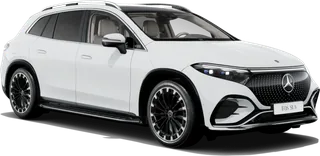
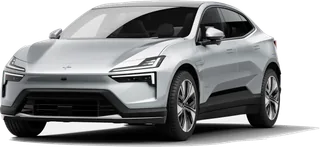
Mercedes-Benz EQS SUV vs Polestar Polestar 4 coupé
Better figure, where one is clearly better
| Mercedes-BenzEQS SUV | PolestarPolestar 4 coupé | |
|---|---|---|
| Overview | ||
| Released | December 2022 | January 2024 |
| Performance | ||
| Powertrain | Electric | Electric |
| Power | 355–536 bhp | 268–536 bhp |
| 0–62 mph | 4.8–6.2 s | 3.8–7.1 s (better) |
| Top speed | 130 mph (better) | 124 mph |
| Engine or motors | EQS 450 4MATIC: 265 kW (360 hp); EQS 580 4MATIC: 400 kW (544 hp); bhp converted from Mercedes' kW figures | Rear motor: 200 kW (272 hp, 268 bhp); Dual motor: 400 kW (544 hp, 536 bhp), with a disconnect clutch on the front motor |
| Torque | 800 Nm (EQS 450 4MATIC), 858 Nm (EQS 580 4MATIC) | 343 Nm (Rear motor), 686 Nm (Dual motor) |
| Gearbox | Single-speed automatic | Single-speed automatic |
| Drive | All-wheel drive (4MATIC) | Rear-wheel drive (Rear motor) or all-wheel drive (Dual motor) |
| Range and charging | ||
| Zero-emission range (WLTP) | 400 miles (better) | 367–385 miles |
| Battery | 118 kWh (better) | 100 kWh |
| Fastest charging | 200 kW | 200 kW |
| Range detail | WLTP range 377–400 miles (EQS 450 4MATIC) or 376–400 miles (EQS 580 4MATIC), depending on specification | WLTP range target 385 miles (Rear motor) or 367 miles (Dual motor). 0–62 mph figures are Polestar's 0–100 km/h times; Polestar UK quotes 0–60 mph in 6.9 and 3.7 seconds |
| Charging | 118 kWh battery (usable, per Mercedes Germany); DC up to 200 kW, 10–80% in 31 minutes; 22 kW AC on-board charger, 0–100% in 6 hours 15 minutes (18 hours 30 minutes at 7.4 kW) | 400 V lithium-ion battery, 100 kWh capacity as Polestar quotes it (cell-to-pack, 110 cells); DC up to 200 kW, 10–80% in 30 minutes; 11 kW AC, 0–100% in 11 hours; Plug & Charge (ISO 15118) |
| Efficiency | 211–224 Wh/km WLTP combined | 28.6–29.6 kWh/100 miles (Rear motor), 30.6–34.9 kWh/100 miles (Dual motor), WLTP |
| CO2 emissions | 0 g/km | 0 g/km |
| Practicality | ||
| Body | SUV | SUV |
| Seats | 7 (better) | 5 |
| Boot | 245 litres | 526 litres (better) |
| Length | 5,125 mm | 4,840 mm |
| Width | 1,959 mm | – |
| Weight | From 3,001 kg | From 2,230 kg |
| Boot | 245 litres with seven seats in use, 2,020 litres with the rear seats folded | 526 litres including the underfloor compartment, 1,536 litres with the rear seats folded; 15-litre front boot |
| Towing | 1,800 kg braked, 750 kg unbraked on the 4MATIC models (Mercedes Germany technical data) | Up to 1,500 kg (Rear motor) or 2,000 kg (Dual motor) |
| Size | 5,125 mm long, 1,959 mm wide without mirrors (2,157 mm with), 1,742 mm high (Mercedes Germany technical data); 11.9 m turning circle; kerb weight 3,001–3,028 kg (UK brochure, including a 75 kg driver) | 4,840 mm long, 2,067 mm wide with mirrors folded (2,139 mm extended), 1,534 mm high; 2,999 mm wheelbase; 11.64 m turning circle; kerb weight 2,230 kg (Rear motor) or 2,355 kg (Dual motor) |
| Tech and safety | ||
| Infotainment | – | 15.4-inch centre display and 10.2-inch driver display; 14.7-inch head-up display with the Plus pack; wireless Apple CarPlay; Google apps built in; Harman Kardon audio |
| Driver assistance | – | Pilot Assist with the Pilot pack; 8.9-inch rear-view digital mirror fed by a roof camera |
| Safety rating | – | Euro NCAP 5 stars (2025); adult occupant 92%, child occupant 85%, vulnerable road users 81%, safety assist 79% |
| Warranty | – | 3 years or 60,000 miles; battery 8 years or 100,000 miles |
More comparisons
- Audi A6 Avant e-tron vs Polestar Polestar 4 coupé
- Polestar Polestar 4 coupé vs Porsche Macan Electric
- Audi Q6 e-tron vs Polestar Polestar 4 coupé
- Mercedes-Benz G 580 with EQ Technology vs Polestar Polestar 4 coupé
- Mercedes-Benz EQE SUV vs Polestar Polestar 4 coupé
- Mercedes-Benz EQS SUV vs Tesla Cybertruck
- BMW iX vs Mercedes-Benz EQS SUV
- Mercedes-Benz EQS SUV vs Tesla Model X (2021)
- Mercedes-Benz EQS Saloon vs Mercedes-Benz EQS SUV
- Mercedes-Benz EQS SUV vs Tesla Model X (2019)