MSI Claw 7 AI+ vs Valve Steam Deck OLED
Better figure, where one is clearly better
| MSIClaw 7 AI+ | ValveSteam Deck OLED | |
|---|---|---|
| Overview | ||
| Released | December 2024 | November 2023 |
| Performance | ||
| Type | Handheld | Handheld |
| CPU | Intel Core Ultra 7 258V, 8 cores | AMD Zen 2, 4 cores / 8 threads |
| GPU | Intel Arc 140V | AMD RDNA 2, 8 CUs |
| GPU compute | – | 1.6 TFLOPS |
| Memory | 32 GB (better) | 16 GB |
| Storage | 512 GB | 512 GB, 1 TB (better) |
| Disc drive | No | No |
| CPU | Intel Core Ultra 7 258V; 4 P-cores and 4 E-cores, up to 4.8 GHz; NPU up to 47 TOPS | 6 nm AMD APU; Zen 2, 4 cores / 8 threads, 2.4–3.5 GHz (up to 448 GFlops FP32); APU power 4–15 W |
| GPU | – | 8 RDNA 2 compute units at 1.6 GHz (1.6 TFlops FP32) |
| Memory detail | 32 GB LPDDR5x-8533 memory on package | 16 GB LPDDR5 on-board, 6400 MT/s, quad 32-bit channels |
| Storage detail | 512 GB NVMe PCIe Gen4 SSD in the UK A2VM-007UK configuration | NVMe SSD |
| Storage expansion | M.2 2230 NVMe PCIe Gen4 SSD slot; microSD reader | High-speed microSD slot (UHS-I; SD, SDHC and SDXC) |
| Display and video | ||
| Maximum output | – | 8K up to 120 fps |
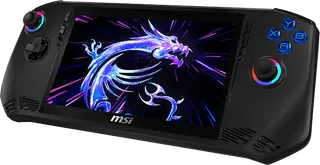
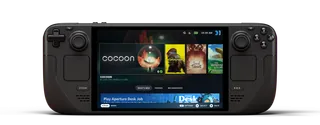
| Built-in screen | 7″ LCD, 1920 × 1080, 120 Hz | 7.4″ OLED, 1280 × 800, 90 Hz |
| Built-in screen | 7-inch IPS-level touchscreen; 100% sRGB (typical); 500 nits (typical), stated in MSI's launch specifications | 1280 × 800 HDR OLED touchscreen; 1,000 nits peak (HDR), 600 nits (SDR); contrast over 1,000,000:1; 110% P3; under 0.1 ms response; dual ambient light sensors. 1 TB model has premium anti-glare etched glass |
| Video output | DisplayPort over Thunderbolt 4 | DisplayPort over USB-C; up to 8K at 60 Hz or 4K at 120 Hz |
| HDR | – | HDR on the built-in OLED screen |
| Variable refresh rate | Supported on the built-in screen, stated in MSI's launch specifications; range not published | – |
| Audio | 2 × 2 W speakers; array microphone; DTS sound effect and Hi-Res Audio support | Stereo speakers with embedded DSP; dual microphone array; 3.5 mm headset jack; multichannel audio over DisplayPort, USB-C or Bluetooth |
| Design and power | ||
| Battery life (maker's claim) | – | Up to 12 hours |
| Weight | 675 g | 640 g (better) |
| Battery life detail | 54.5 Wh, 6-cell lithium-polymer; runtime not published | 50 Wh; 3–12 hours of gameplay depending on content |
| Power use | 65 W USB Type-C PD adapter with the standard model; the separate Super Pack bundle has a 100 W adapter | 45 W USB PD 3.0 power supply with 2.5 m cable |
| In the box | – | Steam Deck OLED, 45 W power supply, carrying case (with removable liner on the 1 TB model) |
| Colours | Black | – |
| Connections | ||
| Ports | 2 × Thunderbolt 4 Type-C with DisplayPort and Power Delivery 3.0; microSD; mic/headphone combo jack | 1 × USB-C (DisplayPort over USB-C, USB 3 Gen 2, charging), 3.5 mm headset jack, microSD slot |
| Wi-Fi and Bluetooth | Intel Wi-Fi 6E AX211; Bluetooth 5.3 | Tri-band Wi-Fi 6E (2.4, 5 and 6 GHz, 2 × 2 MIMO), Bluetooth 5.3 |
| Controller | RGB Hall effect analogue sticks, Hall effect triggers, RGB ABXY buttons, D-pad, bumpers, View, Menu, MSI Center M, Quick Settings and M1/M2 macro buttons; HD haptics; 6-axis IMU; fingerprint sensor | Built-in controls with A/B/X/Y, D-pad, analogue triggers, bumpers, 4 assignable grip buttons, 2 full-size analogue sticks with capacitive touch, 2 × 32.5 mm square haptic trackpads, HD haptics and a 6-axis gyro |
| Backward compatibility | Windows 11 Home; MSI Center M; MSI App Player for supported Android games | Runs Steam games natively on SteamOS 3 or through Proton; KDE Plasma desktop mode |
More comparisons
- MSI Claw 8 EX AI+ vs Valve Steam Deck OLED
- MSI Claw 7 AI+ vs MSI Claw 8 EX AI+
- ASUS ROG Xbox Ally X vs Valve Steam Deck OLED
- Lenovo Legion Go Gen 2 vs MSI Claw 7 AI+
- MSI Claw 7 AI+ vs MSI Claw A8
- MSI Claw A8 vs Valve Steam Deck OLED
- Nintendo Switch 2 vs Valve Steam Deck OLED
- Lenovo Legion Go S (8″, 1) vs Valve Steam Deck OLED
- MSI Claw 7 AI+ vs MSI Claw A1M
- MSI Claw 7 AI+ vs MSI Claw 8 AI+
- ASUS ROG Ally (2023) vs MSI Claw 7 AI+
- ASUS ROG Ally X (2024) vs MSI Claw 7 AI+
- ASUS ROG Ally X (2024) vs Valve Steam Deck OLED
- MSI Claw A1M vs Valve Steam Deck OLED
- ASUS ROG Ally (2023) vs Valve Steam Deck OLED
- Lenovo Legion Go (2023) vs Valve Steam Deck OLED