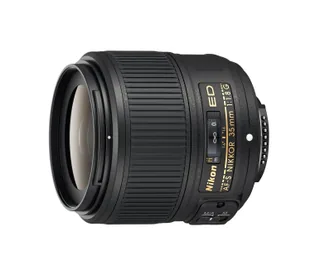
Nikon AF-S NIKKOR 35mm f/1.8G ED vs Nikon NIKKOR Z 28-135mm f/4 PZ
Better figure, where one is clearly better
| NikonAF-S NIKKOR 35mm f/1.8G ED | NikonNIKKOR Z 28-135mm f/4 PZ | |
|---|---|---|
| Overview | ||
| Released | February 2014 | April 2025 |
| Optics | ||
| Lens type | Prime | Zoom |
| Focal length | 35 mm | 28–135 mm |
| Maximum aperture | f/1.8 | f/4 |
| Minimum aperture | f/16 | f/22 |
| Optical construction | 11 elements in eight groups | 18 elements in 13 groups |
| Special elements | One ED glass element and one aspherical element | Three ED elements, one aspherical ED element and four aspherical elements |
| Coatings | Super Integrated Coating, identified by Digital Camera World; no Nano Crystal Coat, according to ePHOTOzine | Meso Amorphous Coat and fluorine coating on the front element |
| Diaphragm | Seven rounded blades | Nine rounded blades |
| Angle of view | FX and 35 mm film 63°; DX 44° | FX 75° to 18°10′; DX 53° to 12° |
| Mount and compatibility | ||
| Mounts | Nikon F mount | Nikon Z mount |
| Image circle | Full frame | Full frame |
| Compatibility | Nikon F mount with full-frame/FX coverage; also usable on DX. This is distinct from the AF-S DX NIKKOR 35mm f/1.8G | – |
| Focus and stabilisation | ||
| Autofocus | Yes | Yes |
| Minimum focus distance | 0.25 m | 0.34 m |
| Maximum magnification | 0.24× | 0.25× |
| Optical stabilisation | No | No |
| Autofocus detail | Silent Wave Motor; both reviews confirm manual focus override | Stepping motor autofocus and internal focusing |
| Focus distance detail | Minimum 0.25 m from the focal plane; ePHOTOzine confirms internal focusing and a non-rotating filter thread | Minimum focal-plane distances of 0.34 m at 28, 35 and 50 mm; 0.39 m at 70 mm; 0.43 m at 85 mm; 0.49 m at 105 mm; 0.57 m at 135 mm |
| Magnification detail | – | Maximum reproduction ratio 0.25× at 55–135 mm |
| Stabilisation detail | No optical VR, confirmed by both reviews | No optical VR, confirmed by Digital Camera World; camera stabilisation depends on the body |
| Video features | – | Focus-breathing suppression, linear manual-focus support and power zoom; Hi-Res Zoom synchronisation requires a supported camera and suitable firmware |
| Design | ||
| Dust and moisture resistant | – | Yes |
| Filter diameter | 58 mm | 95 mm |
| Maximum diameter | 72 mm | 105 mm |
| Length | 71.5 mm | 177.5 mm |
| Weight | 305 g (better) | 1,210 g |
| Controls | Focus ring, distance window and M/A–M switch; no aperture ring. Digital Camera World notes limited distance markings between 0.7 m and infinity | Zoom rocker, electronically coupled zoom and focus rings, customisable control ring, two L-Fn buttons and A–M switch; no mechanically driven manual zoom ring |
| Zoom design | – | Internal power zoom with eleven selectable speeds on compatible cameras; adjustable zoom-ring direction and rotation angle, with firmware and camera compatibility requirements |
| Filter detail | 58 mm screw-in filters; 0.75 mm thread pitch | 95 mm screw-in filter thread; HB-116 rectangular hood has a filter adjustment window |
| Weather resistance | ePHOTOzine identifies a rubber gasket at the mount; Digital Camera World says it is not extensively weather sealed. A general weather-resistance rating is not assigned | Maker dust and drip-resistant design; protection is not guaranteed in every condition |
| Dimensions detail | Approximately 72 mm maximum diameter × 71.5 mm length from the lens mount flange | Approximately 105 mm maximum diameter × 177.5 mm from the mount flange |
| Weight detail | Approximately 305 g | Approximately 1,210 g including tripod collar, used in the main specifications; approximately 1,120 g without it |
| Tripod mount | – | Tripod collar with removable foot |
| Lens hood | HB-70 bayonet hood included | – |
| In the box | LC-58 front cap, LF-4 rear cap, HB-70 hood and CL-0915 flexible pouch | LC-95B front cap, LF-N1 rear cap, HB-116 hood and CL-C5 case |
| Release detail | Nikon Japan records first sale on 6 February 2014; Nikon USA announced later US availability on 20 February 2014 | Nikon USA specified April 2025 retail availability; the February announcement date is not used as the on-sale date |

More comparisons
- Nikon NIKKOR Z 28-135mm f/4 PZ vs Nikon NIKKOR Z 70–200mm f/2.8 VR S II
- Nikon AF-S NIKKOR 35mm f/1.8G ED vs Nikon NIKKOR Z 70–200mm f/2.8 VR S II
- Nikon NIKKOR Z 24–105mm f/4–7.1 vs Nikon NIKKOR Z 28-135mm f/4 PZ
- Nikon AF-S NIKKOR 35mm f/1.8G ED vs Nikon NIKKOR Z 24–105mm f/4–7.1
- Nikon NIKKOR Z 28-135mm f/4 PZ vs Nikon NIKKOR Z DX 16–50mm f/2.8 VR
- Nikon NIKKOR Z 28-135mm f/4 PZ vs Nikon NIKKOR Z DX MC 35mm f/1.7
- Nikon AF-S NIKKOR 35mm f/1.8G ED vs Nikon NIKKOR Z DX 16–50mm f/2.8 VR
- Nikon AF-S NIKKOR 35mm f/1.8G ED vs Nikon NIKKOR Z DX MC 35mm f/1.7
- Nikon NIKKOR Z 24-70mm f/2.8 S II vs Nikon NIKKOR Z 28-135mm f/4 PZ
- Nikon AF-S NIKKOR 35mm f/1.8G ED vs Nikon NIKKOR Z 24-70mm f/2.8 S II
- Nikon NIKKOR Z 24-120mm f/4 S vs Nikon NIKKOR Z 28-135mm f/4 PZ
- Nikon NIKKOR Z 28-135mm f/4 PZ vs Nikon NIKKOR Z 28-75mm f/2.8
- Nikon NIKKOR Z 28-135mm f/4 PZ vs Nikon NIKKOR Z 35mm f/1.2 S
- Nikon NIKKOR Z 28-135mm f/4 PZ vs Nikon NIKKOR Z 50mm f/1.4
- Nikon NIKKOR Z 28-135mm f/4 PZ vs Nikon NIKKOR Z 35mm f/1.4
- Nikon NIKKOR Z 28-135mm f/4 PZ vs Nikon NIKKOR Z 28-400mm f/4-8 VR