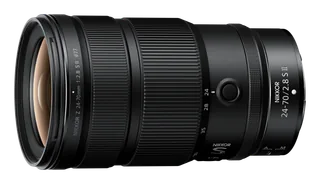
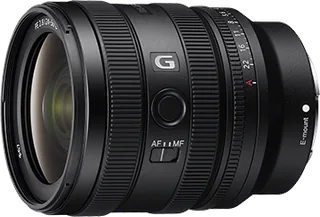
Nikon NIKKOR Z 24-70mm f/2.8 S II vs Sony FE 24-50mm F2.8 G
Better figure, where one is clearly better
| NikonNIKKOR Z 24-70mm f/2.8 S II | SonyFE 24-50mm F2.8 G | |
|---|---|---|
| Overview | ||
| Released | September 2025 | May 2024 |
| Optics | ||
| Lens type | Zoom | Zoom |
| Focal length | 24–70 mm | 24–50 mm |
| Maximum aperture | f/2.8 | f/2.8 |
| Minimum aperture | f/22 | f/22 |
| Macro lens | No | – |
| Optical construction | 14 elements in 10 groups | 16 elements in 13 groups |
| Special elements | Two ED and three aspherical elements | Four aspherical elements and two ED glass elements |
| Coatings | Meso Amorphous Coat and ARNEO Coat; fluorine-coated front element | Fluorine coating on the front element |
| Diaphragm | 11 rounded blades | 11 rounded blades |
| Angle of view | FX 84°–34°20′; DX 61°–22°50′ | 84–47° full frame; 61–32° APS-C |
| Mount and compatibility | ||
| Mounts | Nikon Z | Sony E |
| Image circle | Full frame | Full frame |
| Image circle detail | – | Full-frame coverage; 36–75 mm equivalent field of view on APS-C |
| Teleconverter support | – | Not compatible with SEL14TC or SEL20TC |
| Compatibility | Nikon Z mount, FX/full-frame image circle | – |
| Focus and stabilisation | ||
| Autofocus | Yes | Yes |
| Minimum focus distance | 0.24 m | 0.18 m (manual focus) |
| Maximum magnification | 0.32× | 0.33× (manual focus) |
| Optical stabilisation | No | No |
| Autofocus detail | Multi-focusing system with Silky Swift Voice Coil Motors | Two linear motors; supports Alpha 9 III AF/AE tracking up to 120 fps under Sony test conditions; actual speed depends on shooting conditions and focus mode |
| Focus distance detail | Minimum focus from focal plane 0.24 m at 24/28 mm, 0.27 m at 35 mm, 0.30 m at 50 mm and 0.33 m at 70 mm | Autofocus minimum 0.19 m at 24 mm and 0.30 m at 50 mm; manual focus minimum 0.18 m at 24 mm and 0.29 m at 50 mm; Linear Response MF |
| Magnification detail | Maximum 0.21× at 24 mm or 0.32× at 70 mm | Maximum magnification 0.30× with autofocus or 0.33× with manual focus |
| Stabilisation detail | No in-lens VR according to Photography Blog; stabilisation depends on the attached camera body | No lens stabilisation; compatible bodies provide stabilisation |
| Video features | Focus-breathing suppression; internal zoom keeps the centre of gravity steady on gimbals | Breathing compensation on compatible bodies may alter angle of view and image quality, with compensation not guaranteed in every situation. Supports compatible-body Active Mode stabilisation with a narrower angle of view; 4K120p/FHD240p tracking depends on the camera |
| Design | ||
| Dust and moisture resistant | Yes | Yes |
| Filter diameter | 77 mm | 67 mm |
| Maximum diameter | 84 mm | 74.8 mm |
| Length | 142 mm | 92.3 mm |
| Weight | 675 g | 440 g (better) |
| Controls | Click on/off control ring, two assignable L-fn buttons and focus-limit switch that restricts minimum focus to 0.33 m throughout the zoom range | Aperture ring with click on/off, AF/MF switch and one customisable focus-hold button |
| Zoom design | Internal zoom maintains the lens length | Short extending zoom barrel; Sony qualifies its small centre-of-gravity shift for gimbal use |
| Weather resistance | Dust- and drip-resistant construction; not guaranteed in every situation | Dust- and moisture-resistant design; not guaranteed completely dust- or moisture-proof |
| Dimensions detail | Approximately 84 mm maximum diameter by 142 mm from camera mount flange to lens end | – |
| Weight detail | Maker approximately 675 g | Approximately 440 g lens; separate hood and caps excluded |
| Lens hood | HB-117 with window for rotating filters | ALC-SH178 petal bayonet hood |
| In the box | LC-77B front cap, LF-N1 rear cap, HB-117 hood and CL-C2 case | ALC-SH178 hood, ALC-F67S front cap and ALC-R1EM rear cap; no case |
| Release detail | Announced 22 August 2025; Nikon US specified mid-September availability. Main keeps the confirmed month without inventing a UK retail day | Sony UK and North America specify May 2024 availability. Sony Japan revised its original 19 April date to 17 May in an update dated 5 April. Photography Blog gives April; the revised maker sale evidence takes priority. Maker dimensions, 67 mm filter and 36–75 mm APS-C equivalent take priority over typographic mistakes in review text |
More comparisons
- Nikon NIKKOR Z 24-70mm f/2.8 S II vs Nikon NIKKOR Z 70–200mm f/2.8 VR S II
- Sony FE 24-50mm F2.8 G vs Sony FE 28-70mm F3.5-5.6 OSS II
- Nikon NIKKOR Z 24–105mm f/4–7.1 vs Nikon NIKKOR Z 24-70mm f/2.8 S II
- Nikon NIKKOR Z 24-70mm f/2.8 S II vs Nikon NIKKOR Z DX 16–50mm f/2.8 VR
- Nikon NIKKOR Z 24-70mm f/2.8 S II vs Nikon NIKKOR Z DX MC 35mm f/1.7
- Nikon AF-S NIKKOR 24-70mm f/2.8E ED VR vs Nikon NIKKOR Z 24-70mm f/2.8 S II
- Nikon NIKKOR Z 24-70mm f/2.8 S vs Nikon NIKKOR Z 24-70mm f/2.8 S II
- Nikon NIKKOR Z 24-70mm f/2.8 S II vs Nikon NIKKOR Z 24-70mm f/4 S
- Nikon NIKKOR Z 24-120mm f/4 S vs Nikon NIKKOR Z 24-70mm f/2.8 S II
- Canon RF 28–70mm F2.8 IS STM vs Nikon NIKKOR Z 24-70mm f/2.8 S II
- Nikon NIKKOR Z 24-70mm f/2.8 S II vs Sony FE 24–70mm F2.8 GM II
- Nikon NIKKOR Z 24-70mm f/2.8 S II vs Nikon NIKKOR Z 28-135mm f/4 PZ
- Nikon NIKKOR Z 24-70mm f/2.8 S II vs Nikon NIKKOR Z 35mm f/1.2 S
- Nikon NIKKOR Z 24-70mm f/2.8 S II vs Nikon NIKKOR Z 50mm f/1.4
- Nikon NIKKOR Z 24-70mm f/2.8 S II vs Nikon NIKKOR Z 35mm f/1.4
- Nikon NIKKOR Z 24-70mm f/2.8 S II vs Nikon NIKKOR Z 28-400mm f/4-8 VR