Nokia E50 vs Nokia E52
Better figure, where one is clearly better
| NokiaE50 | NokiaE52 | |
|---|---|---|
| Overview | ||
| Released | 2006 | 2009 |
| Display | ||
| Screen size | – | 2.4″ |
| Resolution | 320 × 240 | 320 × 240 |
| Sharpness | – | 167 pixels per inch |
| Panel | LCD | LCD |
| Display type | QVGA 240 × 320 TFT LCD with 262,144 colours in the production reviews; not a touchscreen. Maker physical diagonal not recovered, so no headline inches inferred. | 2.4-inch QVGA active-matrix TFT with up to 16 million colours; automatic landscape rotation, non-touch |
| Performance | ||
| Memory | – | 128 MB |
| Storage | 70 MB (better) | 60 MB |
| CPU | – | 600 MHz ARM11 in GSMArena's exact production review; no specific chip identity inferred |
| Memory | 70 MB internal user storage in GSMArena and TechRadar's camera-equipped production tests; the camera-free configuration has no borrowed capacity. Installed physical RAM not verified in the maker guide or these tests. | Up to 60 MB internal user storage in the maker datasheet; headline storage records that maximum. 128 MB RAM from GSMArena's exact review, not inferred from free memory. |
| Storage type | microSD beneath the metal rear cover, removable without removing the battery in both tests; no maximum card capacity inferred | microSD expansion up to 16 GB and 1 GB card supplied in maker launch/datasheet; not E60 RS-MMC or E62 miniSD |
| Cameras | ||
| Main camera | 1.3 MP | 3.2 MP (better) |
| Ultra wide camera | None | None |
| Telephoto camera | None | None |
| Optical zoom | None | None |
| Main camera | E50-1 RM-170 has a 1.3 MP camera, up to 1280 × 960 pixels in the exact maker guide. E50-2 RM-171 omits the camera; headline camera applies to the equipped configuration. | 3.2 megapixels, 2048 × 1536, flash and extended-depth-of-field fixed-focus lens. No autofocus or macro mode; All About Symbian finds subjects within roughly half a metre blurry. |
| Front camera | – | Secondary video-call camera in GSMArena's exact production review; resolution not inferred |
| Video recording | QCIF 176 × 144 in GSMArena's camera-equipped production test; no unverified frame rate inferred | VGA 640 × 480 at 15 fps in both production reviews; panorama stitching is a separate still-photo mode |
| Battery and charging | ||
| Battery | 970 mAh | 1,500 mAh (better) |
| Wireless charging | None | None |
| Battery life detail | Removable BL-5C 970 mAh identified in GSMArena's exact production test. Maker launch claims up to six hours of talk; not video playback. TechRadar's 55-hour result involved weak coverage and about 20 minutes of calls. | BP-4L 1500 mAh Li-Po; maker datasheet claims up to eight hours GSM/six hours WCDMA talk and 23 days GSM/29 days WCDMA standby. Review endurance varies with use; not video playback. |
| Wired charging | Separate small Nokia charger connector. Exact issue 1 guide lists AC-4 and DC-4; no charging wattage inferred. | Charges through micro-USB, including a compatible USB data cable; exact guide says cable charging is slower and a USB hub may not work. No charging wattage inferred. |
| Design | ||
| Type | Standard | Standard |
| Weight | 104 g | 98 g (better) |
| Thickness | 15.5 mm | 9.9 mm (better) |
| Height × width | 113 × 43.5 mm | 116 × 49 mm |
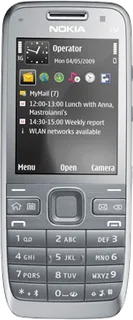
| Weight detail | 104 g and 113 × 43.5 × 15.5 mm from GSMArena's exact-model specification table; TechRadar rounds thickness to 16 mm. Maker dimension sheet unresolved. | Maker datasheet gives 98 g and 116 × 49 × 9.9 mm; no different configuration or hardware borrowed from E55 |
| Colours | – | Metal Grey Aluminium, Graphite Grey and Golden Aluminium in maker datasheet; manufacturer launch gallery covers Metal Grey and Golden Aluminium |
| Materials | Metal rear battery cover with plastic sections; Silver/Black original press finish | – |
| Buttons | Numeric keypad, joystick, dedicated menu and correction keys, side volume/edit/voice controls; notification light around joystick | Numeric keypad, navigation key, Home/Calendar/Email one-touch keys, side volume and voice controls; exact guide describes shortcut customisation |
| Speakers | Built-in loudspeaker; mono headset in both reviewed packages, stereo headset or compatible adaptor sold separately. No FM radio in GSMArena's production test. | Mono loudspeaker, music player and FM radio with RDS; wired stereo and Bluetooth A2DP audio |
| Software | ||
| Operating system | Symbian | Symbian |
| Software at launch | Symbian OS 9.1 with S60 Third Edition | Symbian OS 9.3, S60 Third Edition Feature Pack 2 in GSMArena's exact production review |
| Software features | Quickoffice views Word, Excel and PowerPoint; PDF reader, ZIP manager, Team Suite, voice functions and phone-wide search. Maker launch's two-number feature routes an office line through enterprise software; not dual-SIM hardware. Historical enterprise servers and downloads may no longer operate. | Maker datasheet lists Quickoffice editors, mobile VPN and business/personal email. Both production reviews test supplied editing; owner guide qualifies editing as requiring the editor version. Early firmware/service differences retained, with no claim that historical online services still operate. |
| Release detail | Nokia announced E50 on 18 May 2006. Its full-year 2006 results confirm first shipments during 2006; earliest retail month unresolved, so year precision retained. May announcement and planned third-quarter shipment are not treated as sale dates. No inferred predecessor link. | Nokia announced E52 on 6 May 2009 and planned second-half2009 availability. Maker's 2009 sustainability report lists it among products launched that year, and August production reviews establish retail units. Earliest maker-supported on-sale month unresolved, so year precision retained. No E51 predecessor link inferred from secondary descriptions. |
| Connectivity | ||
| Mobile network | EGSM 850/900/1800/1900, GPRS and EDGE; no UMTS or LTE | Quad-band GSM/EGSM 850/900/1800/1900; regional WCDMA 850/2100 or 900/2100 variants, not one four-band 3G radio. HSDPA up to 10.2 Mbps, HSUPA up to 2 Mbps. |
| Wi-Fi | No Wi-Fi in both production tests | IEEE 802.11b/g in maker datasheet; UPnP/Home media in exact production reviews |
| Bluetooth | Bluetooth 2.0 in the exact owner guide, with headset/hands-free, dial-up, object/file transfer, imaging and remote SIM profiles; no A2DP support inferred | Bluetooth 2.0 with enhanced data rates and A2DP stereo audio in maker datasheet |
| USB | Pop-Port data/accessory connector, PC Suite and memory-card mass-storage modes; infrared. No standard headphone socket. | Micro-USB with High Speed USB in maker datasheet; standard 3.5 mm AV/headset connector |
| Positioning | – | Integrated A-GPS receiver and digital compass; historical Maps navigation licences, services and downloads may no longer operate |

More comparisons
- Nokia E52 vs Nokia E72
- Nokia E50 vs Nokia E72
- Nokia E52 vs Nokia N86 8MP
- Nokia E52 vs Sony Ericsson W995
- Nokia E52 vs Nokia E55
- Nokia E52 vs Nokia E63
- Nokia E52 vs Nokia E66
- Nokia E52 vs Nokia E71
- Nokia E52 vs Nokia E65
- Nokia E51 vs Nokia E52
- Nokia E52 vs Nokia E61i
- Nokia E52 vs Nokia E62
- Nokia E50 vs Nokia E55
- Nokia E52 vs Nokia E60
- Nokia E52 vs Nokia E61
- Nokia E52 vs Nokia E70