Nokia E60 vs Nokia N73
Better figure, where one is clearly better
| NokiaE60 | NokiaN73 | |
|---|---|---|
| Overview | ||
| Released | 2006 | 2006 |
| Display | ||
| Screen size | – | 2.4″ |
| Resolution | 416 × 352 (better) | 320 × 240 |
| Sharpness | – | 167 pixels per inch |
| Panel | LCD | LCD |
| Display type | TFT with 16 million colours and 352 × 416 pixels in GSMArena's exact production test; portrait/landscape rotation. No physical diagonal inferred from the measured active area. | 2.4-inch QVGA TFT with 240 × 320 pixels and up to 262,144 colours. Ambient-light sensor adjusts illumination; original maker consumer specifications. Native refresh and brightness in nits not published. |
| Performance | ||
| Storage | 64 MB (better) | 42 MB |
| Memory | 64 MB internal user storage in both production reviews; no installed physical RAM borrowed from N80 or inferred from free application memory | Up to 42 MB dynamic shared internal storage, original maker consumer and Forum Nokia tables. Installed applications share this space. Independent reviews report different free storage and operational RAM; neither free RAM nor an unlimited application heap establishes installed physical RAM, so no RAM capacity inferred. |
| Storage type | Reduced-size dual-voltage 1.8/3.0 V MultiMediaCard, hot-swappable in the exact owner guide; not microSD or full-size MMC/SD. No maximum capacity inferred. | Hot-swappable miniSD card, up to 1 GB in the original consumer specification; not RS-MMC or full-size SD. Original Danish sales package does not list an included card. The later shared Music Edition guide covers different software/bundles explicitly. |
| Cameras | ||
| Main camera | None | 3.2 MP (better) |
| Ultra wide camera | None | None |
| Telephoto camera | None | None |
| Optical zoom | None | None |
| Front camera | – | 0.3 MP |
| Main camera | No camera; intended for workplaces restricting camera-equipped devices | 3.2 MP CMOS rear camera, 2048 × 1536 pixels, autofocus Carl Zeiss Tessar optics with 5.6 mm physical focal length. Focus from 10 cm to infinity, macro at 10 cm; mechanical shutter 1/1000–2 seconds. Sliding protective cover and two-stage camera key. Built-in flash up to 1 m, maker consumer specifications. |
| Front camera | – | VGA 640 × 480-pixel secondary camera with up to 2× digital zoom for video calls and portrait-mode capture. Headline 0.3 MP rounds the maker pixel count. Exact N73-1/RM-133 guide distinguishes main landscape and secondary portrait operation. |
| Zoom | – | Up to 20× digital zoom for rear still photographs; no optical zoom. Rear video digital zoom up to 4× in CIF or 8× in QCIF, maker consumer table. |
| Video recording | – | MPEG-4 CIF 352 × 288 at up to 15 fps with AAC stereo audio and video stabilisation, maker consumer specifications and Forum Nokia. Maker claims up to 1.5 hours per clip, subject to storage. Shared guide High mode uses MP4; Sharing uses QCIF 3GP with a 300 kB limit, about 20 seconds. Playback codecs are separate from camera recording. |
| Camera features | – | Auto/user/macro/portrait/landscape/sport/night scenes, white balance, colour effects, exposure and sensitivity adjustments, self-timer and sequence mode. Image/video editing, slideshows and PictBridge USB or Bluetooth printing. Network photo sharing depends on compatible services; retired Flickr/Lifeblog services are not promised to work today. |
| Battery and charging | ||
| Battery | 970 mAh | 1,100 mAh (better) |
| Wireless charging | None | None |
| Battery life detail | Removable BL-5C 970 mAh in GSMArena's exact production test; its stated maker claim is up to 290 hours standby and 6 hours 40 minutes talk. Conditions and reviewer findings differ; not video playback. | Removable BP-6M battery, 1100 mAh. Original maker ECTEL claims up to 226 minutes WCDMA or 246 minutes GSM talk, 370/350 hours standby respectively, 150 minutes video calling, 366 minutes CIF video playback and 12.6 hours offline music. Conditions and network affect runtime. |
| Wired charging | Separate charger socket; exact issue 3 guide lists LCH-12, ACP-12 and AC-1 chargers. No charging wattage inferred. | Dedicated small Nokia charger connector; AC-4 charger and CA-44 adapter supplied in the original Danish package. Pop-Port USB is a data connection, not USB charging; exact independent GSMArena test. Charging watts not published. |
| Design | ||
| Type | Standard | Standard |
| Weight | 117 g | 116 g (better) |
| Thickness | 17 mm (better) | 19 mm |
| Height × width | 115 × 49 mm | 110 × 49 mm |
| Colours | – | Original launch finishes: silver grey/deep plum, frost white/metallic red and frost white/mocha brown, 24 July 2006 maker shipping release. Regional Danish consumer package lists the first two only. Music Edition is explicitly distinguished in the later shared operating guide; its software/bundle is not silently applied to the original. |
| Weight detail | 117 g and 115 × 49 × 17 mm in GSMArena's exact production description; weight includes fitted battery. Maker dimension sheet not recovered. | – |
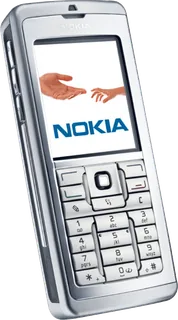
| Materials | Silver/black enclosure with metal front framing and side controls in GSMArena's exact test | – |
| Buttons | Numeric keypad, joystick, soft keys, call/menu/edit/correction keys, side volume and voice key; top power/profile button | Five-way joystick, numeric and soft keys, dedicated multimedia/review/camera controls and side zoom/volume rocker. Original edition multimedia key opens configurable shortcuts; later Music Edition guide explicitly distinguishes that key behaviour. |
| Speakers | Built-in loudspeaker and MP3/AAC music playback; no FM radio in GSMArena's exact test | Integrated stereo loudspeakers with maker 3D-sound claim; stereo FM/Visual Radio uses a compatible wired headset as its antenna. Original HS-23 headset connects through Pop-Port; no built-in standard 3.5 mm headphone socket. |
| Software | ||
| Operating system | Symbian | Symbian |
| Software at launch | Symbian OS 9.1 with S60 Third Edition | Symbian OS 9.1 and Nokia S60 3rd Edition, exact maker consumer/developer tables. Native 2nd Edition applications need compatible 3rd Edition versions; Java MIDP 2.0/CLDC 1.1 also supported. |
| Software features | Exact guide includes Word document, spreadsheet and presentation editing, PDF viewing, screen export and remote device management. Voice recorder maximum 60 seconds. Original maker launch supports corporate email and IP telephony; historical servers and downloads may no longer operate. | Contacts, calendar/tasks/notes, email with attachments, web browser, music, Visual Radio, document viewers and PC Suite synchronisation. Quickoffice components and Adobe PDF viewer are readers, not unrestricted document editors. Historical third-party services and firmware observations retain their original context. |
| Release detail | Nokia announced E60 with E61/E70 on 12 October 2005, planning the first quarter of 2006. Nokia's 2006 annual report confirms actual first E60 shipments during 2006; earliest maker-supported retail month unresolved, so year precision retained. The announcement and planned quarter are not first-sale dates. No predecessor link inferred. | Announced 25 April 2006. Maker says shipments have begun on 24 July 2006; the August full retail test confirms market presence but does not prove the worldwide first retail month. Year precision retained. Original N73-1/RM-133; no unsupported direct predecessor link or no-front-camera regional hardware inferred. |
| In the box | – | Original Danish package lists BP-6M battery, AC-4 charger, CA-44 adapter, HS-23 stereo headset, CA-53 data cable, wrist strap, lens cloth, software CD and documentation. Region/operator and Music Edition bundles may differ. |
| Connectivity | ||
| Mobile network | GSM 900/1800/1900 and WCDMA 2100 in Nokia's original launch release; GPRS and EDGE | GSM/EDGE 850/900/1800/1900 MHz and WCDMA 2100 MHz, original maker consumer and developer tables. Consumer overview gives WCDMA 128/384 kbps upload/download while its packet-data section lists 384/384; conflict retained without assigning an unsupported upload speed. Actual service/network determines throughput. |
| Wi-Fi | WLAN with internet calling; IEEE 802.11g/e/i described in TechRadar's exact test | No Wi-Fi, independently tested in the contemporary All About Symbian and GSMArena full reviews. |
| Bluetooth | Bluetooth 1.2 in the exact owner guide, with headset/hands-free, serial/dial-up, file/object transfer, imaging and remote SIM profiles; no A2DP in GSMArena's production test | Bluetooth Specification 2.0, exact N73-1/RM-133 English guide and consumer specifications. Profiles include printing, dial-up networking, headset/hands-free, object/file transfer, imaging, SIM access, synchronisation and HID; compatibility depends on both devices. |
| USB | Pop-Port accessory/data connector with USB-compatible cable and infrared; proprietary headset connection, not a standard headphone socket | Pop-Port USB 2.0 full-speed, maker consumer specification; supplied CA-53 cable. Supports USB Mass Storage and PC Suite; no high-speed transfer inferred. Infrared and Bluetooth also support local transfers and synchronisation. |
| Positioning | External Bluetooth GPS receiver needed for the Positions, Navigator and Landmarks applications in GSMArena's exact test; no integrated GPS | – |

More comparisons
- Nokia N73 vs Nokia N8
- Nokia E60 vs Nokia E72
- Nokia N73 vs Nokia N97 mini
- Nokia N73 vs Nokia N86 8MP
- Nokia N73 vs Nokia N97
- Nokia E52 vs Nokia E60
- Nokia E55 vs Nokia E60
- Nokia N73 vs Nokia N85
- Nokia N73 vs Nokia N96
- Nokia E60 vs Nokia E63
- Nokia E60 vs Nokia E66
- Nokia E60 vs Nokia E71
- Nokia N73 vs Nokia N78
- Nokia N73 vs Nokia N79
- Nokia E60 vs Nokia E65
- Nokia E51 vs Nokia E60