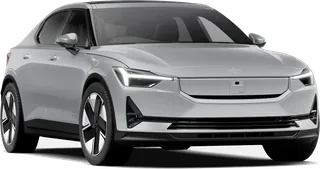
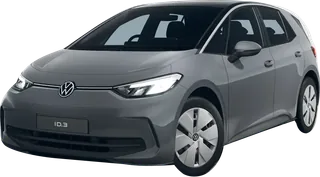
Polestar Polestar 2 vs Volkswagen ID.3
Better figure, where one is clearly better
| PolestarPolestar 2 | VolkswagenID.3 | |
|---|---|---|
| Overview | ||
| Released | July 2020 | July 2020 |
| Performance | ||
| Powertrain | Electric | Electric |
| Power | 268–469 bhp (better) | 168–322 bhp |
| 0–62 mph | 4.2–6.4 s (better) | 5.7–8.2 s |
| Top speed | 127 mph (better) | 99–124 mph |
| Engine or motors | Single rear motor, 200 kW (272 hp, 268 bhp) or 220 kW (299 hp, 295 bhp); dual motor, 310 kW (421 hp, 416 bhp) or 350 kW (476 hp, 469 bhp) with the Performance pack | Single rear-mounted permanent-magnet synchronous motor, 170 PS (125 kW), 204 PS (150 kW) or 326 PS (240 kW); bhp converted from Volkswagen's PS figures |
| Torque | 490 Nm (single motor), 740 Nm (dual motor) | 310 Nm (170 PS), 265 Nm (204 PS), 545 Nm (326 PS) |
| Gearbox | Single-speed automatic | Single-speed automatic |
| Drive | Rear-wheel drive (single motor) or all-wheel drive (dual motor) | Rear-wheel drive |
| Range and charging | ||
| Zero-emission range (WLTP) | 344–409 miles (better) | 241–371 miles |
| Battery | 67–79 kWh | 52–79 kWh |
| Fastest charging | 180–205 kW (better) | 145–185 kW |
| Range detail | WLTP: 344 miles (Standard range), 409 miles (Long range Single motor), 370 miles (Dual motor), up to 352 miles (Performance pack). 0–62 mph figures are Polestar's 0–100 km/h times; Polestar UK quotes 0–60 mph in 6.2, 5.9, 4.3 and 4.0 seconds | WLTP combined: 240–241 miles (52 kWh), 268–269 miles (59 kWh), 351–352 miles (Pro S), 365–371 miles (GTX); city 312–460 miles |
| Charging | Battery 400 V lithium-ion, 70 kWh (24 modules) or 82 kWh (27 modules) gross as Polestar quotes it; EV Database gives 67 or 79 kWh usable. DC up to 180 kW (10–80% in 26 min) or 205 kW (10–80% in 28 min); 11 kW AC, 0–100% in 7 or 8 hours; Plug & Charge (ISO 15118) | 10–80% DC in 25 min (52 kWh, 145 kW), 24 min (59 kWh, 165 kW) or 26 min (79 kWh, 185 kW); AC 7.2 kW on 52 kWh (8 h 30 min to full), 11 kW on others (6 h 30 min for 59 kWh, 8 h 30 min for 79 kWh) |
| Efficiency | 23.8–27.6 kWh/100 miles (WLTP) | WLTP combined: 15.2–15.3 kWh/62 miles (52 kWh), 15.4 (59 kWh), 15.6 (Pro S), 14.7 (GTX Performance) |
| CO2 emissions | 0 g/km | 0 g/km at the tailpipe |
| Practicality | ||
| Body | Hatchback | Hatchback |
| Seats | 5 | 5 |
| Boot | 407 litres (better) | 385 litres |
| Length | 4,606 mm | 4,264 mm |
| Width | 1,859 mm | 1,809 mm |
| Weight | From 1,949 kg | From 1,787 kg |
| Boot | 407 litres including the underfloor compartment, 1,097 litres with the rear seats folded; 41-litre front boot | 385 litres; 1,267 litres with the rear seats folded, loaded to the roof |
| Towing | Up to 1,500 kg | Bicycle-carrier coupling with 75 kg drawbar load optional |
| Size | 4,606 mm long, 1,859 mm wide (1,985 mm with mirrors), 1,479 mm high; 2,735 mm wheelbase; 11.5 m turning circle; kerb weight 1,949–2,185 kg | 4,264 mm long, 1,809 mm wide (excluding mirrors), 2,070 mm with mirrors, 1,564 mm high; 2,770 mm wheelbase; 10.3 m turning circle; drag coefficient 0.263; weight is Volkswagen's unladen figure with driver, 1,787 kg (52 kWh) to 1,993 kg (GTX Performance) |
| Tech and safety | ||
| Infotainment | Android Automotive OS with Google apps built in; 11.2-inch centre display and 12.3-inch driver display; wired Apple CarPlay and Android Auto; 8-speaker 250 W audio as standard, Harman Kardon (Plus pack) or Bowers & Wilkins options | 12.9-inch touchscreen with navigation and "Hello ID." voice control with ChatGPT; 5.3-inch driver display; augmented-reality head-up display available |
| Driver assistance | Adaptive Cruise Control and Lane Keeping Aid as standard; Pilot Assist, 360° cameras and Blind Spot Information with steer assist with the Pilot pack | Travel Assist with swarm data and assisted lane changes optional; Car2X hazard warnings |
| Safety rating | Euro NCAP 5 stars (2021); adult occupant 93%, child occupant 89%, vulnerable road users 80%, safety assist 83% | – |
| Warranty | 3 years or 60,000 miles; battery 8 years or 160,000 km | 3 years or 60,000 miles; high-voltage battery 8 years or 100,000 miles (70% capacity) |